Talks by Dr. Mattia Rosso and Samuel Post
Автор: Timing Research Forum
Загружено: 2023-12-07
Просмотров: 122
Описание:
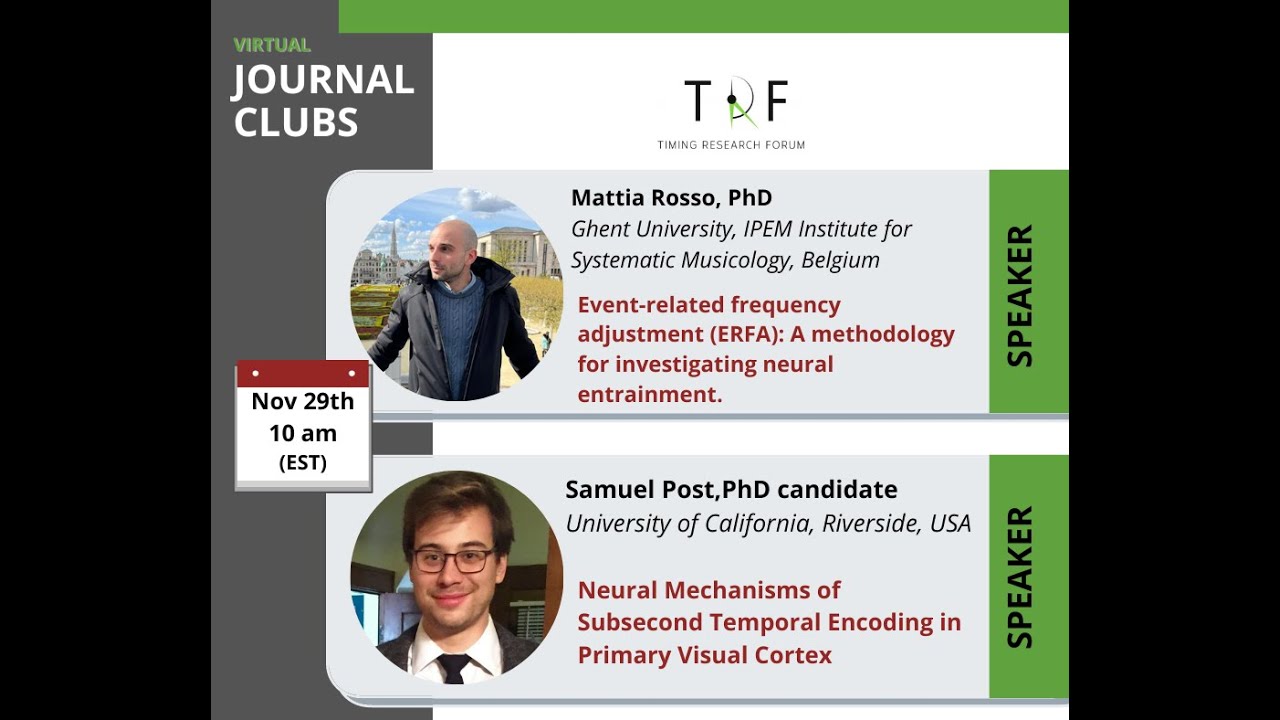
Speaker: Dr. Mattia Rosso, Ghent University, IPEM Institute for Systematic Musicology, Belgium.
Title: Event-related frequency adjustment (ERFA): A methodology for investigating neural entrainment.
Abstract: Neural entrainment has become a phenomenon of exceptional interest to neuroscience, given its involvement in rhythm perception, production, and overt synchronized behavior. Yet, traditional methods fail to quantify neural entrainment due to a misalignment with its fundamental definition (e.g., see Novembre and Iannetti, 2018; Rajandran and Schupp, 2019).
The definition of entrainment assumes that endogenous oscillatory brain activity undergoes dynamic frequency adjustments to synchronize with environmental rhythms (Lakatos et al., 2019). Following this definition, we recently developed a method sensitive to this process. Our aim was to isolate from the electroencephalographic (EEG) signal an oscillatory component that is attuned to the frequency of a rhythmic stimulation, hypothesizing that the oscillation would adaptively speed up and slow down to achieve stable synchronization over time. To induce and measure these adaptive changes in a controlled fashion, we developed the event-related frequency adjustment (ERFA) paradigm (Rosso et al., 2023).
A total of twenty healthy participants took part in our study. They were instructed to tap their finger synchronously with an isochronous auditory metronome, which was unpredictably perturbed by phase-shifts and tempo-changes in both positive and negative directions across different experimental conditions. EEG was recorded during the task, and ERFA responses were quantified as changes in instantaneous frequency of the entrained component. Our results indicate that ERFAs track the stimulus dynamics in accordance with the perturbation type and direction, preferentially for a sensorimotor component. The clear and consistent patterns confirm that our method is sensitive to the process of frequency adjustment that defines neural entrainment.
In this Virtual Journal Club, the discussion of our findings will be complemented by methodological insights beneficial to researchers in the fields of rhythm perception and production, as well as timing in general. We discuss the dos and don’ts of using instantaneous frequency to quantify oscillatory dynamics, the advantages of adopting a multivariate approach to source separation, the robustness against the confounder of responses evoked by periodic stimulation, and provide an overview of domains and concrete examples where the methodological framework can be applied.
Speaker: Samuel Post, PhD candidate, University of California, Riverside, USA.
Title: Neural Mechanisms of Subsecond Temporal Encoding in Primary Visual Cortex
Abstract: Subsecond timing underlies nearly all sensory and motor activities across species and is critical to survival. While subsecond temporal information has been found across cortical and subcortical regions, it is unclear if it is generated locally and intrinsically or if it is a read out of a centralized clock-like mechanism. Indeed, mechanisms of subsecond timing at the circuit level are largely obscure. Primary sensory areas are well-suited to address these question as they have early access to sensory information and provide minimal processing to it: if temporal information is found in these regions, it is likely to be generated intrinsically and locally. We test this hypothesis by training mice to perform an audio-visual temporal pattern sensory discrimination task as we use 2-photon calcium imaging, a technique capable of recording population level activity at single cell resolution, to record activity in primary visual cortex (V1). We have found significant changes in network dynamics through mice’s learning of the task from naive to middle to expert levels. Changes in network dynamics and behavioral performance are well accounted for by an intrinsic model of timing in which the trajectory of q network through high dimensional state space represents temporal sensory information. Conversely, while we found evidence of other temporal encoding models, such as oscillatory activity, we did not find that they accounted for increased performance but were in fact correlated with the intrinsic model itself. These results provide insight into how subsecond temporal information is encoded mechanistically at the circuit level.
Повторяем попытку...
Доступные форматы для скачивания:
Скачать видео
-
Информация по загрузке: