USMLE MSK 4: Muscle Sarcomere Anatomy and Physiology
Автор: LY Med
Загружено: 2017-05-28
Просмотров: 4961
Описание:
Want to support the channel? Be a patron at:
/ lymed Welcome to LY Med, where I go over everything you need to know for the USMLE STEP 1, with new videos every day.
Follow along with First Aid, or with my notes which can be found here: https://www.dropbox.com/sh/ces0j7obod...
Moving onto the "musculo" part of our "musculo"skeletal block, this video will be all about muscles! So what are muscles are made of? Muscles are made up of cells called myoctes, and their main purpose is to contract and help us move! Now to understand the myocyte, you should know the terminology, including sarcoplasm (cytoplasm), sarcoplasmic reticulum (smooth ER), and sarcolemma (cell membrane). Also, in the sarcoplasm, there are long cords made up of myosin actin, and titin. These are the things that contract to give us muscle contraction!
All these make up the three types of muscles that we have: skeletal muscle, cardiac muscle, and smooth muscles.
So how does it cause contractions? The sarcoplasmic reticulum contains calcium. It forms a network around the myofilaments and surrounds it. It even has dilated ends called the terminal cisternae. Invaginations of the sarcolemma wrap wround this complex. We call this transverse tubules or T tubules.The T Tubules and sarcoplasmic reticulum are linked via the dihydropyridine/ryanodine receptor. Dihydropyridine is found on the T tubule, while ryanodine is found on the sarcoplasmic reticulum. Depolarization causes the coupled ryanodine receptors and dihydropyradimine receptors to release calcium. Calcium helps the movement of the myosin head against the actin filaments. When calcium is released, it binds to troponin C, causing a conformational change in tropomysin, which allows myosin to bind to actin and contract!
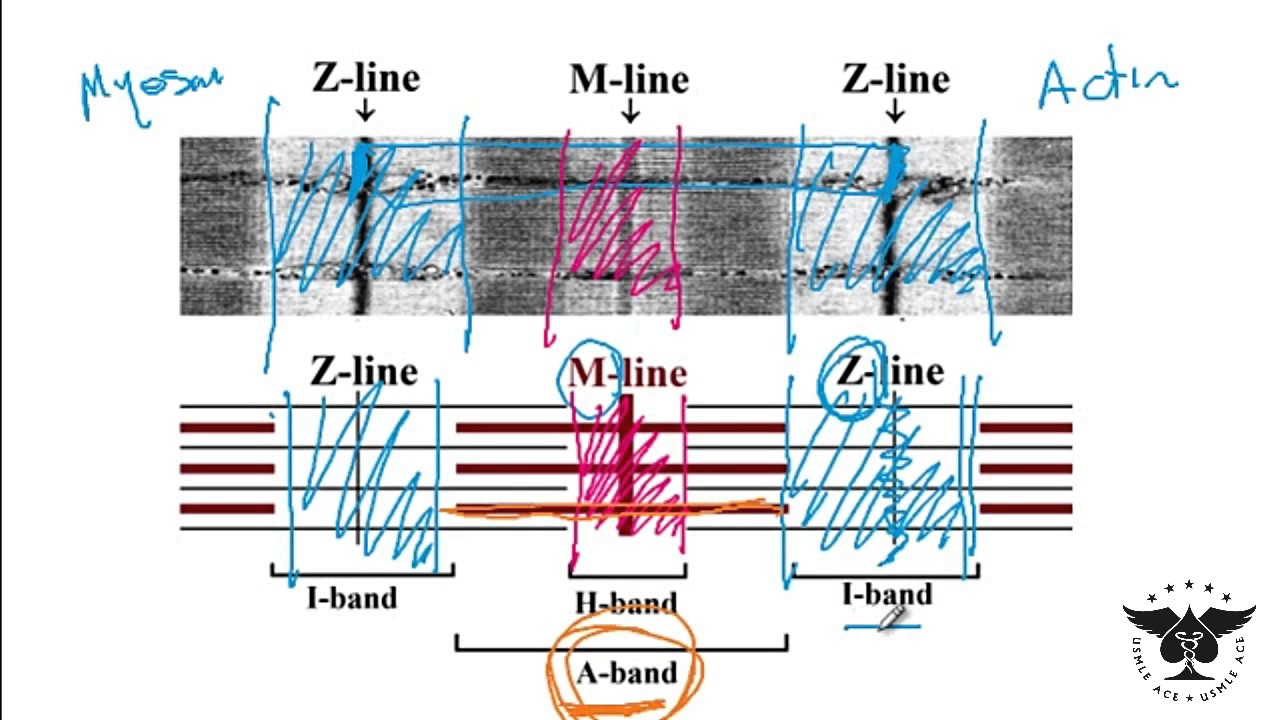
Moving on to the sarcomere, we discuss the different components, including the M line, Z line, I line, H line and A line. We discuss what moves during contraction.
Next topic is the different types of muscle. We sometimes refer to these types of muscle as slow or fast twitch muscles. Type 1 is slow twitch and is full of mitochondria. It is for endurance. Type 2 is fast twitch and has a lower amount of mitochondria. It's used for explosive power.
Done with skeletal muscles, we'll discuss cardiac and smooth muscles and how they differ. For example, cardiac muscles have L-type calcium channels instead of dihydropyridine receptors. Smooth muscles differ because they don't even have sarcomeres! Instead they use a protein called calmodulin which activates myosin light chain kinase which causes contraction.
By knowing all these intricate details of muscles, we can now move on to our next video about muscle pathology!
Повторяем попытку...
Доступные форматы для скачивания:
Скачать видео
-
Информация по загрузке: