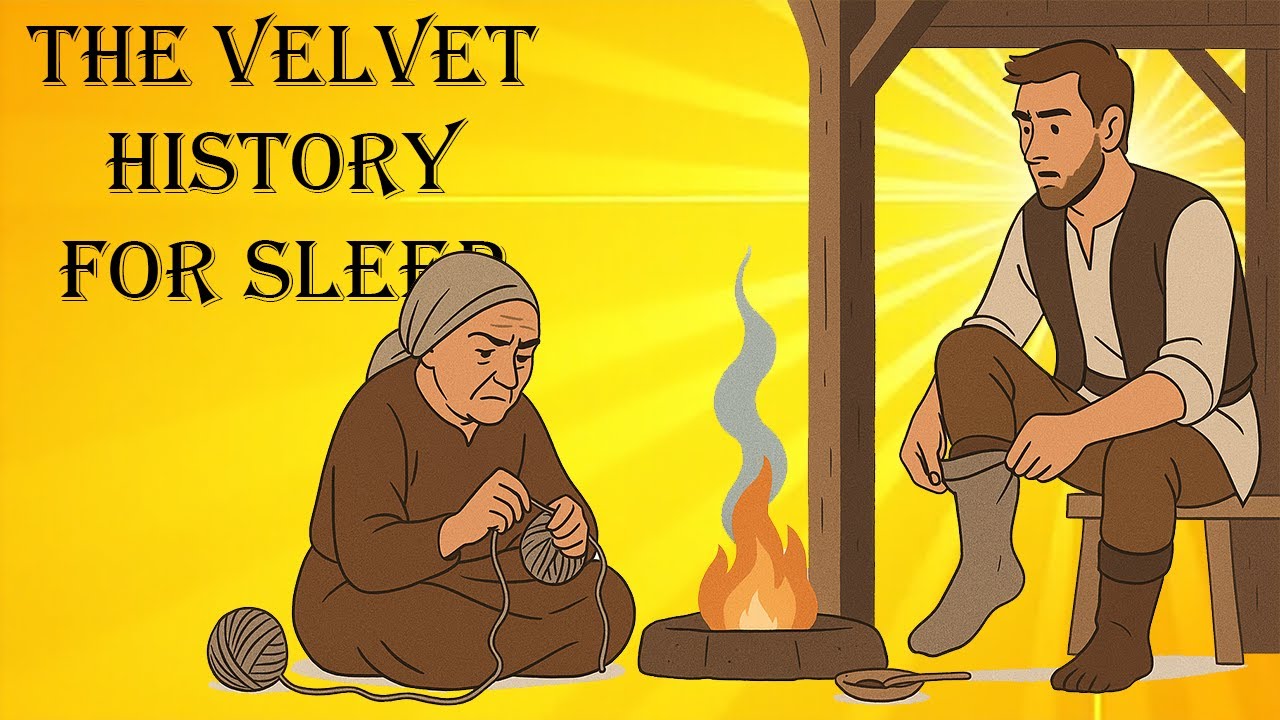
Woolen Silence: How Viking Socks Softened the Night
Автор: Velvethist
Загружено: 2025-10-30
Просмотров: 10
Описание:
Welcome to VelvetHist — where calming storytelling, soft-spoken narration, and immersive ambient sounds transport you into the forgotten corners of history.
Here, the past becomes a gentle escape — perfect for drifting into sleep, unwinding after a long day, or simply enjoying a quiet moment of reflection. Each episode takes you through tales of ancient civilizations, legendary figures, lost knowledge, and mysterious events, all told in a warm, tranquil female voice. The subtle background of crackling fires, flowing water, or distant winds creates the perfect atmosphere for deep relaxation.
VelvetHist is perfect for anyone who loves:
ASMR history storytelling
Soft-spoken sleep stories
Calming narratives about ancient mysteries
“Boring history” for sleep (in the best way possible)
Ambient background for relaxation or meditation
Let these gentle whispers of history carry you into peaceful dreams and timeless worlds. #calmhistory #asmrhistory #vikinghistory
Sources & Further Reading:
Østergård, Else. Woven into the Earth: Textiles from Norse Greenland. Aarhus Univ. Press, 2004. — Definitive evidence for Viking-age socks, nalbinding fragments, fibers, and wear.
Bender Jørgensen, Lise. North European Textiles until AD 1000. Aarhus Univ. Press, 1992. — Survey of yarns, weaves, and regional techniques; context for wool handling and warmth.
Hald, Margrethe. Ancient Danish Textiles from Bogs and Burials. National Museum of Denmark, 1980. — Classic corpus on early wool, lanolin retention, and garment construction.
Hägg, Inga. Die Textilfunde aus Haithabu. Wachholtz, 1984. — Hedeby finds; cutting, mending, and shoe-adjacent textile details for a trading town.
Walton Rogers, Penelope. Cloth and Clothing in Early Anglo-Saxon England, AD 450–700. CBA, 2007. — Comparative techniques (spinning, stitching) illuminating pre-Viking continuities.
Ewing, Thor. Viking Clothing. Tempus, 2006. — Readable synthesis on garments, socks, footwear, and domestic care habits.
Banck-Burgess, Jutta. “Nålebinding in the Roman and Migration Periods.” Archaeological Textiles Review 46 (2004): 45–56. — Technical discussion of the thumb-loop method and seams.
Andersen, Elsa et al. Textiles and Equipment from the Oseberg Ship Burial. Museum of Cultural History (series), 2000–. — High-status toolkit: needles, yarn prep, dye traces.
Graham-Campbell, James (ed.). The Viking World. Routledge, 2013. — Daily life frames for hearth rules, travel routines, and craft specialization.
Price, Neil. Children of Ash and Elm: A History of the Vikings. Basic Books, 2020. — Ethnographic texture for home rhythms, watchfulness, and quiet labor.
Roesdahl, Else. The Vikings. Penguin, 1998. — Concise reference for settlement types, fuel, and winter housekeeping.
Goubitz, Olaf; Van Driel-Murray, Carol; Groenman-van Waateringe, Willy. Stepping Through Time: Archaeological Footwear from Prehistoric Times until 1800. Spa, 2001. — Leather shoe forms, soles, and sock–shoe interfaces.
Egan, Geoff; Pritchard, Frances. Dress Accessories c.1150–c.1450. Museum of London, 1991. — Later but useful parallels for needles, awls, and mending kits.
Crowfoot, Elisabeth; Pritchard, Frances; Staniland, Kay. Textiles and Clothing 1150–1450. Museum of London, 1992. — Detailed sections on fulling, felting, and dye kitchen practice.
Cardon, Dominique. Natural Dyes: Sources, Tradition, Technology and Science. Archetype, 2007. — Dye stuffs (walnut, madder), mordants, and colorfastness relevant to Norse palettes.
National Museum of Denmark. “Nålbinding: Viking-Age Needle Looping.” Online exhibit. — Clear primer on stitches, tools, and extant Scandinavian pieces.
University of Oslo, Museum of Cultural History. “Oseberg Textiles & Tools.” Collection notes. — Photographic documentation of yarn, looms, and sewing equipment.
Jørgensen, Lise Bender. “Wool in Northern Europe.” In The Oxford Handbook of Prehistoric Textile Production, OUP, 2020. — Fibre properties, lanolin, and climate adaptation.
Sindbæk, Søren. “Hedeby and Ribe: Craft, Trade, and Urban Households.” In Viking Towns, Oxbow, 2015. — Urban shop routines matching quiet rules and work-watch pacing.
Crumlin-Pedersen, Ole. Viking-Age Ships and Shipbuilding in Hedeby/Schleswig. Viking Ship Museum, 1997. — Shipboard lighting norms, watches, and kit storage affecting footwear and spares.
Andrén, Anders. Between Artifacts and Texts: Historical Archaeology in Global Perspective. Plenum, 1998. — Methodological backdrop for reading small objects (socks, wicks, snuffers) as daily systems.
Повторяем попытку...
Доступные форматы для скачивания:
Скачать видео
-
Информация по загрузке:


