WOODLAND WILDFLOWERS British wildflower & plant identification for uk foragers and naturalists.
Автор: Árvores madeiras e jardins florestais arboricultura
Загружено: 2017-02-07
Просмотров: 19290
Описание:
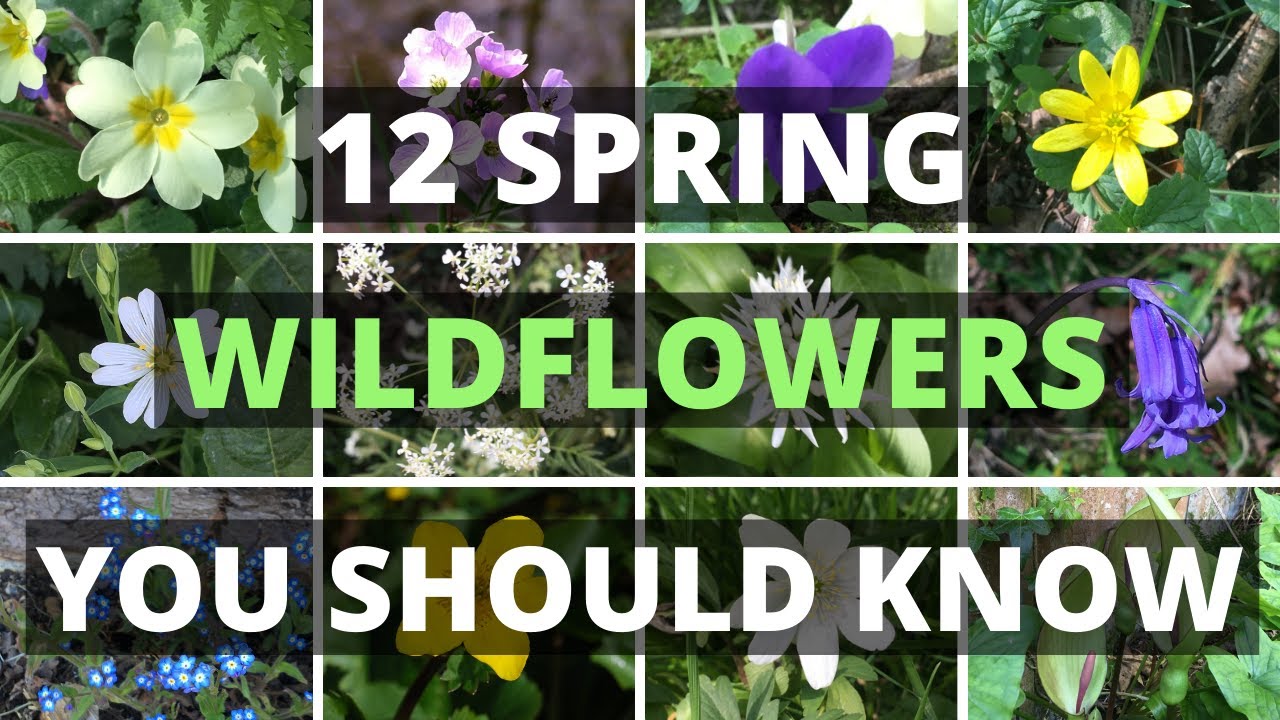
Identifying 6 British wildflowers. Includes identifying native British bluebells and non native Spanish bluebells. Ancient woodland indicator plant species identified: Wood Anemone, Wild Garlic / Ramsons, Native Bluebells, Moschatel, Herb Paris / Lovers Knot, Common Toothwort.
Hyacinthoides non-scripta (formerly Endymion non-scriptus or Scilla non-scripta) is a bulbous perennial plant, found in Atlantic areas from north-western Spain to the British Isles, and also frequently used as a garden plant. It is known in English as the common bluebell or simply bluebell, a name which is used in Scotland to refer to the harebell, Campanula rotundifolia. In spring, H. non-scripta produces a nodding, one-sided inflorescence of 5–12 tubular, sweet-scented violet–blue flowers, with strongly recurved tepals, and 3–6 long, linear, basal leaves.
H. non-scripta is particularly associated with ancient woodland where it may dominate the understorey to produce carpets of violet–blue flowers in "bluebell woods", but also occurs in more open habitats in western regions. It is protected under UK law, and in some other parts of its range. A related species, H. hispanica has also been introduced to the British Isles and hybridises with H. non-scripta to produce intermediates known as H. × massartiana.
Anemone nemorosa is an early-spring flowering plant in the buttercup family Ranunculaceae, native to Britain and Europe. Common names include wood anemone, windflower, thimbleweed, and smell fox, an allusion to the musky smell of the leaves. It is a herbaceous perennial plant growing 5–15 centimetres (2–6 in) tall.
Allium ursinum – known as ramsons, buckrams, wild garlic, broad-leaved garlic, wood garlic, bear leek, or bear's garlic – is a wild relative of chives native to Britain, Europe and Asia. The Latin name is due to the brown bear's taste for the bulbs and its habit of digging up the ground to get at them; they are also a favourite of wild boar. In Europe, where ramsons are popularly harvested from the wild, similarity to poisonous plants such as lily of the valley or Colchicum autumnale regularly leads to cases of poisoning.
Adoxa moschatellina (moschatel, five-faced bishop, hollowroot, muskroot, townhall clock, tuberous crowfoot) is an herbaceous perennial flowering plant in the family Adoxaceae. It grows throughout Europe, Asia, and North America, in hedgerows, cool forests, at low altitudes in the far north, to high altitudes in mountains in the south of its range. The plant and its flowers have a musk-like scent, which it emits towards evening when the dew falls. If the plant is bruised this scent disappears. In Europe, it flowers in April and May.
The names "five-faced bishop" and "townhall clock" allude to the structure of its inflorescence. This consists of five flowers: one four-petalled flower facing upwards, and four five-petalled flowers facing horizontally.
Paris quadrifolia, the herb-paris or true lover's knot, is a Eurasian species of flowering plant in the family Melanthiaceae, although authorities formerly regarded it as part of the Liliaceae family. It is related to Trillium, with which it can be confused. Trillium, however, is generally 3-merous (3 leaves per whorl, 3 petals etc.), whereas Paris quadrifolia is 4-merous.
Common toothwort (Lathraea squamaria) is parasitic on the roots of hazel and alder, occasionally on beech, in shady places such as hedge sides. Lathraea squamaria is widespread in Europe.
A wildflower (or wild flower) is a flower that grows in the wild, meaning it was not intentionally seeded or planted. Yet "wildflower" meadows of a few mixed species are sold in seed packets. The term implies that the plant probably is neither a hybrid nor a selected cultivar that is in any way different from the way it appears in the wild as a native plant, even if it is growing where it would not naturally. The term can refer to the flowering plant as a whole, even when not in bloom, and not just the flower. https://en.wikipedia.org/wiki/Wildflower
Footage from / all rights / natreswales Natural Resources Wales - featured channel. 🌳
#wildflowers #woodland #ancientwoodland
I created this video with the YouTube Video Editor ( / editor )
Повторяем попытку...

Доступные форматы для скачивания:
Скачать видео
-
Информация по загрузке: