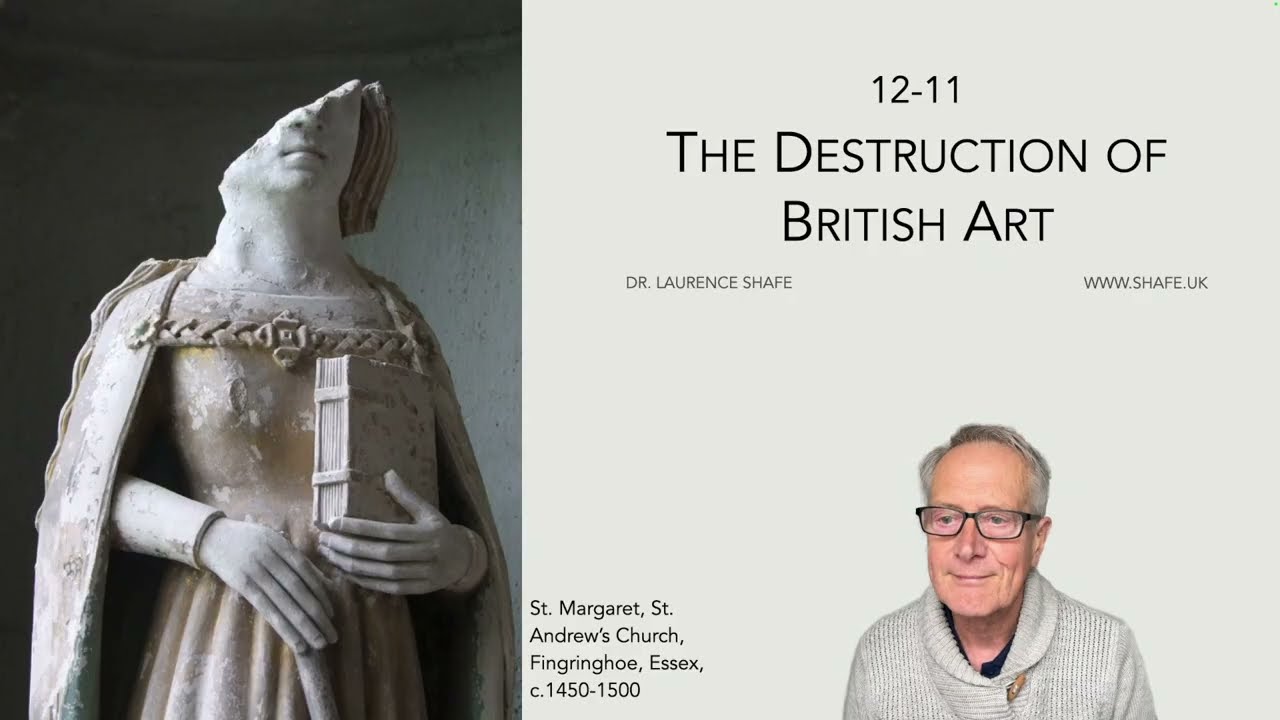
12-11 The Destruction of British Art
Автор: Dr Laurence Shafe
Загружено: 2025-12-06
Просмотров: 563
Описание:
#arthistory #iconoclasm #reformation #arthistory
The Great Erasure: How England Deleted 99% of Its Art
Step inside an old English parish church, and you see austere, plain-walled simplicity—an image that feels ancient. This feeling, however, is a profound historical illusion. Before the English Reformation, these same churches were ablaze with color: walls covered in vibrant paintings, niches filled with gilded statues, and altars rich with tapestries. They were as full of art as any church on the European continent.
What happened to this vast cultural wealth was not the slow decay of time, but one of the most comprehensive acts of state-sponsored iconoclasm in European history. This act was fertilized by a native English movement, Lollardy, which had long challenged the church’s use of images.
1. A Near-Total Erasure (90% to 99% Lost)
The destruction was not a selective pruning; it was a near-total purge. Historians estimate that between 90% and 99% of all religious art in England was destroyed. This campaign left entire categories of English medieval art almost completely blank.
The loss is staggering: a 2002 Tate exhibition, "Image and Idol: Medieval Sculpture," could identify only 23 remnants of medieval religious sculpture nationwide (excluding tombs). This wasn't merely religious reform; it was a "cultural revolution designed to obliterate England’s memory of who and what she had been."
2. An Orderly Destruction, Not a Riot
Contrary to common images of frenzied mobs, the destruction in England was largely carried out by officials methodically following government orders. As one source notes, "In England it was not angry mobs that destroyed images... but local bureaucrats efficiently doing a job."
The process began with Henry VIII's Royal Injunctions of 1538, but was formalized and radically intensified under Edward VI. A sweeping royal injunction in 1547 left no ambiguity, ordering the total eradication of religious imagery from public and private life:
Also, That they shall take away, utterly extinct and destroy all shrines... pictures, paintings, and all other monuments of feigned miracles, pilgrimages, idolatry, and superstition: so that there remain no memory of the same in walls, glass-windows or elsewhere within their churches or houses.
Adding bureaucratic insult to injury, parishes were often forced to pay for the "service" of having their own art destroyed.
3. The Purge Consumed Books and Music Too
The cultural purge extended far beyond sculpture and painting. Medieval libraries were targeted with equal ferocity, with centuries of knowledge put to the flame. For example, out of six hundred books in the library of Worcester Priory, only six remain.
Church music was also a target; manuscripts were destroyed on a vast scale, and even organs were ripped out. This confirms the goal was to dismantle the entire intellectual and auditory world of the old religion, not simply remove "idols."
4. Survival by Cunning and Luck
The few treasures that escaped did so through local resistance, practicality, and pure chance. Early on, some congregations engaged in quiet acts of defiance (e.g., ladders "mysteriously disappearing" when officials came to smash carvings). The parishioners of Ufford, Suffolk, famously saved an elaborate font cover by pretending to have lost the key.
Other items survived for pragmatic reasons. Many medieval stained glass windows were spared simply "because of the cost of re-glazing a church." Artworks were also saved by being plastered over (wall paintings) or sealed within niches. Some high-quality alabaster carvings were sold abroad before the destruction became total, which is why the best examples are often found in Continental European museums today.
5. A New Kind of British Art from the Void
The long-term consequence of this great erasure was profound. The Reformation "severed Britain’s deep cultural links with Continental Europe and with Continental art," and the patronage system that sustained centuries of religious art was gone. This created a cultural vacuum.
Into this void emerged a new kind of art. With the church no longer the primary patron, English artists in the eighteenth century turned to the world around them—to secular life rather than sacred stories. The acerbic social satire of Hogarth and the society portraits of Gainsborough and Reynolds were born from the ashes of the old world, marking a permanent shift in the nation’s artistic identity.
The quiet, plain-walled churches we see today are not just survivors of time; they are powerful monuments to that great deletion, echoes of a drowned, colorful world that was dismantled by decree.
Повторяем попытку...
Доступные форматы для скачивания:
Скачать видео
-
Информация по загрузке:


