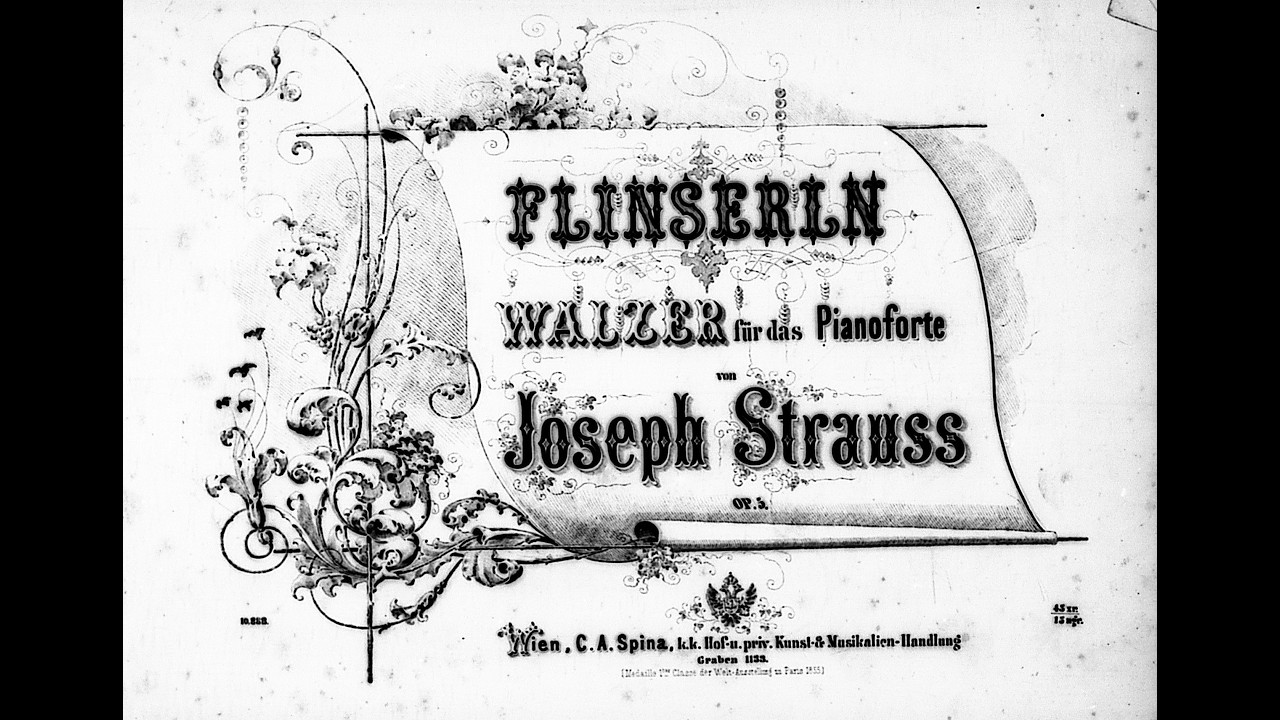
Josef Strauss (1827-1870): Flinserln (Sequins きらきら飾り) Walzer (Ländler) op.5 (1) Piano (2) Orchestra
Автор: Dr. Taka Otagawa
Загружено: 2026-03-14
Просмотров: 42
Описание:
***Josef Strauβ BICENTENNIAL CELEBRATION (1827-2027) 祝ヨーゼフ・シュトラウス生誕200年***
Josef Strauss (1827-1870): Flinserln (Sequinsきらきら飾り) Walzer (Ländler) Op. 5 – (1) Piano (2) 7:42 Orchestra
1st Performance: August 27, 1855 – Parish Festival Ball at Unger’s Casino in the suburb of Hernals – performed by the Strauβkapelle conducted by Josef Strauss
[1] The Piano:
Source: 1st edition Piano Score published by C. A. SPINA, Wien Plate no. C.S.10,888 (2.13.1856) Performed by Dr. Taka S. [STRAUSS] Otagawa Ph.D. in Physical Chemistry (Texas A&M Class of '83), US Citizen 小田川 隆朗 理工学博士 (The Pianist) https://drive.google.com/file/d/1Ua5y...
Recorded LIVE (8.21.1977) at Herr Karasawa (唐澤俊三)* Residence, Yokohama, JAPAN
[* Founder/Director of the Tokyo Johann Strauβ Ensemble] Equipment: Top-of-the-line Yamaha Upright Piano, TEAC Reel-to-Reel Tape Recorder, Professional Recording Microphone ANALYSIS of “The HISTORICAL PIANO RECORDINGS” by Herr Karasawa https://drive.google.com/file/d/1JEPK...
[2] The Orchestra:
Source: The Josef Strauss Edition “Revised” Piano score - based on the Josef’s original autograph score (or the Like) - by Carl Pfleger plate no. J. E. 606. Bd.III (1900)
The Orchestral performance: Courtesy of Karl Albert Geyer – Slovak State Philharmonic Orchestra (2000)
(1) Josef wrote the very effective “Obbligatos” played by Cello in the Waltz 4A.
(2) Johann II’s Three (3) Waltzes (Ländler) written for the Parish Festival Balls at Unger’s Casino are:
1851 (op.99): • Johann Strauss II (1825-1899): Frauenkäfer...
1852 (op.119): • Johann Strauss II: Volkssänger (Folk Singe...
1854 (op.157): • Johann Strauss II (1825-1899): Nachtfalte...
From the original Marco Polo CD NOTEs about Flinserln (Sequinsきらきら飾り) Walzer (Ländler) Op. 5 [written in 2002 by Professor Franz Mailer (1920-2010) The Book: “Josef Strauss: Genius Against His Will (1985)” https://www.amazon.com/Josef-Strauss-...
In the summer of 1855, Josef Strauss again had to substitute for his brother Johann, because a new waltz was due for the Hernals church festival to be celebrated at Unger’s casino. In August 1853, Johann Strauss stayed in Bad Neuhaus for a cure, and in the summer of 1855, he recovered in Bad Gastein. This time it was clear from the start that Josef Strauss’s waltz under the meaningful title Die Ersten und die Letzten (The First and the Last) • Josef Strauss (1827-1870): Die Ersten und ... , performed in 1853, would not be his first and last composition. ‘Pepi’ was now recognized finally as an equal partner in the Strauss family’s ‘waltz businesses. Therefore, he gave the first performance of his waltz Flinserln, composed especially for that evening, together with the new polka Mille Fleurs • Mille fleurs, Op. 4a: Mille fleurs, Polka ... (which later appeared as Op. 4) at Unger’s casino on 27th August 1855, as part of the Hernals church festival.
As required by the tradition established by the older Johann Strauss, the novelty for the Hernals church festival had to be a waltz in the Ländler style, its character being defined by popular Viennese motifs. It is remarkable how quickly Josef Strauss, who in 1849 was still writing ambitious compositions for piano in the style of Chopin and Liszt, made the genre of Viennese music his own.
The title Flinserln also came from the dialect spoken in Vienna and its surrounding areas. Flinserln were sequins used in theatre costumes, but they existed also outside the stage: first the horse-drawn carriages, the coachmen, and then elegant ‘cavaliers’ from the suburbs wore them on their ear-lobes. Sequins were fashionable during the 1850s. The trend disappeared later, but can be found occasionally even today.
The waltz not only enjoyed immediate acceptance among sequin-wearers, but also earned resounding applause from all the dancers during the 1855 Hernals church festival, and had to be repeated on the second day on 2nd September 1855. Some days later the Theater-Zeitung published a report about Johann and Josef Strauss’s activities. This article also mentioned Josef’s new compositions (among them, Flinserln), as ‘products of a muse, which found the most thunderous and enthusiastic acceptance at each performance’. The editor’s suggestion that ‘it would be desirable for these musical creations, which contain a plethora of piquant and original melodies, to be published in print’ did not fulfil itself immediately. It was not until 1st February 1856 that an advertisement appeared in the Wiener Zeitung announcing that C.A. Spina had published Opp.1 to 9 by Josef Strauss.
Повторяем попытку...
Доступные форматы для скачивания:
Скачать видео
-
Информация по загрузке: