The Pioneers of Cathode Rays: A Tribute to Early Physicists
Автор: iitutor.com
Загружено: 2016-04-05
Просмотров: 9302
Описание:
📢 Receive Comprehensive Mathematics Practice Papers Weekly for FREE 😊
Click this link to get: ▶️▶️▶️ https://iitutor.com/email-list/ ◀️◀️◀️
🔬 Welcome to a journey through scientific history! Join us in paying tribute to the brilliant minds who unlocked the secrets of cathode rays, laying the foundation for modern physics.
🌌 In this enlightening video, we delve into the world of cathode ray tubes – those iconic vacuum tubes with electrodes at their ends. Discover how these simple yet ingenious devices led to groundbreaking discoveries about the fundamental building blocks of matter.
🔍 Learn about the visionary scientists who made it all possible, starting with Michael Faraday, who, in 1838, observed the enigmatic cathode rays' luminous display. Faraday's curiosity ignited the quest to understand these mysterious phenomena, which form the core of our exploration.
⚡ Explore the pivotal work of Heinrich Geissler, the German physicist who refined vacuum technology in 1855, allowing scientists to study cathode rays with unprecedented precision. Geissler unlocked a mesmerising green glow by creating a near-perfect vacuum inside glass tubes and applying high voltage and paving the way for further investigations.
🌟 Meet Julius Plücker, whose ingenious experiments unveiled the nature of cathode rays. Plücker's innovative approach, involving sealed electrodes, shed light on the rays' behaviour, their path from the cathode to the anode, and their mysterious ability to fluoresce glass walls.
🔮 Dive into the compelling story of Eugene Goldstein, the scientist who coined the term "cathode rays" and transformed these elusive phenomena into a well-defined field of study. Explore how cathode ray tubes, now famously known as discharge tubes, became instrumental in unravelling the secrets of these rays.
💡 Discover how early experimenters used modified cathode ray tubes to investigate various properties of cathode rays and their connection to X-rays. From turning paddle wheels to penetrating metals and responding to magnetic fields, these rays exhibited remarkable behaviors that continue to inspire scientific inquiry.
🧲 This video celebrates the pioneers of cathode rays and their relentless pursuit of knowledge. Their discoveries advanced our understanding of matter's atomicity and laid the groundwork for countless technological advancements.
🌐 Join us on this educational and awe-inspiring journey as we pay homage to the visionaries who paved the way for the wonders of modern physics. Don't forget to like, share, and subscribe to stay tuned for more fascinating scientific explorations!
#CathodeRays #ScientificHistory #PhysicsPioneers #DiscoveryOfCathodeRays #EducationalVideos #ScienceHistory #Physics #STEM
What is a cathode ray tube?
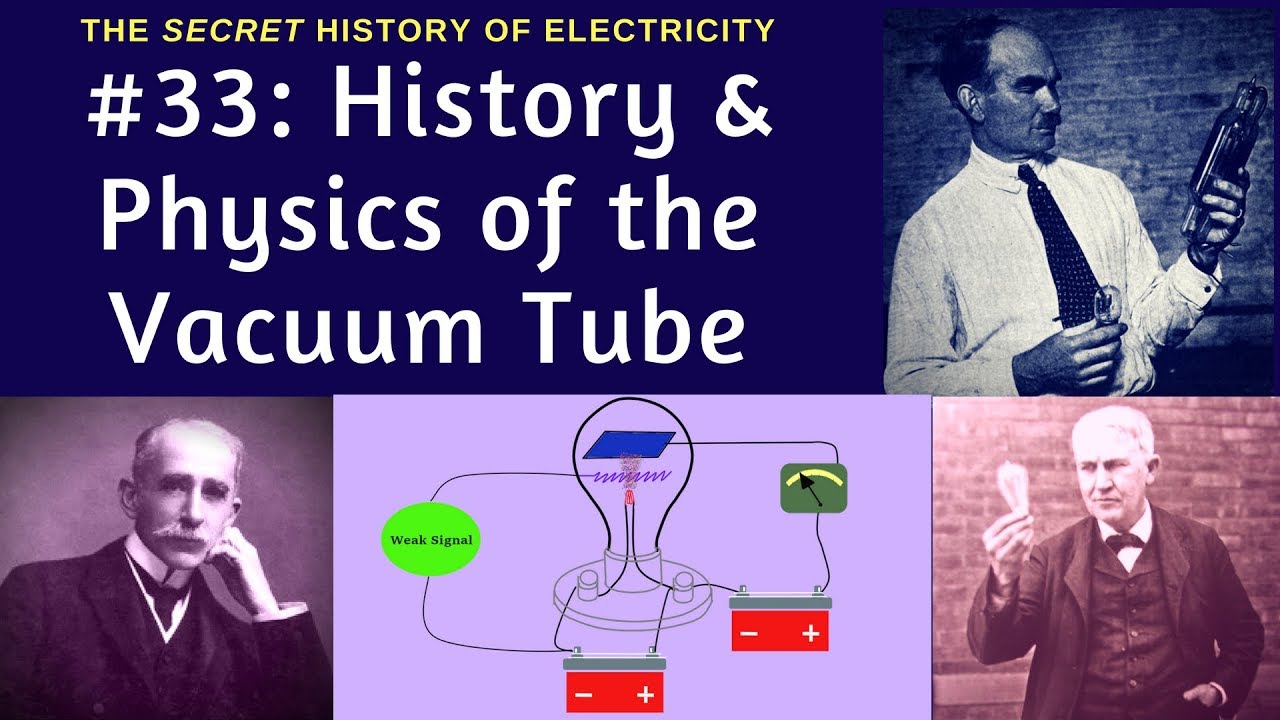
A cathode-ray tube is simply a vacuum tube with electrodes at either end. The electrodes are simply conductive metal pieces with contacts outside the tube. When a high potential difference is applied to the tube, bypassing high voltage electricity through the tube (by connecting the electrodes to a circuit), electrons jump from one electrode to the other, crossing the tube. This cannot occur in normal air because the high density of air molecules prevents the electrons from travelling large distances. However, this is not an issue in a vacuum tube. This description clearly shows that cathode rays are negatively charged electrons. Light emission occurs when the electrons collide with particles inside the tube, causing the particles to emit light as they absorb and then release the energy the electron carries (which is transferred to the particle in the collision). The appearance of the light, such as its shape and colour, depends on the chemical composition of the gas inside the tube and on the gas pressure.
Whether or not matter was infinitely divisible was debated, on and off, for centuries. In more modern times, evidence for the atomicity of matter accumulated steadily.
Discovery of cathode tube and cathode rays
Faraday first observed Cathode rays in 1838, who noticed light emission from within the vacuum tube he was experimenting with. This led to the ongoing research into cathode rays that forms the majority of this HSC topic.
In 1855, a German physicist, Heinrich Geissler (1814-1879), refined a vacuum pump so that it could be made to evacuate. A glass tube to within 0.01 per cent of normal air pressure. Julius Plücker (1801-1868), took these tubes and sealed a metal plate, called an electrode, to each end of the tube. The electrodes made electrical connections through the glass and were sealed to maintain the partial vacuum in the tube. These were then connected to a high voltage source.
Plücker showed that when a high voltage was connected across the electrodes in such a tube the glass walls of the tube near the anode (positive electrode) began to fluoresce and emit an eerie green light.
Повторяем попытку...

Доступные форматы для скачивания:
Скачать видео
-
Информация по загрузке:





![Пожалуй, главное заблуждение об электричестве [Veritasium]](https://imager.clipsaver.ru/6Hv2GLtnf2c/max.jpg)