IVP Solving: Fourth-Order Taylor Series vs Euler's Method
Автор: Den of Learning
Загружено: 2024-09-18
Просмотров: 1017
Описание:
Learn how to solve initial value problems (IVPs) for ordinary differential equations (ODEs) using the higher-order Taylor series method. In this tutorial, we focus on the 4th-order Taylor series method, showing how it outperforms Euler’s method by using more derivative terms for better accuracy with the same step size.
What you’ll see:
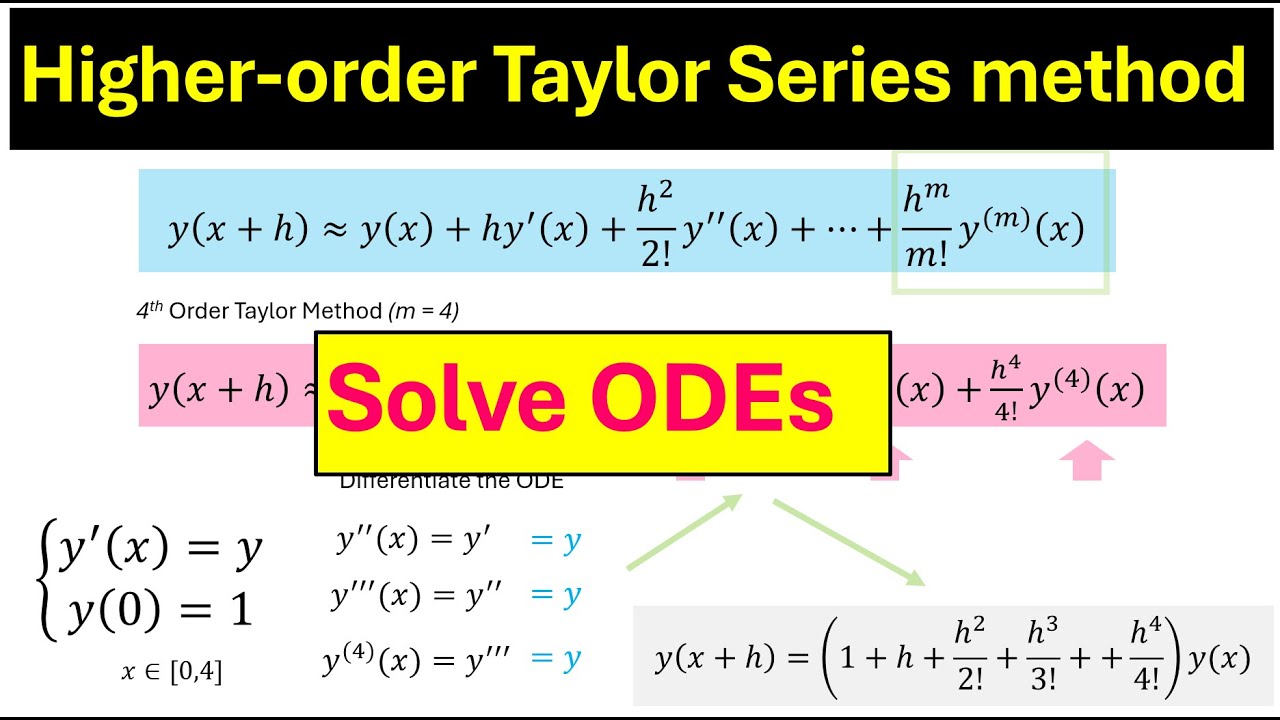
A practical derivation of the 4th-order Taylor formula
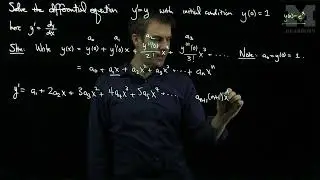
A clear worked example with y’ = y, y(0) = 1
Higher derivatives obtained directly from the ODE
Side-by-side comparison with Euler’s method for the same IVP and step size
Practical tips for computing higher derivatives using algebra or symbolic tools
Key takeaways:
Taylor 4th order uses derivatives up to y^(4), improving local truncation error to O(h^4)
For smooth problems, Taylor methods often deliver smaller error than Euler at the same h
Works for explicit IVPs dy/dx = f(x, y) with manageable derivative calculations
Ideal for students studying numerical methods, applied mathematics, or preparing for engineering exams.
Links to related content:
Taylor and Maclaurin Series: • Unlock the Power of Taylor & Maclaurin Ser...
Euler's Method for Solving IVPs: / 9whoazds36y
Heun's and Midpoint Methods: • Why Heun's Method LEAVES Euler's Behind in... and • The Midpoint Method Explained: The Step Up...
Runge-Kutta Methods Overview: • 5 Minutes to Understanding the POWER of Ru...
Adaptive RK (RK45) with Python: • Master the RUNGE KUTTA METHOD with RK45 fo...
Subscribe for more clear, step-by-step math tutorials, and let me know which numerical method you want covered next!
#ODE #TaylorSeries #NumericalMethods #IVP #MathTutorial
Повторяем попытку...
Доступные форматы для скачивания:
Скачать видео
-
Информация по загрузке: