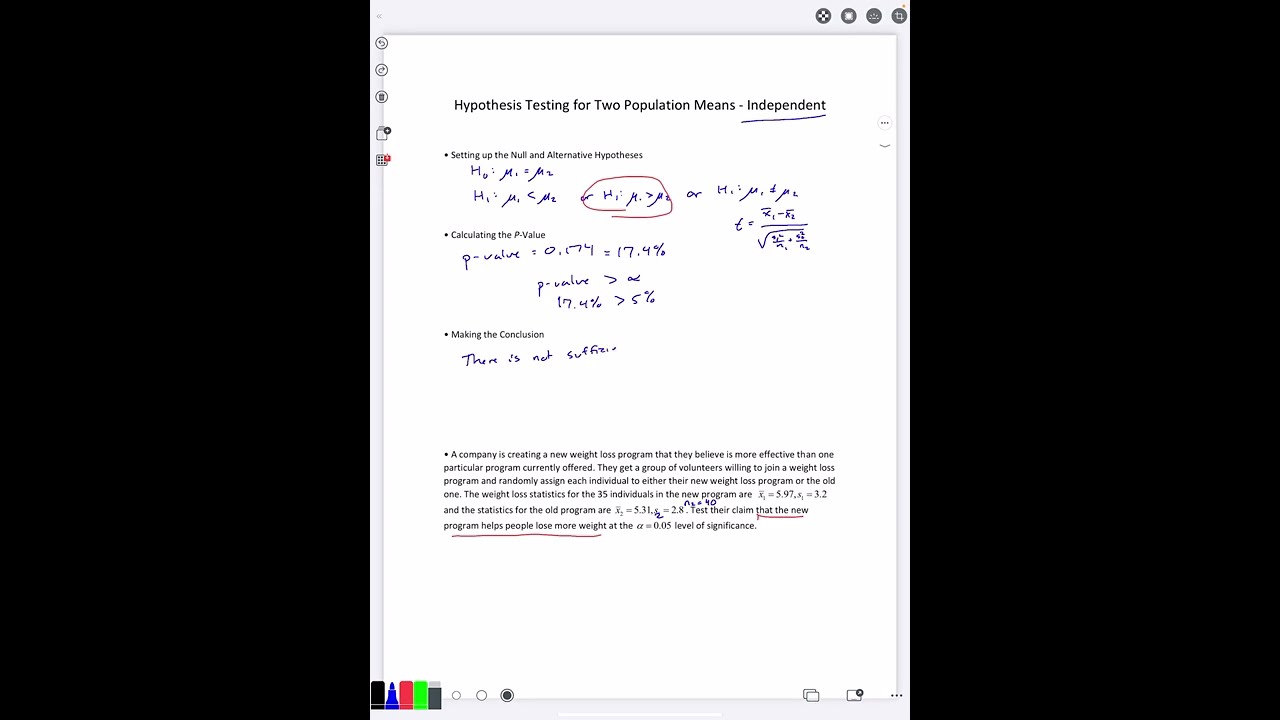
Hypothesis Testing The Difference Between Means For Dependent Samples
Автор: Whats Up Dude
Загружено: 2020-08-06
Просмотров: 20097
Описание:
In this video we discuss how to do hypothesis testing the difference between means for dependent or matched/paired samples. We go through the process of finding critical values and rejection regions and how to use the formula to calculate a standardized test statistic.
Transcript/notes (partial)
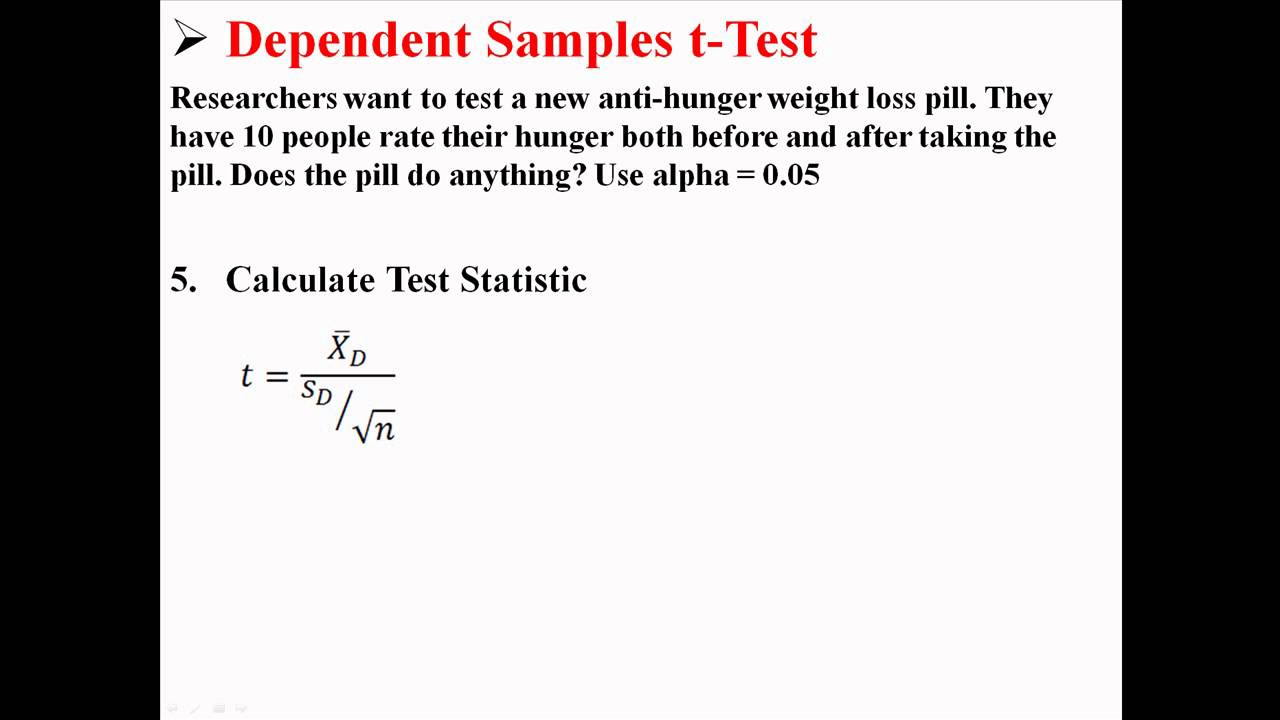
The formula for calculating the standardized test statistic is t equals, d bar minus mew sub d, divided by s sub d, over the square root of n. In this formula, t is the standardized test statistic, d bar is the test statistic, or the mean difference between paired data entries in the dependent samples.
Mew sub d is the hypothesized differences between the paired entries in the population, and we assume this is equal to 0.
S sub d is the standard deviation of the differences between the paired entries, and n is the sample size, and the degrees of freedom are equal to n minus 1.
Alright, lets go through a full example step by step.
A company claims that they can increase employee productivity by having them take a special training course. 10 randomly selected employees productivity rates are measured before taking the course and after taking the course. Those rates are shown in this table. Assume the productivity rates are normally distributed. At a level of significance of alpha equals 0.10, is there enough evidence to support the company’s claim.
Step 1 is to make sure the 3 conditions are met. The samples are random, as that was stated in the information given, the samples are dependent, as there are matched pairs, before and after training, and the population is normally distributed, as that was also stated in the information given.
Step 2 is to write the claim out and identify the null and alternative hypotheses. The claim is that there is a difference between the means. The company is claiming that the productivity rates before the training will be less than the productivity rates after the training. So, the claim is that mew sub d is less than 0. And we know the alternative hypothesis contains a statement of inequality, so h sub a is mew sub d is less than zero. The null hypothesis is the complement of the alternative hypothesis and contains a statement of equality, so h sub 0 is mew sub d is greater than or equal to zero.
Step 3 is to identify the level of significance, which was given, alpha = 0.10.
Step 4 is to identify the degrees of freedom, which is n minus 1, and that results in 7 degrees of freedom.
Step 5, is to determine the test to use, left tailed, right tailed or 2 tailed, and because the alternative hypothesis contains the less than inequality, this will be a left tailed test.
Step 6 is to determine the critical value. Graphically this looks like this, with our critical value, t naught, here and this shaded area in the left tail being the rejection region. Since the level of significance, alpha equals 0.10, and this is a left tailed test, the rejection region will equal alpha, 0.10. And in the t distribution table the value that corresponds to an area of 0.10 to the left is -1.415, and that is our critical value.
Step 7 is to identify the rejection region, which is any standardized test statistic value that falls in the shaded area, that is any value that is less than -1.415.
Step 8, use the formula and calculate the t value, or the value of the standardized test statistic. To use the formula we need to know 4 variables, d bar, mew sub d, s sub d and n. We know that mew sub d equals zero, as we assume that. We know that n is 10, the sample size, so we need to find d bar and s sub d.
To find d bar, we can add a column to the table for d, being the difference for each entry before and after, so before minus after. And here are those values. The formula for d bar is sum of d divided by n, -21 divided by 10, which equals -2.1, and that is our value for d bar.
To find s sub d, we can use the shortcut formula. In the table we can add a column for d squared, the difference squared, and here are those values, with the summed total at the bottom. Plugging into the s sub d formula we have square root of 85, minus -21 squared over 10, divided by 10 minus 1. And that calculates to 2.132, which is the value for s sub d.
Now we have all 4 variables needed to calculate t, or the standardized test statistic. Plugging and calculating we get t equals -3.115.
Step 9 is to make a decision to reject or fail to reject the null hypothesis. On our graph, you can see that the standardized test statistic does fall in the rejection region, as t, the standardized test statistic is less than t naught, the critical value. So, in this case we would reject the null hypothesis.
Timestamps
0:00 Overview
0:17 What are dependent samples?
0:57 The 3 conditions for using a t test
1:12 The formula for calculating the standardized test statistic
1:39 How to calculate d bar
3:25 Example problem
Повторяем попытку...

Доступные форматы для скачивания:
Скачать видео
-
Информация по загрузке: