Radii of stationary orbit
Автор: Learning physics
Загружено: 2020-10-09
Просмотров: 600
Описание:
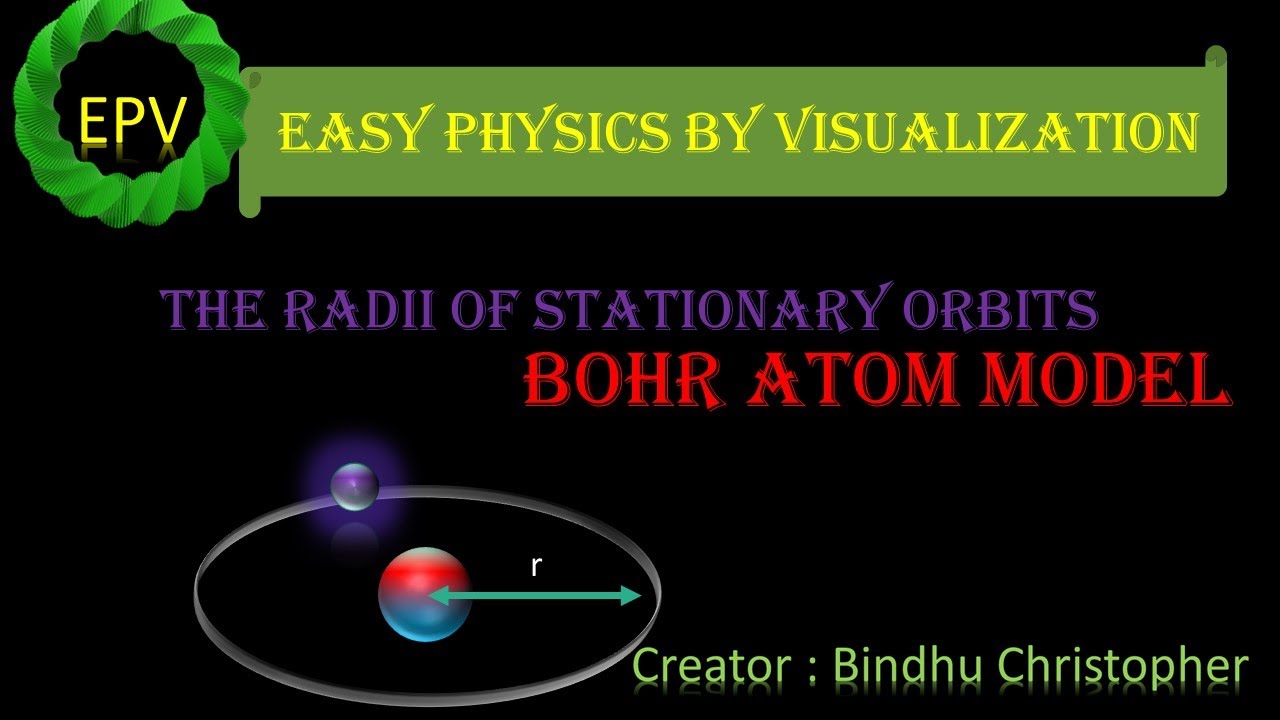
This video explain how to obtain the radius of Bohr orbit.
Bohr Atom Model
• Bohr tries to overcome the defect of Rutherford atomic model.
Postulates of Bohr atomic model
• Bohr proposed the following two postulates.
i. All electron cannot revolve round the all possible orbits, ie the electrons can revolved around the nucleus only in those allowed orbits for which angular momentum of electron is an integral multiple of h/2π.
Explanation-
Here h is the Planck’s constant is equal to6.64 X10-34Js.
The allowed orbits are called stationary orbits.
The electrons revolve in the stationary orbit do not radiate energy.
Angular momentum of an electron L=mvr =nh/2π,where n is called principal quantum number n=1,2,3…….
ii. An atom radiate energy only when an electron jumps from a stationary orbit of higher energy to a lower energy.
Explanation-
If an electron jumps from an initial energy Ei to final orbit energy Ef.
hν=Ei-Ef (if Ei have greater energy than Ef hν of energy released, if Ei have smaller energy than Ef hν of energy is absorbed.)
the energy of photon is equal to
ν = Ei-Ef/h
The Bohr Formulae
• Based on these postulate Bohr’s derive the formula for
iii. The radii of stationary orbits
iv. Total energy of electron in an orbit.
Radii of stationary orbits
• Consider an atom whose nucleus has a charge of +Ze and a mass of M.
• An electron of charge –e and mass m revolving around the nucleus at a particular orbits of radius r.
• Even mass of nucleus is greater than that of electron, the nucleus is stationary.
• Hence mass of the electron does not come in to the calculation.
• The electrostatic force of attraction between the positive charge and negative charge provide centripetal force required to rotation.
• For dynamic stable orbit ,
Centripetal force= Electrostatic force of attraction
Centripetal force= Electrostatic force of attraction
〖Mv〗^2/r=1/( 4πεₒ) 〖Ze/r^2 〗^2→(1)
r=〖(Ze^2)/(4πεₒmv^2 )〗^ →(2
According to Bohr’s first postulate mvr= nh/( 2π)
V=nh/2πrm
V2 =〖(n^2 h^2)/(4π^2 r^2 m^2 )〗^ →(3)
Substituting equation (3) in equation (2 )we get
r = (n^2 h^2 εₒ)/(πZe^2 m)→(4)
Hydrogen atom Z=1
Radius of nth orbit of hydrogen atom = rn=(n^2 h^2 εₒ)/(πe^2 m)→(5)
Here h is the Planck’s constant =6.63X10⁻³⁴
εₒ is the absolute permiability of free space= 8.85X〖10〗^(-12),
π =3.14,
e be the charge of electron =1.6X10⁻¹⁹,
m be the mass of electron = 9.1X10⁻³¹ are constant.
Then rn α n2→(6)
The radii of the orbits are in the ration 1:4:9:16:25 etc
The radius of first orbit can be obtained by substitute the above constants in equation (5) and substitute n=1
We get r1=0.53A ̇
r2=22r1
r3=32r1
rn=n2r1
Повторяем попытку...
Доступные форматы для скачивания:
Скачать видео
-
Информация по загрузке:





![Суть линейной алгебры: #13. Смена базиса [3Blue1Brown]](https://image.4k-video.ru/id-video/P2LTAUO1TdA)

