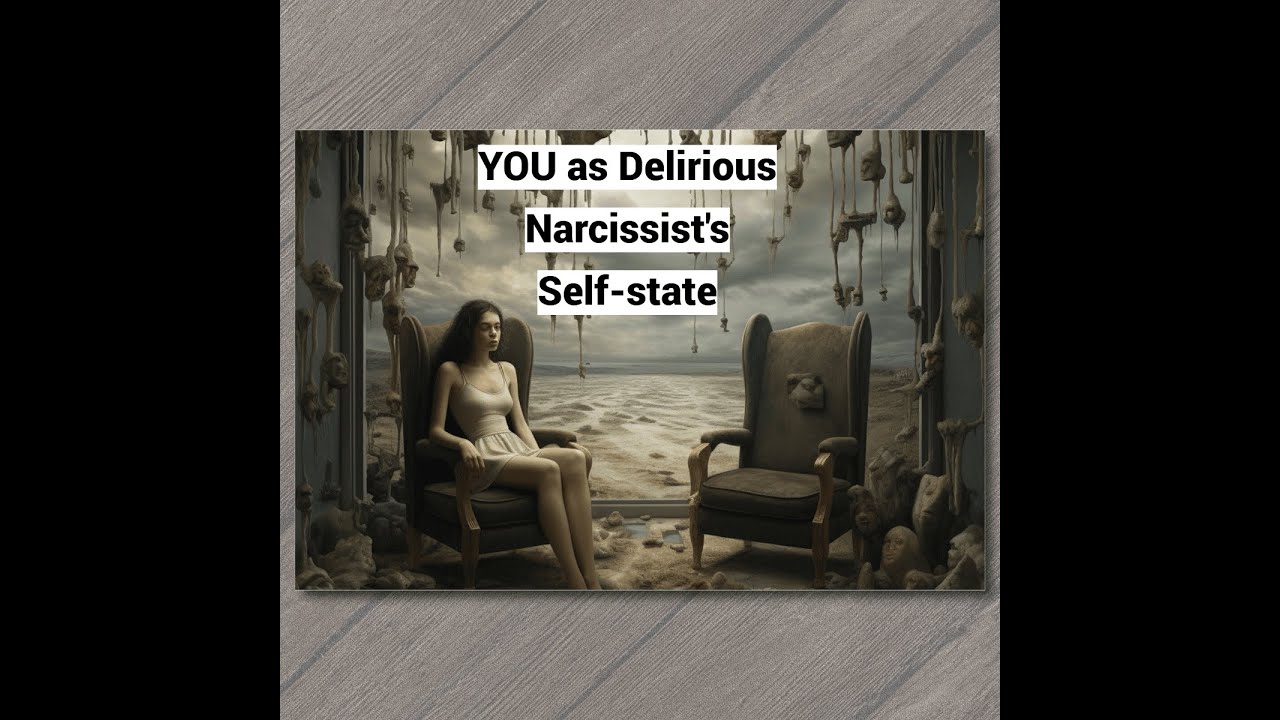
YOU as Delirious Narcissist's Self-state (Pseudo-psychosis)
Автор: Prof. Sam Vaknin
Загружено: 2026-01-24
Просмотров: 4271
Описание:
WATCH Decode, Heal Your Mind with IPAM (Intrapsychic Activation Model) • Decode, Heal Your Mind with IPAM (Intrapsy...
All self-states are anticipatory and reactive to anxiety. They are all on standby. They contain algorithm that allow them to compare the actual environment to predictive ones.
Constructs are agents, not self-states.
The experience of reality is comprised of data from both the external and the internal environments.
The inputs are mediated, structured, and reframed via constructs which activate introjects to produce automatic thoughts. These thoughts affect behaviours intended to modify the environment to conform to a self-state, buttress, and validate it.
Constructs also select memories in order to prevent dissonance and anxiety between recall and self-state. They dissociate memories, alter their emotional content and correlate via attribution and reframing, and impose selectivity.
The construct organizes the output from the introjects according to an algorithm (“identity”) which provides, for each specific environment, selection criteria of self-states and corresponding introjects.
I have been arguing to reverse Kernberg's hierarchy: I postulate that the Narcissist is far closer to psychosis (his personality is far less organized) than the Borderline. Only the narcissist's rigid grandiosity is keeping him together and when it is effectively challenged, he decompensates, acts out, and disintegrates.
Grotstein postulated that the Borderline is a failed narcissist: the pathology did not progress (or devolve) into narcissism which is a full-fledged form of binary Dissociative Identity Disorder with two selves (the False and the True)
The Narcissist's solution to this duality of selves is to switch off the dilapidated, atrophied, and dysfunctional True Self and relegate it to the deepest recesses of the mind where it has no influence whatsoever on the narcissist's psychodynamics. Only the False Self is left.
In contrast, the Borderline fails to repress and dissociate the True Self and, consequently, never becomes a narcissist. This "failure" causes the Borderline's two selves to compete for control of her identity and memories.
It is this inner struggle that mimics other dissociative disorders and led scholars such as Masterson, Dell, Putnam, Ross, Ryle and many others to suggest that BPD may merely be another label for the identity diffusion and alteration common in dissociative disorders.
Narcissists, psychopaths, and Borderlines react with abuse to perceived abuse. But the problem is that their reactive misconduct is based on perceptions and internal dynamics, not on reality, which they cannot be trusted to appraise properly.
People with these personality disorders also possess a low threshold for frustration and poor impulse control.
But the greatest problem is the triple whammy trifecta of cognitive deficits, hypervigilance, and referential ideation. Cluster B patients maintain poor reality testing and paranoid ideation.
Consequently, they misperceive and misinterpret many behaviors as abusive - and react with an arsenal of nuclear weapons to the slightest upset.
So, though many of these perpetrators abuse only when triggered and rarely ignite the chain reaction of maltreatment, their behavioral choices are disproportional and they leverage everything they have, body and intelligence, for instance, to lend their response a bleeding edge.
They may be first provoked (via projective identification, for example) - but then embark upon an unbridled attempt to DESTROY the source of frustration and narcissistic injury (at least mentally, if not always physically). This dynamic is especially evident in couples where one partner is a Borderline and the other one, a Narcissist.
Find and Buy MOST of my BOOKS and eBOOKS in my Amazon Store: https://www.amazon.com/stores/page/60...
Повторяем попытку...
Доступные форматы для скачивания:
Скачать видео
-
Информация по загрузке: