Le Corbusier Origins Changed the Way We Build Forever
Автор: Space Shape Scale
Загружено: 2025-06-24
Просмотров: 160
Описание:
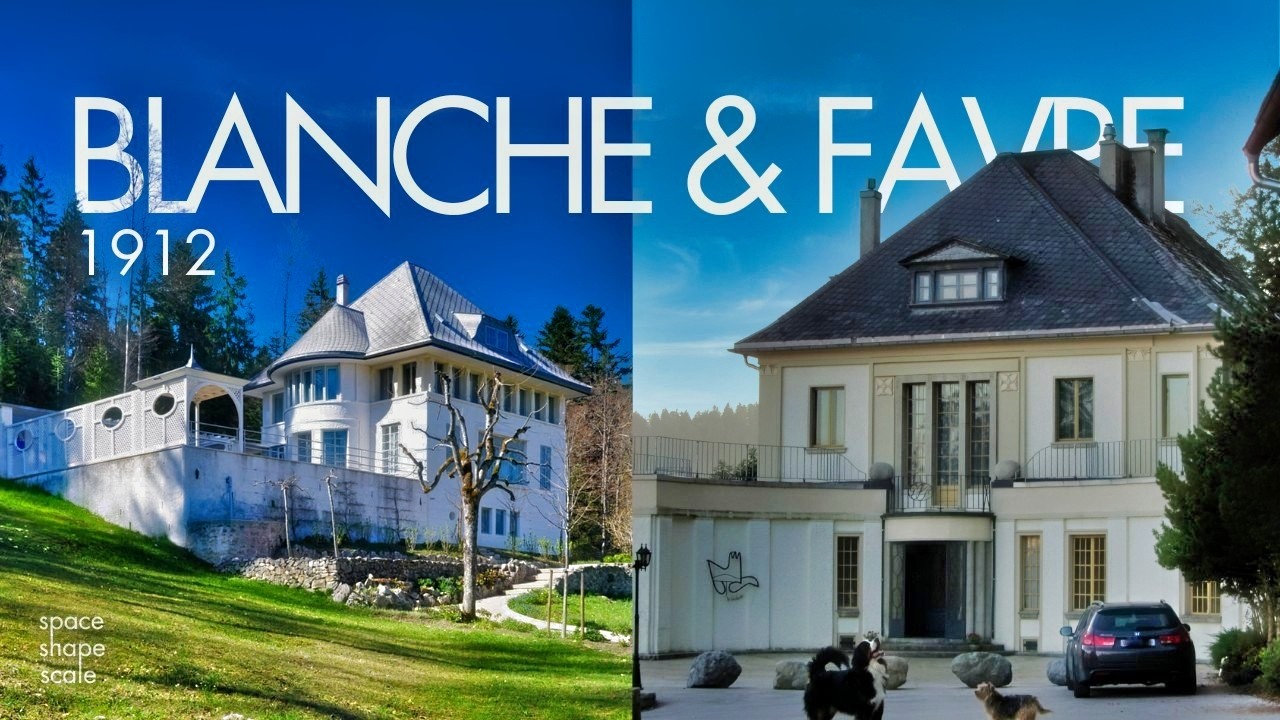
Explore the architectural roots of one of the 20th century’s most influential designers with a deep dive into Maison Blanche and Villa Favre two of the earliest residential projects by Le Corbusier that foreshadowed the revolutionary ideas he would later unleash on the world of modern architecture.
Before he was known as Le Corbusier, Charles-Édouard Jeanneret grew up in the quiet watchmaking town of La Chaux-de-Fonds, Switzerland a place defined by alpine traditions and decorative craftsmanship. Yet from this picturesque setting emerged a restless young mind determined to redefine architecture for the machine age.
Maison Blanche: the first rupture
In 1912, barely 25 years old, Le Corbusier received his first independent commission: to design a home for his parents. The result was Maison Blanche literally “the White House,” named for its pristine façade. At first glance, Maison Blanche still nods to traditional domestic scale. But look closer, and you’ll see the seeds of modernism breaking through: The interior plan opened up traditional rooms into flowing sequences, guided by daylight and framed views. Even details like the modest ribbon windows and restrained decorative touches hinted at a shift from historicist clutter to geometric clarity. It was here that Le Corbusier began to explore the relationship between function, light, and proportion experiments that would echo in everything from Villa Savoye to Chandigarh decades later.
Villa Favre: a step toward rational modernism
Not far from Maison Blanche stands Villa Favre-Jacot, commissioned by the watch industrialist for whom Le Corbusier had earlier designed a workers’ housing plan. This villa reveals an even bolder evolution of ideas: Interior spaces followed a more rational, modular organization, setting up the early logic of free plans.
Through these homes, the young architect experiment stripping away superfluous decoration to uncover a new architectural language suited for modern life.
Breaking from the decorative arts
At the time, La Chaux-de-Fonds was a stronghold of the Art Nouveau-infused Swiss Secession, filled with fluid lines, floral motifs, and artisanal flourishes. Charles L’Eplattenier, Le Corbusier’s early mentor, encouraged this synthesis of art and craft. But even as a student, Le Corbusier chafed under stylistic constraints.
Maison Blanche and Villa Favre show him rebelling against the ornamental tradition of watchcase engraving and marquetry favoring instead simplification, economy, and spatial clarity. This was his quiet revolution before the world-shaking manifestos.
From these seeds to modernist doctrine
It’s astonishing to look at Maison Blanche and see early hints of ideas that would later become the “Five Points of a New Architecture” pilotis, free façades, ribbon windows, roof gardens, and open plans crystallized in Villa Savoye. Or to sense how the careful control of light and volume would lead to the luminous interiors of the Notre-Dame du Haut at Ronchamp.
Subscribe & keep exploring
At Space Shape and Scale, we journey through the masterpieces, manifestos, and daring ideas that reshaped the built world. From Paxton’s industrial glass palaces to Wagner’s Secessionist banks, Gaudí’s organic fantasies, Wright’s democratic prairies, Loos’s minimalist manifestos, and here, Le Corbusier’s early Swiss explorations that planted the seeds of modern architecture.
Join us weekly as we uncover how space, shape, and scale express the deepest ambitions of their time and continue to shape ours.
#LeCorbusier #MaisonBlanche #VillaFavre #EarlyModernism #ModernArchitecture #InternationalStyle #ArchitecturalHistory #SwissArchitecture #DesignTheory #SpaceShapeScale
TIMELINE OF INFLUENTIAL ARCHITECTS
Joseph Paxton (1803) – Victorian Engineering / Proto-Modernism
Otto Wagner (1841) – Vienna Secession
Lluís Domènech i Montaner (1850) – Catalan Modernisme
Antoni Gaudí (1852) – Catalan Modernisme
Louis Sullivan (1856) – Prairie School / Functionalism
Josep Puig i Cadafalch (1867) – Catalan Modernisme
Frank Lloyd Wright (1867) – Prairie School / Organic Architecture
Charles Rennie Mackintosh (1868) – Art Nouveau / Arts and Crafts
Charles & Henry Greene (1868) – American Arts and Crafts
Peter Behrens (1868) – Industrial Modernism
Giacomo Mattè-Trucco (1869) – Industrial Architecture
George Grant Elmslie (1869) – Prairie School
Adolf Loos (1870) – Rationalism / Early Modernism
Auguste Perret (1874) – Concrete Modernism
Antonin Nechodoma (1877) – Caribbean Prairie Style / NeoGothic
William Gray Purcell (1880) – Prairie School
Adolf Meyer (1881) – Bauhaus / Functionalism
Walter Gropius (1883) – Bauhaus / Modernism
Pierre Chareau (1883) – Industrial Modernism
Erik Gunnar Asplund (1885) – Nordic Classicism / Functionalism
Sigurd Lewerentz (1885) – Nordic Classicism / Brutalism
Ludwig Mies van der Rohe (1886) – International Style
Rudolf Schindler (1887) – Early California Modern
Le Corbusier (1887) – International Style / Modernism
Повторяем попытку...
Доступные форматы для скачивания:
Скачать видео
-
Информация по загрузке: