Electric Circuit Analysis | Lecture - 9B | Source Transformation, Thevenin's, & Norton's in FD
Автор: Engineering Devotion
Загружено: 2022-01-31
Просмотров: 4491
Описание:
Source Transformation, Thevenin's Theorem, and Norton's Theorem in the Frequency Domain: Simplifying AC Circuit Analysis
In the frequency domain (AC circuits), we analyze circuits using phasors for voltages and currents, and impedances ($Z$) for components like resistors ($R$), inductors ($L$), and capacitors ($C$). The concepts of Source Transformation, Thevenin's Theorem, and Norton's Theorem remain invaluable for simplifying complex AC circuits.
Source Transformation in Frequency Domain
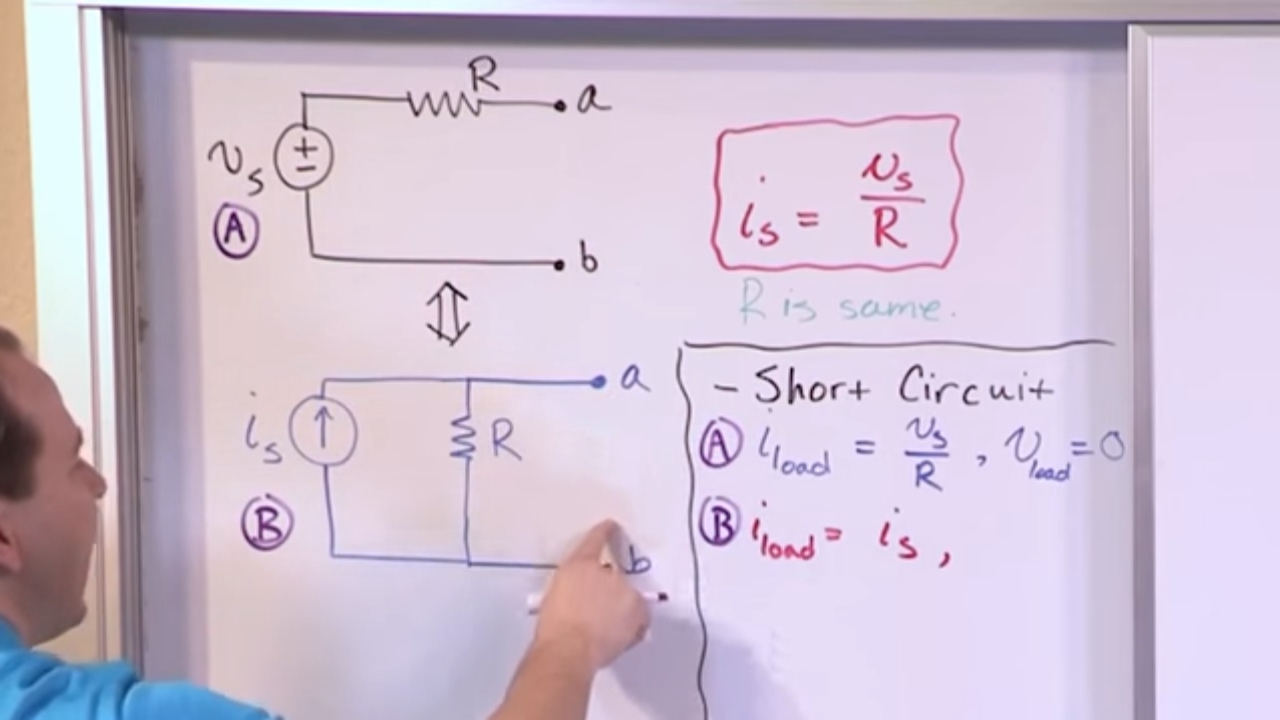
Source transformation in the frequency domain is a technique to convert a practical voltage source (a voltage source phasor $V_s$ in series with an impedance $Z_s$) into an equivalent practical current source (a current source phasor $I_s$ in parallel with the same impedance $Z_s$), and vice versa. This simplifies circuit analysis by allowing combination of sources or easier application of other theorems. The conversion uses Ohm's Law: $V_s = I_s Z_s$ or $I_s = V_s / Z_s$. The impedance $Z_s$ remains unchanged. This is highly useful for simplifying networks with mixed sources and for AC circuit analysis.
Thevenin's Theorem in Frequency Domain
Thevenin's Theorem in the frequency domain states that any linear, two-terminal AC circuit can be replaced by an equivalent circuit consisting of a single voltage source ($V_{Th}$, the Thevenin voltage phasor) in series with a single equivalent impedance ($Z_{Th}$, the Thevenin impedance). $V_{Th}$ is the open-circuit voltage across the terminals, and $Z_{Th}$ is the equivalent impedance looking back into the circuit with all independent sources turned off (voltage sources shorted, current sources opened). This simplifies analysis by reducing a complex network to a simple series equivalent.
Norton's Theorem in Frequency Domain
Norton's Theorem in the frequency domain states that any linear, two-terminal AC circuit can be replaced by an equivalent circuit consisting of a single current source ($I_N$, the Norton current phasor) in parallel with a single equivalent impedance ($Z_N$, the Norton impedance). $I_N$ is the short-circuit current flowing between the terminals, and $Z_N$ is the equivalent impedance looking back into the circuit with all independent sources turned off (same as $Z_{Th}$). This theorem simplifies analysis by reducing a complex network to a simple parallel equivalent. Norton's and Thevenin's theorems are duals, and their equivalent circuits can be interconverted using source transformation.
Important Search Queries:
AC circuit analysis, frequency domain circuit simplification, Thevenin equivalent AC, Norton equivalent AC, source transformation AC circuits, phasor analysis theorems, impedance network reduction, complex circuit analysis, electrical engineering theorems, AC circuit problem solving.
#CircuitAnalysis #FrequencyDomain #TheveninsTheorem #NortonsTheorem #SourceTransformation #ACCircuits #ElectricalEngineering #Phasors #Impedance #CircuitSimplification
Повторяем попытку...
Доступные форматы для скачивания:
Скачать видео
-
Информация по загрузке: