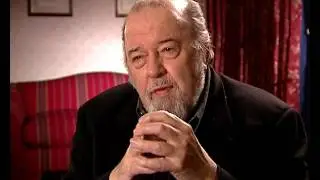
Peter Hall - 'Theatre has always been dying' (40/40)
Автор: Web of Stories - Life Stories of Remarkable People
Загружено: 2017-07-27
Просмотров: 999
Описание:
To listen to more of Peter Hall’s stories, go to the playlist:
• Peter Hall (Theatre director)
British-born theatre director, Sir Peter Hall (1930-2017), ran the Arts Theatre, founded the Royal Shakespeare Company when he was only 29, and directed the National Theatre. In 1977 he was knighted for his contribution to the theatre. [Listener: John Goodwin; date recorded: 2006]
TRANSCRIPT: One of the interesting things about the theatre is that from time immemorial it's been dying, and it's always dying, and it's always going through some awful convulsion. I mean, when I look back to 1950, '51 when I was starting, there was no National Theatre, there was no Royal Shakespeare Company, there was no Royal Court, there was no Almeida, there was no Donmar. It was the West End, the West End, the West End doing rather middlebrow, middleclass plays; the sort of stuff that you now get for free on television. And that's one of the problems that I think the West End is facing that the smaller theatres – medium to small theatres – that need plays can't afford to do plays and, if you look at the lists, you will see that most of the plays have come from subsidised theatres. And, in that sense, the subsidised theatre is keeping the theatre alive and jolly good luck to it. I think, myself, there's going to be some kind of convulsion in the theatre, some kind of new resolution... revolution. It feels to me as if it's... as if it's time. I feel we've come to the end of a curve; that may be because I'm resisting retirement but it... it certainly feels like an end. I think the beginning, I don't know where it will happen or how it will happen, but I cannot believe that theatre is in any sense threatened because, as our means of communication and our means of entertainment is more and more and more screen-based, I think the fact of going to a live performance with a live person saying will you imagine with me becomes more and more special, more and more peculiar, a bit of hard work sometimes, as compared with the way that the screen does the work for you, but nonetheless very provocative and exciting and unforgettable. And I believe that's... that's going to increase, that's going to last... that's going to last.
I hope Shakespeare will continue to live for another couple of hundred years at least but we have to recognise the fact that Shakespeare's language is becoming more and more ancient and just as Chaucer's language is ancient to us, in a hundred years time people will probably find Shakespeare quite hard to understand. At this moment they don't. If an actor understands it and phrases it correctly he can make an audience understand it, where individually they wouldn't by reading it. And that's exciting. But, if he speaks it badly and he doesn't know what he's saying, then of course it compounds the problem, it just convinces the audience that Shakespeare is un-understandable. So I think a clarification there is... is going to happen, has got to happen, because otherwise you will have audiences wondering what Shakespeare's all about... and the whole thing running down. I highlight Shakespeare because he's the best, and if you can act Shakespeare you can act anything, whereas if you can act anything, you don't necessarily act Shakespeare; it's different. I mean it's the Olympics test – Shakespeare – no question. And I think from that sense, it... it's likely to last another couple of hundred years. The theatre probably will become even more elitist and even more specialised; there's nothing particularly wrong with that. I mean a Picasso painting is elitist, it doesn't invalidate it; it's only one of them. And I think we... we're too keen on watering everything down to a kind of egalitarian sludge and I think that's a great danger which the theatre can combat. In that sense I think we might even surprisingly see theatre move slightly to the right; it's usually nestling safely on the left, but it's difficult to know what the left is now. Well there is no left. There isn't, is there? There are different forms of right. It's terrible, terrible. Well the theatre is... it always will be and it always, except in the Elizabethan days, has been... Yes. And I don't think there's any... the use of the word. The word has got a nasty sound...Yes... but the fact is, that it will never be a hugely popular taste, never... No... I think it can be, but because of that, it's able to do all sorts of things that the other media can't do because they're up there speaking to too wide an audience. Yes, I think that's true. I think it's able to take all sorts of risks and move all sorts of boundaries because it's playing to, on the whole, a sophisticated audience...Yeah... you know...absolutely and I think that's good. I don't think anybody should be ashamed of the fact. No, nor do I, nor do I. [...]
Read the full transcript at https://www.webofstories.com/play/pet...
Повторяем попытку...

Доступные форматы для скачивания:
Скачать видео
-
Информация по загрузке: