Fun English: 16 HOMOPHONES & Past Simple Verbs
Автор: Английский с Ронни · EngVid
Загружено: 2019-05-20
Просмотров: 154159
Описание:
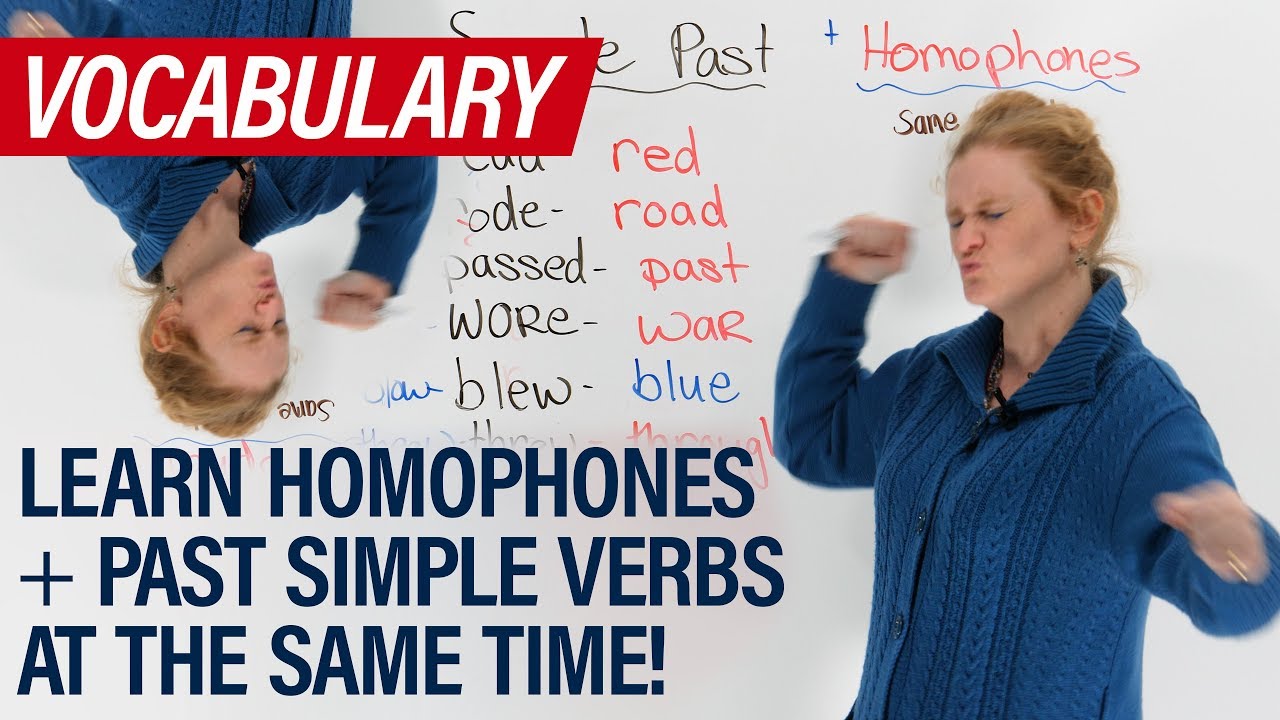
Homophones are words that are spelled differently but sound exactly the same. For example, “the red book” and “the read book” sound the same, but they mean completely different things. To understand the meaning of the word, you need to rely on context or spelling. There are hundreds of homophones in English, and in today’s lesson, I will teach you eight pairs of them, so 16 words in total. You will notice that each pair is made up of one past simple verb and one other word with a different function. I will teach you the difference between “rode” and “road”, “passed” and “past”, “wore” and “war”, “blew” and “blue”, “threw” and “through”, “ate” and “eight”, and “made” and “maid”. I will explain their meaning and give you examples. By the end of the lesson, you will know how to differentiate the past simple verbs from their homophone counterparts. After watching, make sure you take the quiz at https://www.engvid.com/16-homophones-... and watch my other lesson on Homophones and Part Participle Verbs here: • Learn English: 17 HOMOPHONES & Past Partic...
TRANSCRIPT
Hello. Homophones, homophones, homophones. I love homophones. Do you know what a "homophone" is? A "homophone" is really fun in English, and important because it teaches you pronunciation and also a bonus. The bonus is you get to say one word, and it actually has two different meanings. Wow. So, you're cutting your studying time in half. I'm saving you time. I know, it's amazing.
So, "homophones" are words that are spelt differently, but sound exactly the same. So, "homo" means same and "phone" means sound. So, these are words in English that are pronounced the exact same way, but the spelling is different. And this is what makes English confusing: The pronunciation, because unfortunately in this language, we don't say each of the letters; some letters are silent, some of them we just don't bother to say at all. They're just there to make life more difficult for you; but also, it gives me a reason to talk to you. Yeah. Subscribe. It gives me a reason... It gives you a reason to subscribe to this channel. Ah, do it. Do it now. Homophones.
Another thing that is confusing and crazy in English is remembering the verbs. So, in English we have a base verb; for example, if you want to look at a book, we say: "read". So: "Doo-doo. I'm going to read the book." And then we have the simple past. So, the simple past of the verb would be something like: "Yesterday I read the book." And just here, your brain becomes confused because: "Hey, hey, Ronnie. You wrote the same word for the sim-... The base verb and the simple past."
Well, guess what? This is why English is crazy and this is why I'm here to help you, because we have a homophone. Yay, we love homophones. What colour is this? This is "red". So, the simple past of the verb "read" is said exactly like the colour "red". So, you can say: "I read a red book yesterday." And people might think that you said the verb wrong because it's obviously "read". "I read the book yesterday." And you go: "Oh, no. See, 'read', the past tense is 'read', exactly like the colour because it's a homophone." So, homophones are fun, they're amazing because you learn pronunciation and-doo-doo-do-doo-you learn a new word. So: "read", the simple past is "read", which is a homophone for the colour red. What's your favourite colour? Mine's purple.
We have the verb "ride" and the past tense is "rode, r-o-d-e" and it sounds exactly like a "road". So, a "road" is the thing that you drive on. Don't walk on the road; you'll get hit by a car. We walk on the sidewalk, if we have one. So: "I rode the road home." I'm going to draw a picture of a road because it's very easy for me. Oh, it's got a dividing line. This is a road. Yes, I am an artist. If you'd like to buy any of my artwork, just message me. I'll sell it to you for cheap. $1000, that's it. So: "ride", past tense, simple past is the exact same pronunciation as the noun "road".
This one might also confuse you. So, we have the verb "pass". In the simple past, we put "e-d" on it. Now, this is a regular verb, okay? The other ones are irregular. But you have become very confused at this point because you look at it, and your brain thinks: "pass-ed. I pass-ed the car." But actually, if you look and if you study English pronunciation more, you will understand that when we pronounce "e-d" verbs, we actually have to change the "e-d" to a "t" because of our "s" sound. So, in the past tense, the verb "passed" sounds exactly like "past". We don't say: "pass-ed"; we say: "past".
Next one, this is a verb that a lot of people don't use. It has to do with clothes. So, we wear clothes. Most of us, we have to, it's important. Especially in Canada in the winter, it's cold. If you don't wear clothes, you will die. Maybe it's a little embarrassing if you sit on the subway or you go somewhere on the bus and you're not wearing clothes; people might look at you. […]
Повторяем попытку...
Доступные форматы для скачивания:
Скачать видео
-
Информация по загрузке: