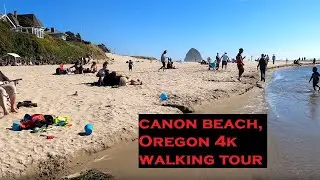
⁴ᴷ⁶⁰ Walking tour of Cannon Beach, Oregon
Автор: Walking & Driving Incognito
Загружено: 2023-09-15
Просмотров: 123
Описание:
September 1, 2023 - 3:30 PM
72°F / 22°C
Walking tour of Cannon Beach, Oregon from the downtown business district to Haystack Rock, via the following route: southbound on Hemlock Street 🠖 westbound on West Gower Avenue 🠖 westbound on Ecola Court 🠖 Cannon Beach
Highlights:
00:00 - Walking south on Hemlock Street
00:43 - Sandpiper Square
01:26 - Mariner Market
02:39 - Coaster Theatre Playhouse
05:10 - Cannon Beach Community Church
12:43 - Walking west on West Gower Avenue
13:44 - Walking west on Ecola Court
14:45 - Walking on Cannon Beach
From Wikipedia:
"Cannon Beach is a city in Clatsop County, Oregon, United States. Its population was 1,690 at the 2010 census. It is a popular coastal Oregon tourist destination, famous for Haystack Rock, a 235 ft (72 m) sea stack that juts out along the coast. In 2013, National Geographic listed it as 'one of the world’s 100 most beautiful places.'
Cannon Beach and its surrounding coast was previously settled by the Tillamook people.
William Clark, one of the leaders of the Lewis and Clark Expedition, journeyed to Cannon Beach in early 1805. The expedition was wintering at Fort Clatsop, roughly 20 miles (32 km) to the north near the mouth of the Columbia River. In December 1805, two members of the expedition returned to camp with blubber from a whale that had beached several miles south, near the mouth of Ecola Creek. Clark later explored the region himself. From a spot near the western cliffs of the headland he saw '...the grandest and most pleasing prospects which my eyes ever surveyed, in front of a boundless Ocean...' That viewpoint, later dubbed 'Clark's Point of View,' can be accessed by a hiking trail from Indian Beach in Ecola State Park.
Clark and several of his companions, including Sacagawea, completed a three-day journey on January 10, 1806, to the site of the beached whale. They encountered a group of Tillamook who were boiling blubber for storage. Clark and his party met with them and successfully bartered for 300 pounds (136 kg) of blubber and some whale oil before returning to Fort Clatsop. There is a whale sculpture commemorating the encounter between Clark's group and the Tillamooks in a small park at the northern end of Hemlock Street.
Clark applied the name Ekoli to what is now Ecola Creek. Ehkoli is a Chinook word for "whale". Early settlers later renamed the creek "Elk Creek", and a community with the same name formed nearby.
In 1846, a carronade, a short naval cannon, from the US Navy schooner Shark, which had sunk earlier that year, washed ashore just north of Arch Cape, a few miles south of the community. The schooner hit land while attempting to cross the Columbia Bar, also known as the "Graveyard of the Pacific." The cannon, rediscovered in 1898, eventually inspired a name change for the growing community. In 1922, Elk Creek was renamed Cannon Beach (reflecting the 8-mile (13 km) beach that extends south of Ecola Creek to Arch Cape) at the insistence of the Post Office Department because the name was frequently confused with Eola. Elk Creek itself was renamed Ecola Creek to honor William Clark's original name.
The cannon is now housed in the city's museum and a replica of it can be seen alongside U.S. Route 101. Two more cannons, also believed to have been from the Shark, were discovered on Arch Cape over the weekend of February 16, 2008.
U.S. Highway 101 formerly ran through Cannon Beach. In 1964, a tsunami generated by the Good Friday earthquake came ashore along the coast of the Pacific Northwest. The subsequent flooding inundated parts of Cannon Beach and washed away the highway bridge located on the north side of city. The city, now isolated from the highway, decided to attract visitors by holding a sand castle contest, an event that still continues annually every June."
Повторяем попытку...

Доступные форматы для скачивания:
Скачать видео
-
Информация по загрузке: