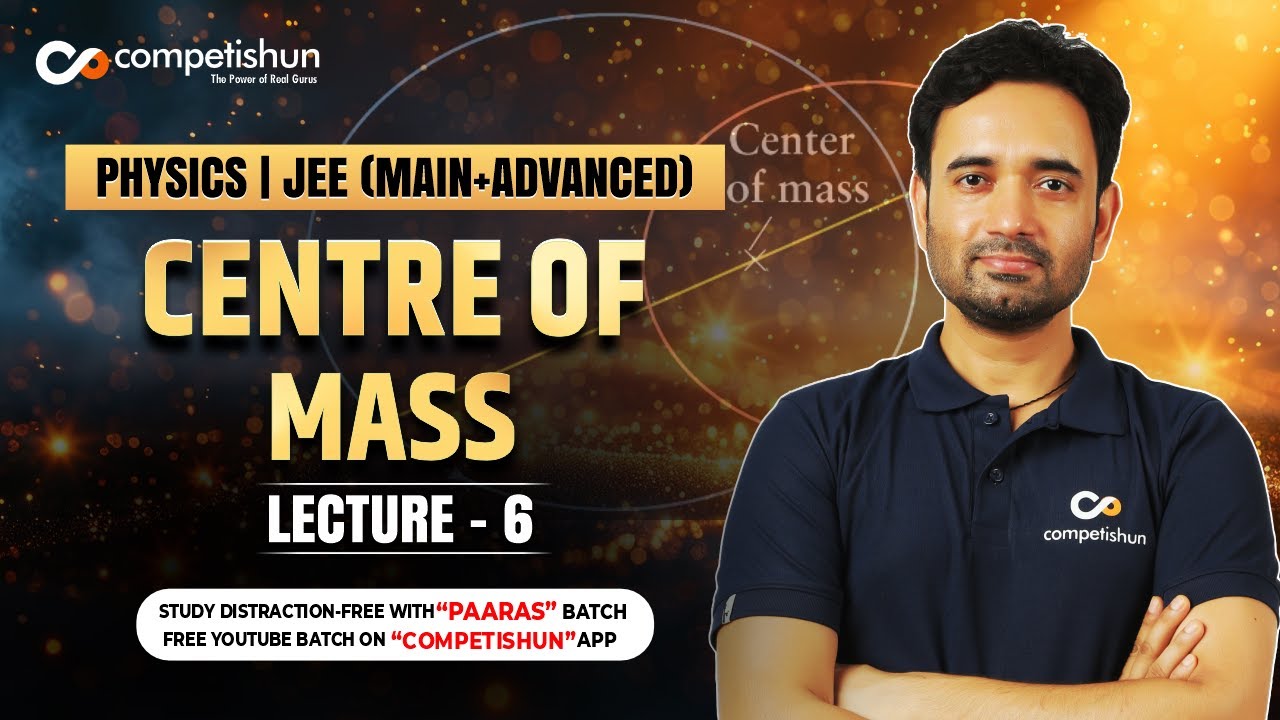
6 Impulse Momentum Theorem, Collision & its types | Centre of Mass Class 11 | JEE Main & Advanced
Автор: Mohit Tyagi
Загружено: 2020-10-09
Просмотров: 128598
Описание:
🎓Watch Complete YouTube Lectures Distraction-Free
Download the Competishun App
👉 https://play.google.com/store/apps/de...
🌐 Login for Courses & Test Series:
👉 https://i.competishun.com/
Popular Courses for IIT-JEE:
Pratham | Prakhar | Prakhar Integrated I | Praveen | Pragyaan
C3 | Champ | CATS | ABC | PYQ Express
UTS | ATS
👉 Explore all: https://competishun.com/courses/
📞 Support:
8888-0000-21 | 7410-900-901 | 7410-900-908
---------------------
---------------
Topics covered in this Chapter Centre of Mass Class 11 lecture by ABJ sir IITD with timestamp:
00:00 - 11:12 COM Problem 1: Based on the Impulse Momentum Theorem. We have two blocks of mass m connected with a string and a bullet of mass m. Bullet strikes block A with a velocity u and gets embedded in it. We have to find the velocity of blocks after this collision. Also, could you find the impulse of the tension and force acting b/w block A and Bullet B? To solve this problem, ABJ Sir uses Impulse Momentum Theorem, Momentum Conservation Theorem and basic calculus.
11:15 - 24:31 Impulsive Force: An impulsive force is one that acts on an object for only a short time. An impulsive force is primarily produced in a collision that changes the velocity or momentum of one or more of the objects involved in the collision. ABJ Sir also gives examples of impulsive forces. Gravitational force and spring force are always non-impulsive ( They can change the momentum of anybody but action is required for a long time.)
24:31 - 31:05 Examples of Impulsive and Non-Impulsive Force: ABJ Sir took examples of impulsive and non-impulsive force.
31:05 - 33:20 Line Of Motion & Line of Impact: Line of Motion is a line along which an object is moving, and a line of impact is a line along which interacting bodies apply force on each other.
33:45 - 37:10 Collision: A Collision happens when two bodies come in direct contact. In this case, the two bodies exert forces on each other in a short period of time. The energy and momentum of bodies interacting undergo a change as a result of the collision. Moreover, the collision may occur through physical contact of the bodies involved. For instance, the collision between two billiard balls.
37:10 - 43:20 Types of Collision (Based on the Line of Motion and Impact): There are two types of Collision based on the Line of Motion and Line of Impact. -
1) Head-On Collision 2) Oblique Collision
Head-On Collision - Line of Motion and Line of Impact Coincide, and Line of Motion before and after the collision remains the same.
Oblique Collision - Line of Motion and Line of Impact differ, and the Line of Motion may differ before and after the collision.
43:36 - 49:53 Types of Collision (Based on the collide Material): There are three types of Collision.
1) Elastic Collision 2) Inelastic Collision 3) Perfectly inelastic Collision
50:15 - 01:04:40 Process of Collision: ABJ Sir explain the process of Collision in which he explains process of deformation and reformation. He also explains the Coefficient of restitution.
01:05:18 - 01:13:34 Elastic Collision: In the elastic collision, the elastic bodies' shape, size and geometry will remain the same before and after the collision. The kinetic energy before the collision is equal to the kinetic energy after the collision. ABJ Sir also explains process of collision for elastic collision. The Value of coefficient of restitution is 1 for elastic collision. There is no deformation due to elastic collision. ABJ Sir also draw the curve of KE and time.
01:14:10 - 01:29:27 Perfectly Inelastic Collision - In perfectly elastic collision, shape, size and geometry changes by maximum amount due to collision. There will be maximum deformation. In a perfectly inelastic collision, the two bodies stick together and move with the same velocity after the collision. The Value of coefficient of restitution is 0 for perfectly inelastic collision. ABJ Sir also draw the curve of KE and time.
01:29:35 - 01:30:27 Inelastic Collision - In Inelastic collision, shape, size and geometry changes in the inelastic bodies due to collision before and after the collision. There will be some deformation. The kinetic energy before the collision is not equal to the kinetic energy after the collision. The Value of coefficient of restitution is b/w 0 to 1 for inelastic collision. ABJ Sir also draw the curve of KE and time.
Prerequisite of the Chapter – There is no prerequisite for this chapter. Basic mathematics and calculus is required to solve good problem and derivations.
Повторяем попытку...
Доступные форматы для скачивания:
Скачать видео
-
Информация по загрузке: