The Half-Remarkable Question - Incredible String Band (cover)
Автор: LiteGauge
Загружено: 2013-04-10
Просмотров: 2223
Описание:
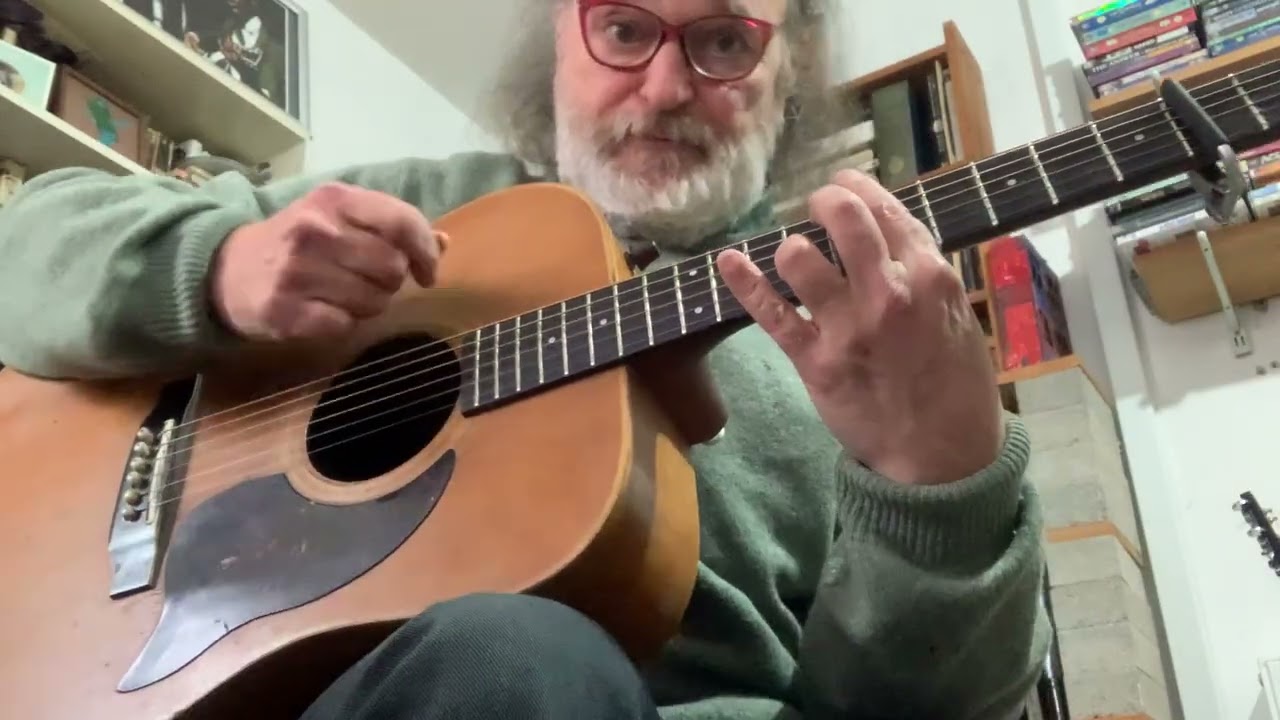
Another song that I've decided to post again. I think the rights to this song and the lyrics are the property of Warner-Tamerlane Publishing Corp. I would just like to say that this video is my own interpretation of this song, and although I'm pretty sure that I've got the tuning right (CGCGCE), much of the arrangement is just me trying to capture at least the spirit of Robin Williamson's original.
The half remarkable question was first released of Wee Tam, which came out at the same time as Big Huge.
The Incredible String Band was an extraordinary phenomenon in the mid-60's and 70's, starting with Robin Williamson, Mike Heron and Clive Palmer. Clive left to form The Famous Jug Band. Robin and Mike continue, being joined by Rose Simpson and Licorice Mackenzie, before the final band formation with the addition of Malcolm Le Maistre amongst others.
A word about Open Tunings. I tend to draw a distinction between open and alternate tunings. For me an open tuning is when the guitar is tuned to a major or minor open chord. The ones I know best are Open D (or E), Open G and Open C and their minors.
The structures of these tunings are very similar. Basically you retune the guitar so that when playing the string open they form a chord. The notes will be DF#A (Root, 3rd and 5th notes of the scale), EG#B, GBD or CEG for the major forms. For the Open D or E the 3rd will be on the 3rd string, for Open G the 3rd will be on the 2nd string and for Open C the 3rd will be on the top string, which give DADF#AD (EBEG#BE), DGDGBD and CGCGCE. This gives each tuning its specific colour. Open C is quite remarkable in fulless of its sound. The structure is therefore R5R35R, (R=roots, etc), 5R5R35 and R5R5R3. You may notice that everything is just being shifted over across the fret-board by one string. This means that chords are relatively easy to work out. In D, D is 000000 and the A chord is 020120. In G, G is 000000, and the C chord is 002012 (a shift towards the higher strings). So for Open C, C is 000000 and the F chord is 000201 or 020201. You can probably see from this that shifting chords across the fret-board towards the top strings means that you'll lose notes off the top, so you can go looking into how to put them back in the bass. Again this will change the colour of the tuning.
I will frequently play an open C chord in Open C tuning as 050000 or 050500. By doing this I'm just adding removing the 5th and adding another root note to the chord. This gives an almost 12-string sound and also adds another tone, because open and fretted notes don't 'sound' the same. Adding a slide up to the 5th fret from the 2nd or 3rd fret also adds another effect.
Two other tunings, which work the same way are DADGAD and EADEAE, which is a shift in the other direction. DADGAD was first publicised and some say invented by Davey Graham, but this argument will probably go on for ever - the cows have decided firmly to remain in the field. EADEAE or its variant DADEAE were used by both Martin Carthy and also by Davey Graham. Martin Carthy's tuning is DADEAE, dropped by a tone to CGCDGA, MC actually retunes the top string to suit the key that he wants to use.
Повторяем попытку...

Доступные форматы для скачивания:
Скачать видео
-
Информация по загрузке: