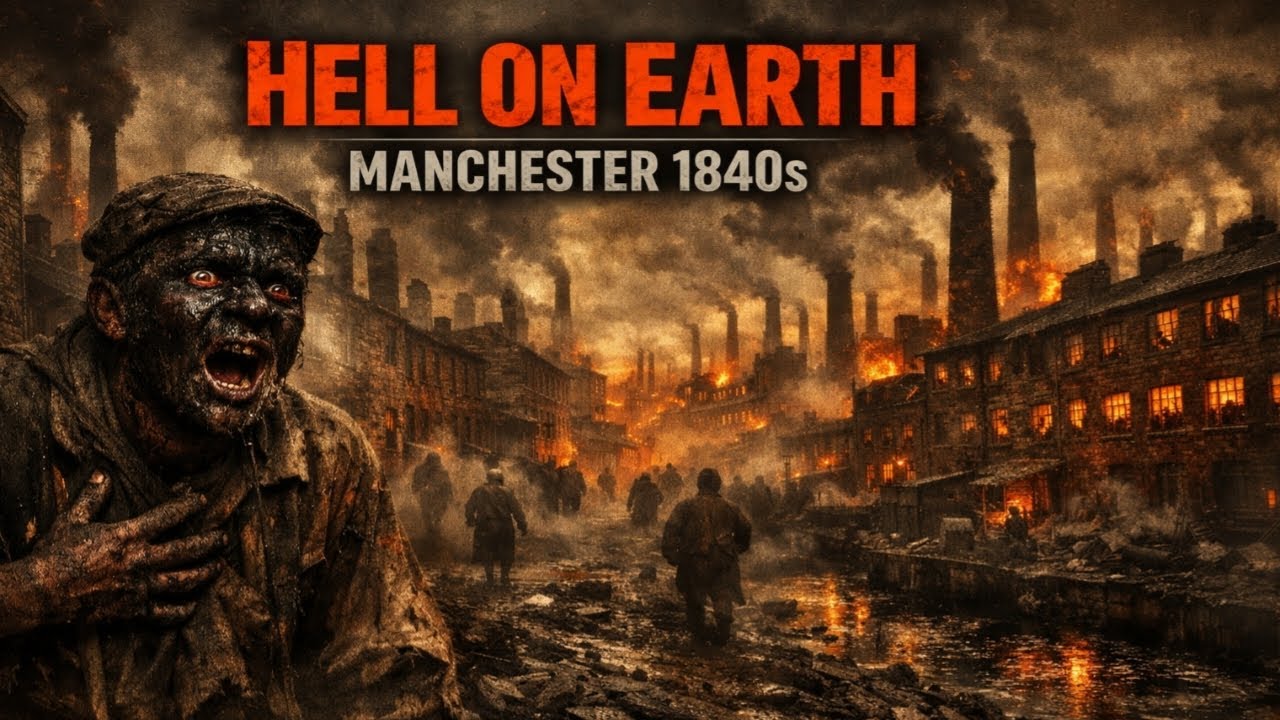
1840s Manchester Was Called HELL ON EARTH - Here's Why
Автор: The Gilded Shadows
Загружено: 2026-01-31
Просмотров: 2577
Описание:
Manchester, 1840s. The cotton capital of the world. The first industrial city. The birthplace of modern capitalism.
Friedrich Engels, who lived there from 1842-1844, called it "Hell upon Earth."
He wasn't exaggerating.
The air was so toxic you couldn't see across the street. The rivers ran black with industrial waste. Children as young as 5 worked 14-16 hour days in factories. The average working-class person died at age 17.
This is the complete story of what Manchester really looked like during the darkest decade of the Industrial Revolution—and why it was genuinely considered the worst city on Earth.
📚 PRIMARY HISTORICAL SOURCES:
• "The Condition of the Working Class in England" - Friedrich Engels (1844)
• "Report on the Sanitary Condition of the Labouring Population of Great Britain" - Edwin Chadwick (1842)
• Manchester Board of Health Reports (1831-1844)
• Factory Commission Reports and Worker Testimonies (1833, 1842)
• Medical Officer Reports from Manchester districts
• Census data and mortality statistics
• Kay-Shuttleworth's "The Moral and Physical Condition of the Working Classes" (1832)
• Parliamentary inquiries and commission testimonies
• Contemporary newspaper accounts (Manchester Guardian, etc.)
• Personal letters and diaries from workers and reformers
🏙️ MANCHESTER "COTTONOPOLIS" FACTS:
• Nickname origin: 85% of world's cotton processed in Manchester region
• Population explosion: 900% growth in 70 years (1772-1842)
• Factory count: Hundreds of cotton mills operating simultaneously
• Chimney forest: Visible for miles, creating permanent smog layer
• Economic output: Generated massive wealth (for factory owners)
• Global dominance: Controlled world cotton trade
• Worker exploitation: Foundation of economic success
• Friedrich Engels: Karl Marx's collaborator, lived in Manchester 1842-1844
• Reform catalyst: Conditions here sparked national factory reform movement
• Legacy: Led to Factory Acts limiting hours and child labor (1840s-1850s)
WHY "HELL ON EARTH"?
Friedrich Engels didn't use this phrase lightly. After 2 years investigating Manchester's working-class districts, he documented:
1. AIR: Coal smoke so thick you couldn't see buildings across streets
2. WATER: All rivers black with chemical waste, used for drinking water
3. HOUSING: Families of 10+ in single rooms, cellars flooded with sewage
4. DISEASE: Cholera, typhoid, tuberculosis killing thousands annually
5. CHILD LABOR: 5-year-olds working 14 hours in dangerous factories
6. MORTALITY: Children dying at rates higher than any previous era
7. ACCIDENTS: Daily factory deaths and maimings with no compensation
8. NO ESCAPE: Workers trapped by poverty, debt, and lack of alternatives
This wasn't hyperbole. It was accurate documentation of the world's first industrial city at its absolute worst.
🎓 RELATED DOCUMENTARIES:
• Industrial Revolution 1700s: Child Labor Hell
• Tower of London: Where Queens Were Beheaded
• Victorian London 1870s: Real Street Life
• 1700s London: What It Really Looked Like
💬 DISCUSSION QUESTIONS:
Was the Industrial Revolution's human cost justified by economic progress?
How does 1840s Manchester compare to modern pollution crises?
Could you have survived working 16 hours daily from age 6?
Why did it take so long for reforms to happen?
Are there modern parallels to this exploitation?
Share your thoughts in the comments!
📢 SUBSCRIBE for more unfiltered historical documentaries that reveal the dark truths behind "progress" and "civilization."
We don't romanticize history. We show what it was really like.
#Manchester1840s #IndustrialRevolution #HellOnEarth #FriedrichEngels #VictorianEngland #Cottonopolis #ChildLabor #IndustrialPollution #BritishHistory #HistoricalDocumentary #DarkHistory #WorkingClass #VictorianHistory #FactoryLife #HistoryChannel
manchester 1840s
industrial revolution
This documentary explores the hidden realities of life in the Victorian era — exposing the systems, routines, and unseen labor behind 19th-century society.
Through slow, cinematic narration and historically accurate detail, we examine what daily life was really like for ordinary people in Victorian England.
Subscribe for dark historical documentaries uncovering the truths history often hides.
you wouldnt survive victorian era
what life was really like
dark history facts
hidden truths history
history you were never taught
Повторяем попытку...
Доступные форматы для скачивания:
Скачать видео
-
Информация по загрузке: