Schubert: Entr’acte No. 2 from Rosamunde | London Symphony Orchestra & Sir John Eliot Gardiner
Автор: DW Classical Music
Загружено: 2026-01-07
Просмотров: 7194
Описание:
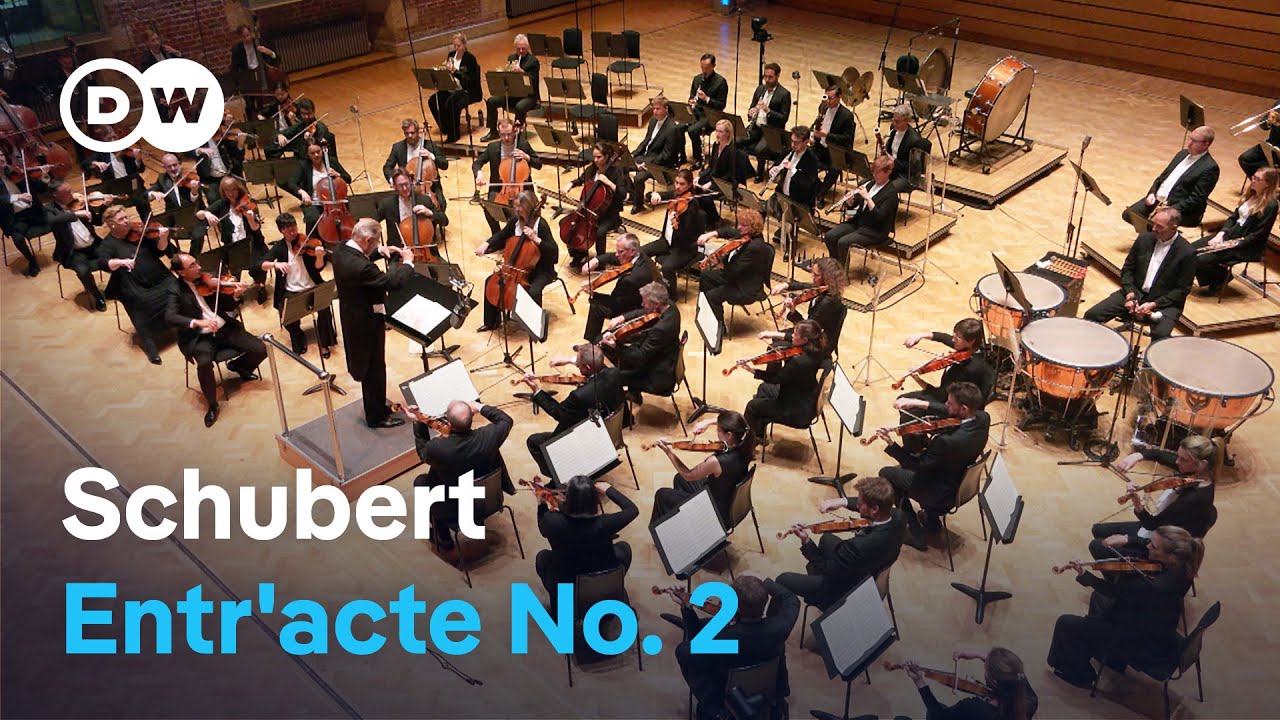
Franz Schubert's Entr'acte No. 2 in D major (D 797) for the play "Rosamunde, Princess of Cyprus," seems to hover between solemnity and darkness. This short intermezzo is performed by the London Symphony Orchestra conducted by Sir John Eliot Gardiner during a performance on July 5, 2022, at St Luke's Church in London.
It only took a few weeks for Franz Schubert (1797–1828) to compose the incidental music for "Rosamunde, Princess of Cyprus" in 1823. The libretto for this "great romantic spectacle with music," as it was described at the time, was written by amateur poet Helmina von Chézy (1783–1856). Despite some of his friends' reservations about setting Chézy's text to music, Schubert nonetheless accepted the commission. The premiere of Rosamunde took place on December 20, 1823, in Vienna, but was not well received by the audience and was removed from the program after the second performance. The flop was attributed exclusively to the text. Meanwhile, Schubert's music enjoyed popularity and was soon performed instrumentally in concert halls.
Schubert's incidental music to Rosamunde consists of ten individual pieces, preceded by an overture. The interlude No. 2 (Andante) consists of three parts. After a short introduction, the solemn main theme is first played by the woodwinds, repeated by the brass, and then repeated in different variations throughout the movement. The repetitions create an atmosphere of suspense until a section related to the introduction comes in at the end. The tension of the romantic intermezzo is created by the alternation between major and minor keys. Although the main key is D major, it repeatedly changes to minor.
The musical atmosphere emanating from Entr’acte No. 2 resembles the state of suspension that is characteristic of Schubert’s famous Symphony No. 8 in B minor, D 759, his so-called "Unfinished" symphony. To this day, it's not clear why the Romantic composer wrote only the first two movements of Symphony No. 8, without completing it. Composers and musicologists continue to attempt to complete Schubert's Eighth as a four-movement symphony. While doing so, they have often incorporated motives and themes from his incidental music for Rosamunde. American musicologist William Carragan (1937–2024), for example, used Entr'acte No. 2 as a slow introduction for his version of the fourth movement of Schubert's "Unfinished."
Text: Rita Kass
© 2022 C Major Entertainment
Watch more great concerts here: • LISTEN AND WATCH - your personal concert hall
and more famous pieces from the Romatic era here: • ROMANTIC MUSIC
Subscribe to DW Classical Music: / dwclassicalmusic
#schubert #interlude #romanticmusic
Повторяем попытку...
Доступные форматы для скачивания:
Скачать видео
-
Информация по загрузке: