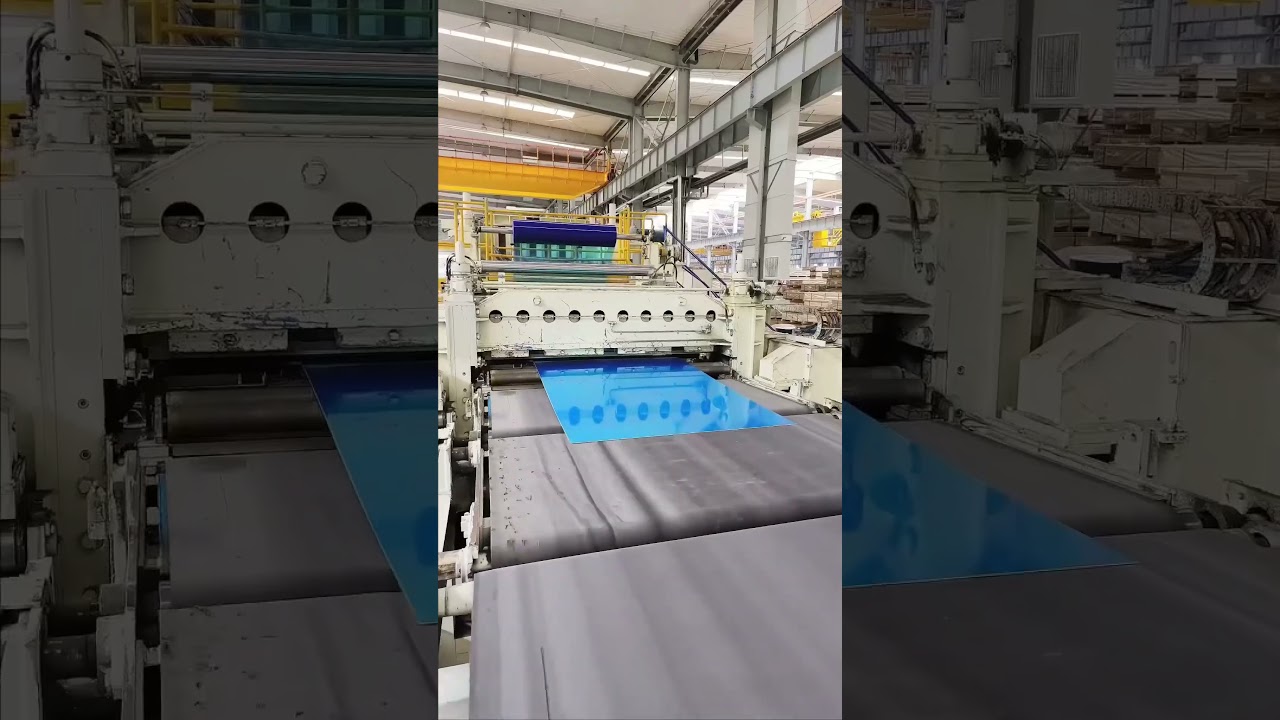
Aluminum Sheet Production Process 2025 | Behind the Scenes: From Molten Metal to Finished Sheets
Автор: Zhengxin Steel
Загружено: 2025-08-13
Просмотров: 1232
Описание:
🎥 Ever Wonder How Raw Aluminum Transforms into Sleek, High-Strength Sheets for Aerospace, Cars, and Construction? Tour Our Factory & Learn the 2025 Production Secrets!" 🎥
Whether you’re a metal fabricator, aerospace engineer, procurement manager, or DIY enthusiast, this video is your ultimate guide to aluminum sheet production—from molten metal to finished sheets ready for your projects. We’re taking you inside a state-of-the-art aluminum mill to break down every step of the aluminum rolling process, reveal quality control secrets, and explain why aluminum sheets dominate industries like aerospace, automotive, and architecture. Perfect for anyone sourcing premium aluminum sheets or curious about modern metal manufacturing!*
What You’ll Discover in This Video
🔧 Step 1: Raw Material Preparation – Molten Aluminum
Starting with high-purity aluminum ingots (99.7% purity) or recycled scrap (sourced sustainably!).
Key specs: Chemical composition (alloying elements like copper, magnesium, or silicon for strength/corrosion resistance).
Melting process: Charged into a furnace (700–750°C) and mixed to achieve target alloy grades (e.g., 1050, 3003, 5052, 6061).
🔧 Step 2: Casting – Solidifying into Ingots/Billets
Direct Chill (DC) Casting: Molten aluminum poured into water-cooled molds to form large ingots (up to 20 tons) or continuous billets.
Why DC casting? Produces dense, defect-free ingots with uniform grain structure (critical for rolling).
Alloy adjustments: Adding trace elements (e.g., titanium for grain refinement) during casting to enhance mechanical properties.
🔧 Step 3: Hot Rolling – Reducing Thickness at High Temperatures
The first rolling stage: Ingots heated to 450–500°C (above aluminum’s recrystallization temp) and passed through rolling mills.
Key parameters:
Reduction ratio: Up to 90% (e.g., 200mm ingot → 20mm slab).
Rolling speed: 500–1,000 m/min (modern mills for efficiency).
Outcome: Semi-finished “hot bands” (thickness: 10–20mm) with uniform microstructure.
🔧 Step 4: Cold Rolling – Precision Thickness & Surface Finish
Second rolling stage: Hot bands cooled to room temperature and further reduced to final thickness (0.1mm–6mm).
Lubrication: Oils/emulsions to reduce friction and prevent surface defects.
Tension control: Rollers apply tension to minimize waviness and ensure flatness (±0.3mm/m²).
Advanced tech: AI-driven thickness gauges adjust roll pressure in real-time for ±0.01mm precision.
🔧 Step 5: Annealing – Relieving Stress & Enhancing Ductility
Why anneal? Cold rolling hardens aluminum, making it brittle—we reverse this with controlled heating.
Process types:
Batch Annealing: Coils heated in bell furnaces (300–350°C) for 4–8 hours, then slow-cooled.
Continuous Annealing: Coils passed through a furnace at 10–20 m/min (faster, for high-volume production).
Result: Softened aluminum with improved formability (critical for stamping, bending, or deep drawing).
🔧 Step 6: Surface Treatment & Finishing
Cleaning: Removing rolling oils with alkaline solutions (pH 8–10) and rinsing.
Polishing/Brushing: For decorative sheets (e.g., architectural panels) to achieve matte, satin, or high-gloss finishes.
Coating (Optional): Anodizing (clear/anodic) for corrosion resistance or powder coating (PVDF/PE) for color (PANTONE-matched).
🔧 Step 7: Quality Control & Testing
Dimensional Checks: Thickness (laser micrometry), width (laser scanners), and length (encoders).
Mechanical Testing: Tensile strength (ASTM E8), yield strength, and elongation (compliance with ASTM B121, EN 485).
Surface Inspection: Automated vision systems to detect scratches, pits, or coating defects.
Certifications: ISO 9001, ASTM, EN 485—documented for every batch.
🔧 Step 8: Cutting, Coiling & Packaging
Slitting: Cutting wide coils into narrower strips (e.g., 1,500mm → 600mm) using rotary shears.
Recoiling: Rewinding strips into tight coils (tension-controlled to prevent deformation).
Protective packaging: Anti-corrosion paper, plastic film, or wooden pallets (for global shipping).
Why Aluminum Sheets Matter
✅ Lightweight: 1/3 the weight of steel with similar strength (reduces fuel/transport costs).
AluminumSheetProduction #AluminumRollingProcess #AluminumManufacturing #MetalFabrication #AerospaceAluminum #AutomotiveAluminum #ConstructionMaterials #IndustrialMetals #AluminumSheets #Manufacturing2025
Повторяем попытку...
Доступные форматы для скачивания:
Скачать видео
-
Информация по загрузке: