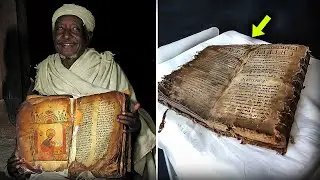
IS THE SHROUD OF TURIN IN THE ORIGINAL GREEK IN THE BIBLE? WITH DR RICHARD KENT, PART 2
Автор: Free Christian Teaching with Dr Richard Kent
Загружено: 2022-10-12
Просмотров: 423
Описание:
Timestamped summary
IS THE SHROUD OF TURIN IN THE ORIGINAL GREEK IN THE BIBLE? WITH DR RICHARD KENT, PART 2
• IS THE SHROUD OF TURIN IN THE ORIGINAL GRE...
The Shroud of Turin may be the authentic burial cloth of Jesus, supported by biblical references and historical evidence, and its implications for understanding the resurrection and early Christian beliefs.
• 🕊️
00:00 The video examines Dr. Richard Kent's research on the Shroud of Turin's potential biblical references and its implications for the resurrection of Jesus Christ. Collapse
• The program continues its exploration of the Shroud of Turin, focusing on whether it is mentioned in the Bible, with Dr. Richard Kent presenting his research on the topic.
• The discussion explores whether the Shroud of Turin is referenced in the Bible and its implications for the authenticity and scientific proof of the resurrection of Jesus Christ.
• 🧕
02:26 The video explores Lazarus's burial practices and their biblical significance, linking them to the Shroud of Turin and Paul's miracles with handkerchiefs. Collapse
• The discussion focuses on the details of Lazarus's burial, highlighting the use of grave clothes, including bandages and a face cloth, as described in John 11:43-44.
• Humans traditionally cover the face of the deceased out of respect, as seen in the biblical account of Lazarus and the preparations made for Jesus's burial.
• The discussion highlights references in Acts 19:11-12 about Paul performing miracles through handkerchiefs, connecting to the Shroud of Turin.
• 🧵
06:21 Debate surrounds Jesus' burial cloth, suggesting he was wrapped in a sudarium, while the Shroud of Turin and Shroud of Oviedo share identical blood stains, indicating a common origin. Collapse
• Debate exists over Jesus' burial cloth, with the original Greek text revealing that he was wrapped in a sudarium, a small piece of cloth, rather than bandages.
• The Shroud of Turin and the Shroud of Oviedo share identical blood stains and the rare blood type A B, indicating they originate from the same source.
• 🕊️
08:58 The Shroud of Turin's authenticity is bolstered by evidence suggesting it predates 1325 and aligns with biblical references to separate linen pieces for Jesus. Collapse
• The Shroud of Turin's history is unclear, but evidence suggests the 1325 date is incorrect, with the Shroud of Oviedo arriving in Spain around 680 AD.
• The Shroud of Turin's authenticity is supported by the existence of a second shroud, which aligns with biblical references to separate linen pieces used for Jesus's body and head.
• 🧵
11:02 The video explores Mark 15:46, emphasizing the term "sindon" for the large cloth wrapping Jesus' body, contrasting it with Lazarus' burial. Expand
•
14:50 Paul’s reference in Galatians 3:1 προεγράφη (proegraphē)
implies the Galatians may have seen a visual representation of Christ's crucifixion, possibly linking the Shroud of Turin to his missionary journeys. Collapse
• Galatians 3:1 suggests that Paul may be referring to a visual representation of Christ's crucifixion, as indicated by the Greek term " proegraphē," which implies something portrayed graphically before the Galatians.
• Paul may have carried a cloth depicting the crucifixion of Jesus, suggesting that the Galatians saw a visual representation rather than just hearing about it.
• The term proegraphē," suggests that the people in Galatia may have seen a literal image, possibly linking the Shroud to Paul's missionary journeys, despite differing interpretations among commentators.
• 🕊️
19:28 Paul's letter to the Galatians highlights that salvation is through faith in Christ's crucifixion, symbolized by the controversial Shroud of Turin, which some defend against claims of forgery. Collapse
• Paul's epistle to the Galatians addresses false teachings about salvation, emphasizing that justification comes through faith in Christ's crucifixion, which is also symbolized by the Shroud of Turin.
• The Shroud of Turin, depicting a crucified person, remains controversial with many believing it to be a fraud, though some argue its authenticity is unlikely to be the work of a medieval forger.
• 🕊️
21:35 Evidence indicates the Shroud of Turin may be the authentic burial cloth of Jesus, supported by biblical descriptions and first-century pollen analysis. Collapse
• Evidence suggests the Shroud of Turin may be linked to Christ's burial, as it aligns with descriptions in scripture of a large piece of cloth used for his burial.
• The Shroud of Turin, photographed in 1898, features unique photo negative elements and aligns with biblical accounts of Jesus being buried in a large piece of linen due to time constraints.
• Microscopic evidence of first-century pollen from Israel found on the Shroud of Turin supports its authenticity as dating to the time of Christ's crucifixion during Passover.
•
Повторяем попытку...

Доступные форматы для скачивания:
Скачать видео
-
Информация по загрузке: