Basic Metabolic pathways Unit I Lecture 1 with Shikimic Acid Pathway
Автор: Pick Pharma DXP
Загружено: 2025-02-27
Просмотров: 250
Описание:
UNIT-I 7 Hours
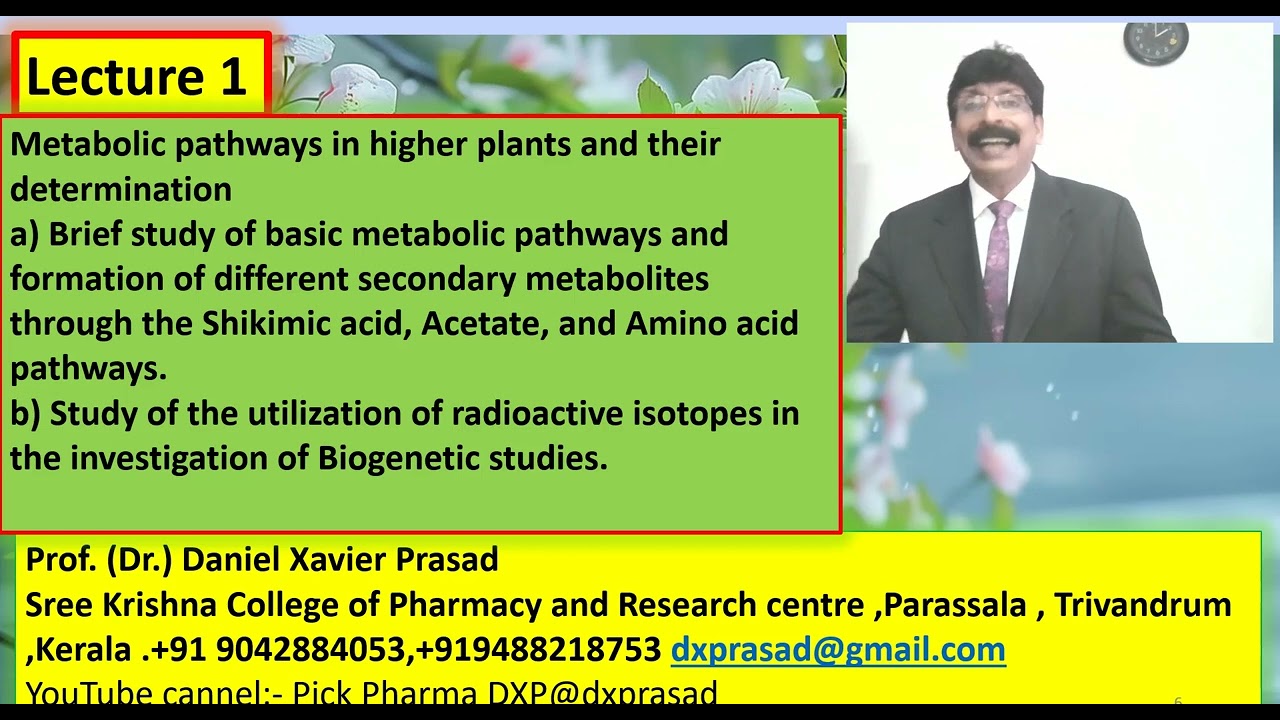
Metabolic pathways in higher plants and their determination
a) Brief study of basic metabolic pathways and formation of different secondary metabolites
through these pathways- Shikimic acid pathway, Acetate pathways and Amino acid pathway.
b) Study of utilization of radioactive isotopes in the investigation of Biogenetic studies.
Prof. (Dr.) Daniel Xavier Prasad
Sree Krishna College of Pharmacy and Research centre ,Parassala , Trivandrum ,Kerala .+91 9042884053,+919488218753 [email protected]
YouTube cannel:- Pick Pharma DXP@dxprasad
Past Kerala University of Health Science Questions since Jan 2020 In UNIT - I
1. Explain competitive feeding (2 marks) Jan 2021
2. Outline the Acetate pathway and explain its significance. (10 marks) Nov 2021
3. Explain the various tracer techniques in the investigation of biogenetic studies (10 marks) july 2022
4. Explain the Mevalonic acid pathway in the biosynthesis of terpenes. (5 marks) july 2022
5. Explain Autoradiography(2 marks) july 2022
6. Explain tracer technique. (5 marks) Dec 2023
7. Name any two basic metabolic pathways in the formation of plant secondary metabolites. (2 marks) Jan 2023
8. Name the different methods of feeding radio isotopes to plants in tracer technique. (2 marks) Jan 2023
9.Discuss briefly about the various tracer techniques used in investigation of biogenetic pathway studies. (10 marks) May 2023
10. Explain in detail the various techniques used in elucidation of biosynthetic pathways. (10 marks) Sep 2023
11. Elucidate Shikimic acid pathway. (5 marks) Sep 2023
12. Explain the acetate pathway and briefly mention the different secondary metabolites formed through this pathway. (10 marks) July 2024
13. Competitive feeding. (5 marks) July 2024
Metabolic pathways in higher plants and their determination
a) Brief study of basic metabolic pathways and formation of different secondary metabolites
through the Shikimic acid, Acetate, and Amino acid pathways.
b) Study of the utilization of radioactive isotopes in the investigation of Biogenetic studies.
Despite the extremely varied characteristics of living organisms, the pathways for generally modifying and synthesizing carbohydrates, proteins, fats, and nucleic acids are essentially the same in all organisms, apart from minor variations.
Kingdom Plantae
Kingdom Animalia
Kingdom Fungi
Kingdom Bacteria These processes demonstrate the fundamental unit of all living matter and are collectively described as primary metabolism, with the compounds involved in the pathways being termed primary metabolites...i.e
Necessary for basic survival of an organism
Used for energy and tissue construction
Includes most
carbohydrates,
amino acids and proteins,
lipids,
nucleic acids,
and some vitamins
& cofactors
Secondary MetabolitesAre assembled from (pieces of) primary metabolites
Are plentiful and diverse in plant-based foods
May be more prevalent or unique to certain genus, species, and similar compounds occur within genus and families
Often have vital functions in the source
attractants for propagation of species
defense against predators
signaling
May have useful nutritional benefits to humans/other organisms
The genes and enzymes guiding biosynthesis vary from one organism to the next.
Synthase: Joints two molecules together w/o hydrolyzing a pyrophosphate bond.
Dehydratase: Removes water to create a double bond
Dehydrogenase: Removes hydrogen atom from its substrate
Kinase: Transfer a phosphate group from a high-energy phosphate compound such as ATP to its substrate.
Aromatic amino acids phenylalanine and tyrosine
Indole, and indole derivatives and a.a.a tryptophan
Alkaloids
Phenylpropanoids,
flavonoids,
tannins, and lignins.3-deoxy-D-arabinoheptulosonate 7-phosphate (DAHP) synthase is the first enzyme in a series of metabolic reactions known as the shikimate pathway.
Since it is the first enzyme in the shikimate pathway, it controls the amount of carbon entering the pathway.
3-dehydroquinate synthase is the second enzyme of the shikimate pathway.
It catalyzes the elimination of phosphate from DAHP to generate 3-dehydroquinate (DHQ).
3-Dehydroquinate Dehydratase (DHQD) catalyzes the third step of the shikimate pathway, dehydration of 3-dehydroquinate to 3-dehydroshikimate.Shikimate-5-Dehydrogenase (SDH) The fourth step of the shikimate pathway is the reduction of DHS to shikimate. the reaction is catalyzed by an NADP-dependent shikimate dehydrogenase (SHD)Shikimate Kinase (SK)- In the fifth step of the shikimate pathway, shikimate kinase catalyzes the specific phosphorylation of the 3-hydroxyl group of D-shikimate to yield shikimate 3-phosphate using ATP as a co-5-Enolpyruvylshikimate 3-Phosphate Synthase (EPSPS) is the sixth enzyme of the shikimate pathway. It catalyzes the reversible formation of 5-enolpyruvyl-shikimate-3- phosphate (EPSP) from shikimate 3-phosphate and PEP.
Повторяем попытку...
Доступные форматы для скачивания:
Скачать видео
-
Информация по загрузке: