Peripheral Neuroanatomy, Human Anatomy, USMLE Step 1 - Full Vignette with Extended Explanations
Автор: EndlessMedical.Academy
Загружено: 2025-12-21
Просмотров: 5
Описание:
A 53-year-old man with a history of esophageal cancer treatment now presents with a weak, breathy voice and difficulty swallowing thin liquids. His physical exam shows abnormal voice quality but no signs of infection or mass. After normal cardiac and sleep studies, what clinical features and tests can help you distinguish the cause of his new hoarseness, especially after prior chemoradiation?
VIDEO INFO
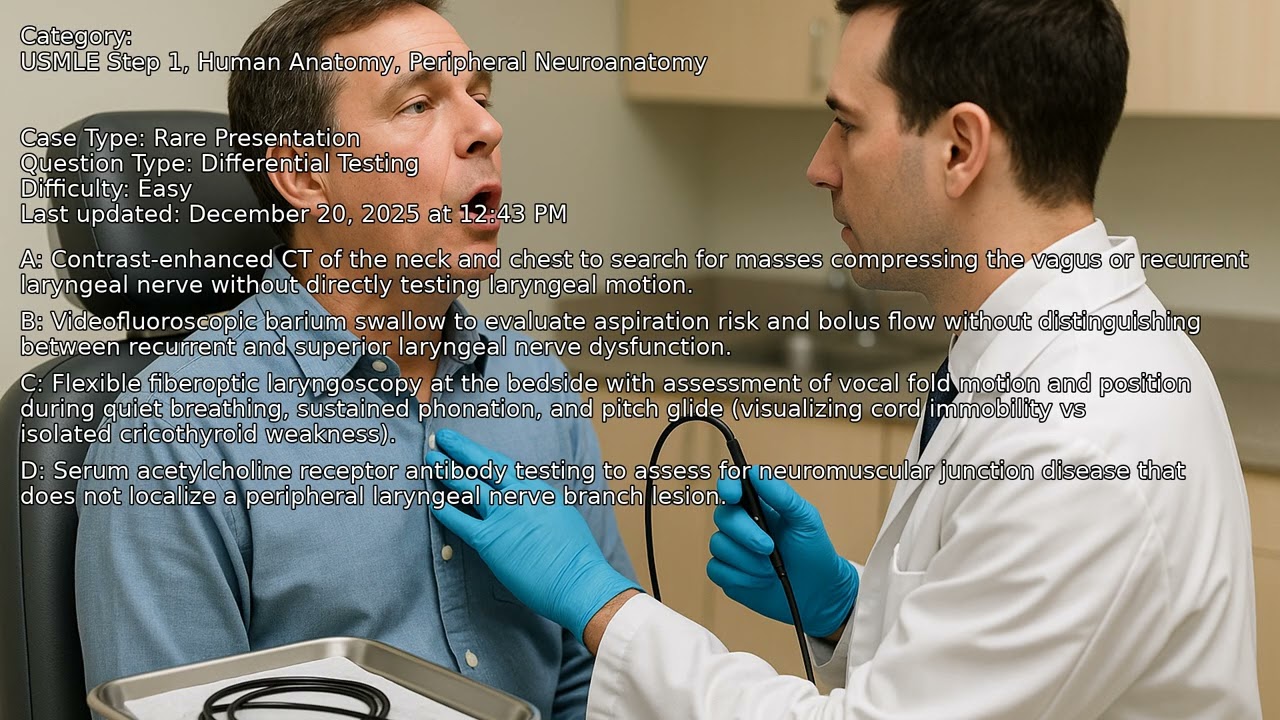
Category: Peripheral Neuroanatomy, Human Anatomy, USMLE Step 1
Difficulty: Easy - Basic level - Suitable for medical students
Question Type: Differential Testing
Case Type: Rare Presentation
Explore more ways to learn on this and other topics by going to https://endlessmedical.academy/auth?h...
QUESTION
A 53-year-old man presents to the clinic with 6 weeks of a rough, weak voice and coughing when drinking thin liquids. He denies fever or chest pain. He feels winded when walking fast but can do his daily tasks. On arrival, pulse is 144 beats/min, blood pressure 145/73 mm Hg, respiratory rate 22 breaths/min, temperature 36.1 degreesC, and oxygen saturation 98% on room air. He appears anxious but is speaking in full sentences. There is no stridor....
OPTIONS
A. Flexible fiberoptic laryngoscopy at the bedside with assessment of vocal fold motion and position during quiet breathing, sustained phonation, and pitch glide (visualizing cord immobility vs isolated cricothyroid weakness).
B. Contrast-enhanced CT of the neck and chest to search for masses compressing the vagus or recurrent laryngeal nerve without directly testing laryngeal motion.
C. Videofluoroscopic barium swallow to evaluate aspiration risk and bolus flow without distinguishing between recurrent and superior laryngeal nerve dysfunction.
D. Serum acetylcholine receptor antibody testing to assess for neuromuscular junction disease that does not localize a peripheral laryngeal nerve branch lesion.
CORRECT ANSWER
A. Flexible fiberoptic laryngoscopy at the bedside with assessment of vocal fold motion and position during quiet breathing, sustained phonation, and pitch glide (visualizing cord immobility vs isolated cricothyroid weakness).
EXPLANATION
Flexible fiberoptic laryngoscopy at the bedside with assessment of vocal fold motion and position during quiet breathing, sustained phonation, and pitch glide (visualizing cord immobility vs isolated cricothyroid weakness). This is the best single test right now because it directly shows how the vocal folds move and tense. Recurrent laryngeal nerve injury typically causes a breathy, weak voice, ineffective cough, and an immobile (often paramedian) cord with a glottic gap on phonation. External branch of the superior laryngeal nerve injury spares gross abduction-adduction but weakens the cricothyroid muscle, so the cords fail to lengthen/tension; patients struggle to raise pitch, and laryngoscopy shows preserved mobility with reduced longitudinal tension and bowing on high-pitch tasks. The 2018 American Academy of Otolaryngology-Head and Neck Surgery hoarseness guideline emphasizes prompt visualization in new or persistent dysphonia so that branch-level localization and early management can proceed.
Contrast imaging of the neck and chest, videofluoroscopic swallow studies, and antibody testing do not answer the specific localization question. Contrast-enhanced CT may later be helpful if laryngoscopy demonstrates paralysis to search for a structural cause along the vagus/recurrent laryngeal course, but by itself it cannot differentiate recurrent laryngeal nerve paralysis from isolated cricothyroid weakness....
---------------------------------------------------
Our cases and questions come from the https://EndlessMedical.Academy quiz engine - multi-model platform. Each question and explanation is forged by consensus between multiple top AI models (GPT, Claude, Grok, etc.), with automated web searches for the latest research and verified references. Calculations (e.g. eGFR, dosages) are checked via code execution to eliminate errors, and all references are reviewed by several AIs to minimize hallucinations.
Important note: This material is entirely AI-generated and has not been verified by human experts; despite stringent consensus checks, perfect accuracy cannot be guaranteed. Exercise caution - always corroborate the content with trusted references or qualified professionals, and never apply information from this book to patient care or clinical decisions without independent verification.
Clinicians already rely on AI and online tools - myself included - so treat this book as an additional focused aid, not a replacement for proper medical education. Visit https://endlessmedical.academy for more AI-supported resources and cases.
This material can not be treated as medical advice. May contain errors.
---------------------------------------------------
Повторяем попытку...
Доступные форматы для скачивания:
Скачать видео
-
Информация по загрузке: