Gram positive and gram negative bacteria | part 3
Автор: Monika Pal
Загружено: 2021-11-01
Просмотров: 88
Описание:
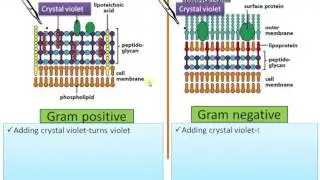
Gram-positive bacteria have a thick peptidoglycan layer and no outer lipid membrane whilst Gram-negative bacteria have a thin peptidoglycan layer and have an outer lipid membrane. The gram-positive bacteria retain the crystal violet colour and stains purple whereas the gram-negative bacteria lose crystal violet and stain red. Thus, the two types of bacteria are distinguished by gram staining.
Gram-negative bacteria are more resistant against antibodies because their cell wall is impenetrable. Gram-positive and gram-negative bacteria are classified based on their ability to hold the gram stain. The gram-negative bacteria are stained by a counterstain such as safranin, and they are de-stained because of the alcohol wash. Hence under a microscope, they are noticeably pink in colour. Gram-positive bacteria, on the other hand, retains the gram stain and show a visible violet colour upon the application of mordant (iodine) and ethanol (alcohol).
Gram-positive bacteria constitute a cell wall, which is mainly composed of multiple layers of peptidoglycan that forms a rigid and thick structure. Its cell wall additionally has teichoic acids and phosphate. The teichoic acids present in the gram-positive bacteria are of two types – the lipoteichoic acid and the teichoic wall acid. The cell wall is known as murein. As Gram-positive bacteria lack an outer lipid membrane, when correctly referring to their structure rather than staining properties, are termed monograms. The outer lipid membrane possessed by Gram-negative bacteria means that, when referring to their physical structure, they are termed sidearms.#upsc # bacteria gram negative and gram positive # upsc botany optional
Повторяем попытку...

Доступные форматы для скачивания:
Скачать видео
-
Информация по загрузке: