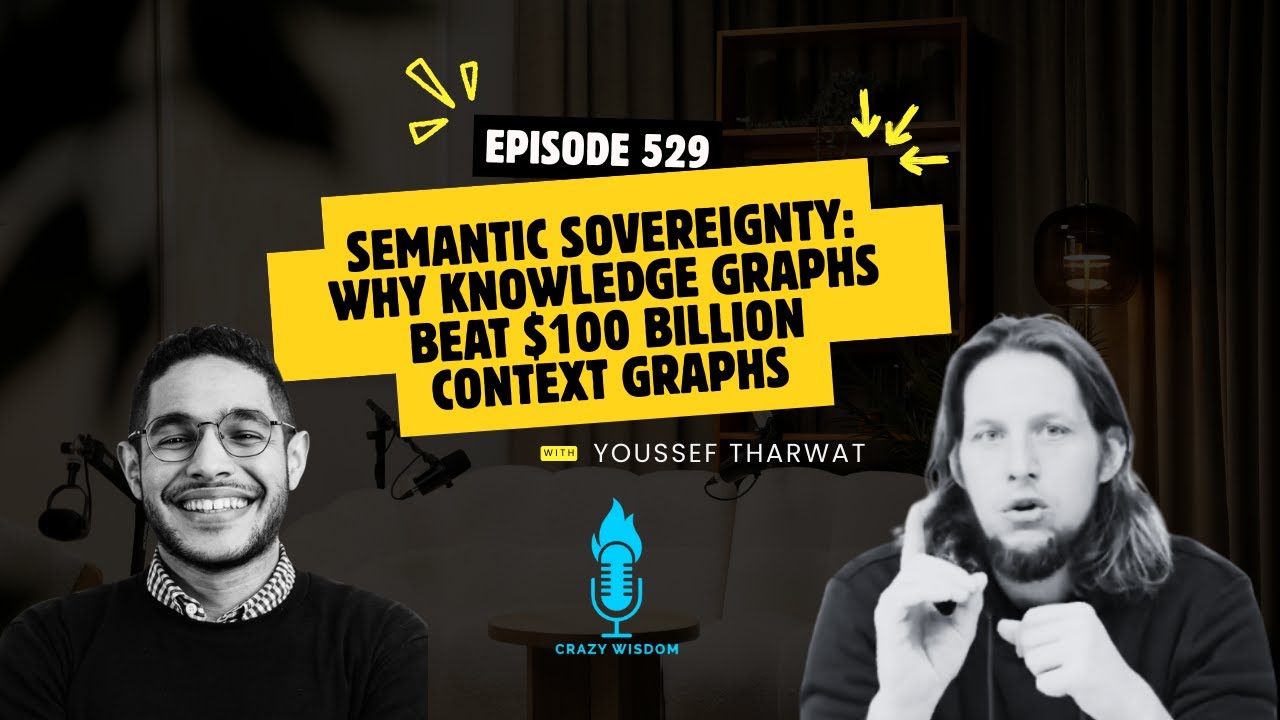
Episode
Автор: Crazy Wisdom
Загружено: 2026-02-06
Просмотров: 25
Описание:
In this episode of the Crazy Wisdom Podcast, host Stewart Alsop explores the complex world of context and knowledge graphs with guest Youssef Tharwat, the founder of NoodlBox who is building dot get for context. Their conversation spans from the philosophical nature of context and its crucial role in AI development, to the technical challenges of creating deterministic tools for software development. Tharwat explains how his product creates portable, versionable knowledge graphs from code repositories, leveraging the semantic relationships already present in programming languages to provide agents with better contextual understanding. They discuss the limitations of large context windows, the advantages of Rust for AI-assisted development, the recent Claude/Bun acquisition, and the broader geopolitical implications of the AI race between big tech companies and open-source alternatives. The conversation also touches on the sustainability of current AI business models and the potential for more efficient, locally-run solutions to challenge the dominance of compute-heavy approaches.
For more information about NoodlBox and to join the beta, visit https://noodlbox.io/
Timestamps
00:00 Stewart introduces Youssef Tharwat, founder of NoodlBox, building context management tools for programming
05:00 Context as relevant information for reasoning; importance when hitting coding barriers
10:00 Knowledge graphs enable semantic traversal through meaning vs keywords/files
15:00 Deterministic vs probabilistic systems; why critical applications need 100% reliability
20:00 CLI tool makes knowledge graphs portable, versionable artifacts with code repos
25:00 Compiler front-ends, syntax trees, and Rust's superior feedback for AI-assisted coding
30:00 Claude's Bun acquisition signals potential shift toward runtime compilation and graph-based context
35:00 Open source vs proprietary models; user frustration with rate limits and subscription tactics
40:00 Singularity path vs distributed sovereignty of developers building alternative architectures
45:00 Global economics and why brute force compute isn't sustainable worldwide
50:00 Corporate inefficiencies vs independent engineering; changing workplace dynamics
55:00 February open beta for NoodlBox.io; vision for new development tool standards
Key Insights
1. Context is information needed for correct reasoning - Quality context comes from relevant information at the right time, not just massive amounts of data dumped into large context windows.
2. Code has natural semantic boundaries - Unlike other domains, code already contains inherent relationships (functions calling functions, imports, etc.) that can be modeled without LLMs creating the structure.
3. Larger context windows don't scale effectively - Both LLMs and humans have cognitive limits; quality degrades with more information, making semantic separation the optimal search approach.
4. Knowledge graphs enable portable, versionable context - Making context an artifact that travels with repos allows sharing and tracking conceptual changes over time, like Git for meaning.
5. Rust provides superior LLM feedback loops - The compiler's explicit, picky nature creates constant feedback that helps LLMs write better code compared to more permissive languages.
6. Deterministic tooling remains essential for software - Despite AI advances, critical systems still need 100% reliability, which probabilistic models can't guarantee for production environments.
7. The "rest of the world" will drive innovation - High subscription costs ($200-300/month) exclude most global developers, creating pressure for efficient, local alternatives to dominate over brute-force scaling.
Повторяем попытку...
Доступные форматы для скачивания:
Скачать видео
-
Информация по загрузке: