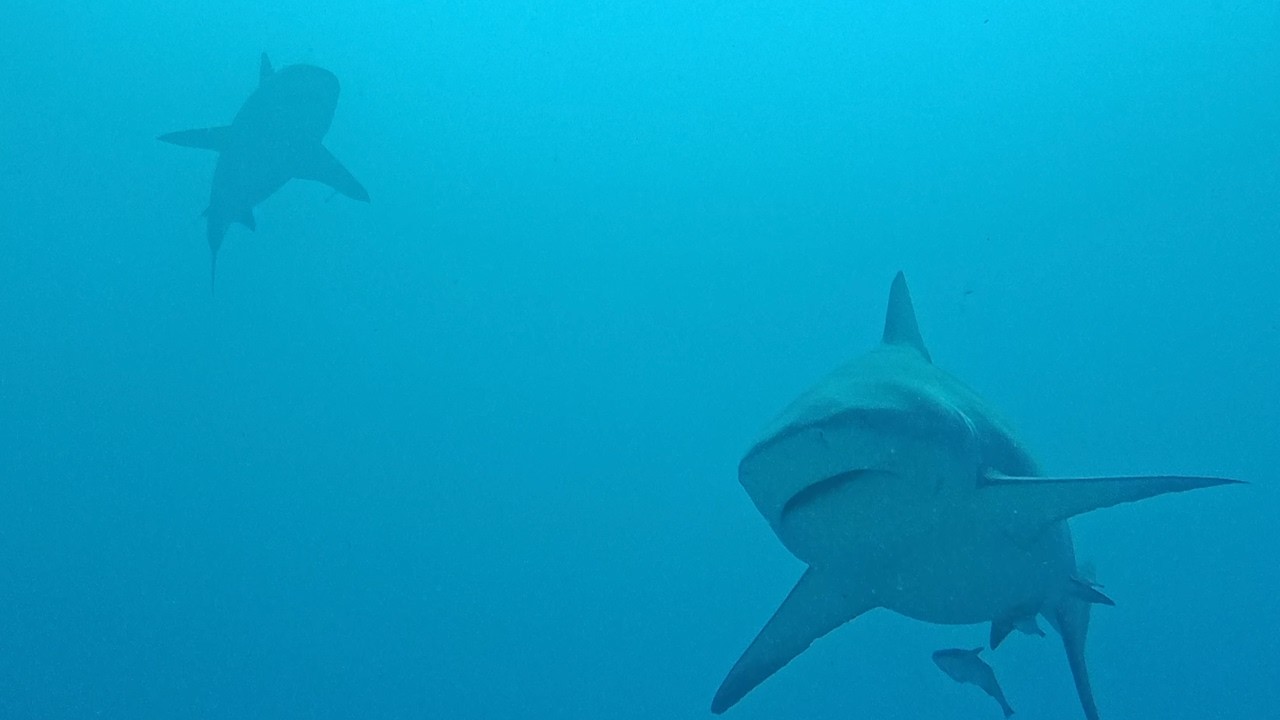
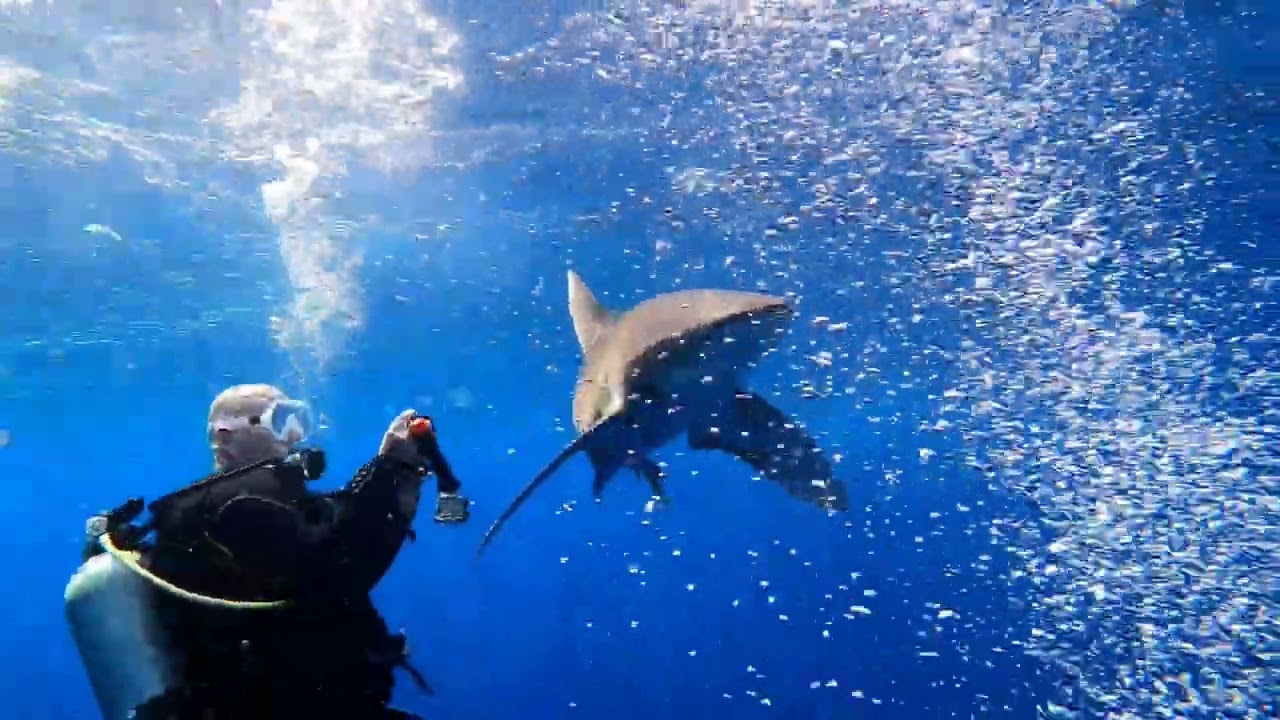
2 oceanic whitetip sharks testing me Daedalus Reef, Red Sea, Egypt 2/11-2020.
Автор: travellingdane
Загружено: 2023-11-15
Просмотров: 13046
Описание:
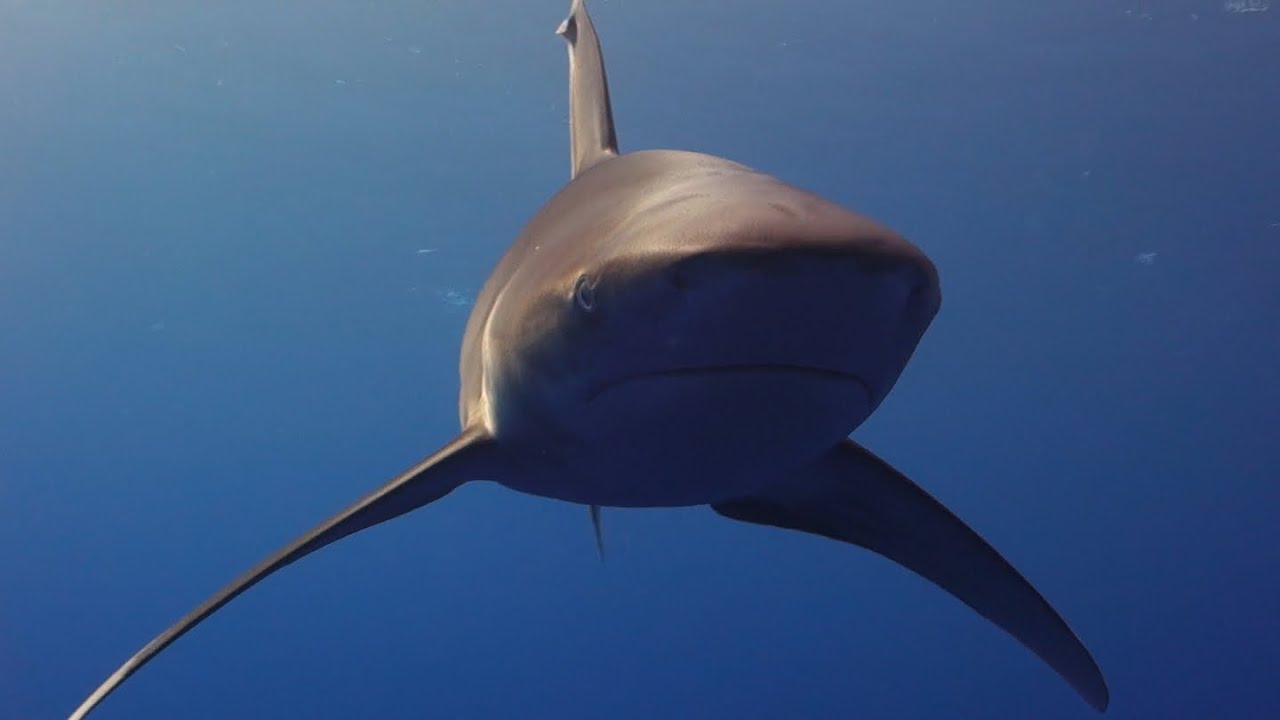
2 oceanic whitetip sharks ( Carcharhinus longimanus ) testing me and checking me out Daedalus Reef, Red Sea, Egypt 2/11-2020.
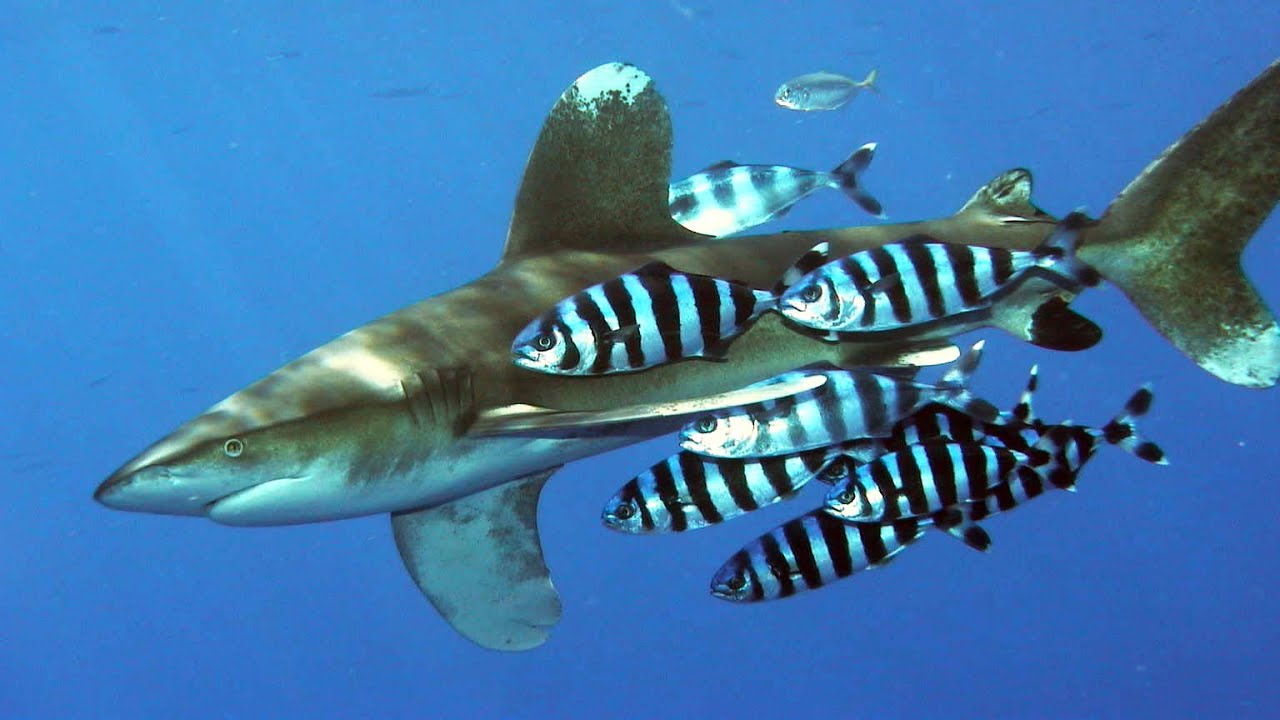
You can clearly see why this species of shark has the latin suffix 'longimanus' which means 'long hands'...its pectoral fins are huge in comparison to its body...this makes for a very agile shark that can maneuver and with ease turn fast and tight.
That day on the South Plateau at Daedalus Reef me and my 2 dive buddies documented a minimum of 10 different individual oceanic whitetip sharks underneath the moored liveaboard boats.
The pectoral fins, the first dorsal fin and also the caudal fin of the oceanic whitetip shark have a distinct and permanent white/light grey pattern that is unique to the individual shark.
Thus by photographing ie the pectoral fins or the first dorsal fin you can identify each individual shark and thus per photo identification track the individual shark over time and range.
Oceanic whitetip shark season in the Egyptian Red Sea is roughly each year May to January.
This particular 2020 oceanic whitetip season in the Egyptian Red Sea was characterized by the oceanic whitetip sharks being somewhat frisky.
In usual seasons the oceanic whitetip sharks come over to you one shark at a time, do 1-2 rounds around you to check you out and then leave you.
But this 2020 season the oceanic whitetip were much more bold and at times it was hard getting rid of their attention. Also they often came over to you in groups of 2-4 sharks at one time.
I believe perhaps the 2020 season was a poor feeding season for the oceanic whitetip sharks in the Red Sea meaning that they had trouble finding enough to eat. Therefore they were extra attentive to any possible food source in the water - also us divers that perhaps somewhat resemble a sick and not very mobile marine animal (like a sick dolphin). The oceanic whitetip shark does seem to have a tendency to preferring sick, immobile prey or carcasses - which of course makes sense as these kinds of food are easy and don't fight back with risk to the shark itself getting severely injured.
So the 2020 season when diving with the oceanic whitetip sharks it was very important to remember to have spatial awareness - especially as sometimes you could have 2-3 oceanic whitetip circling you and not wanting to leave you alone. Therefore my individual videos from that season are perhaps not my best videos - i do have a little mirror on my left arm next to my dive computer to sometimes check what is behind me, but I also often had to turn my head around and away from my camera screen to see if a shark was coming from behind. It was good to dive together with my 2 dive buddies, so that we could keep an eye out for sharks approaching our dive buddies from behind.
One thing that is always challenging when there are oceanic whitetips around is getting back into the zodiac or up on the boat: the oceanic whitetip sharks always seem most keenly interested in stuff splashing around near the surface - probably as that most resembles the behaviour of an injured or sick marine animal (no healthy fish or healthy dolphin usually splashes around in semi-immobile state at the surface).
Though all in all I still find bull sharks more potentially dangerous than oceanic whitetip sharks.
The reason being that oceanic whitetip sharks frequent open ocean waters with good visibility.
Whereas bull sharks often are found in shallow, murky and even brackish water: I can clearly see that bull sharks swimming along the coast or up murky rivers can be a danger to many poor African or Asian fishermen who often stand fishing in the shallow, murky coastal or riverine waters.
Повторяем попытку...
Доступные форматы для скачивания:
Скачать видео
-
Информация по загрузке: