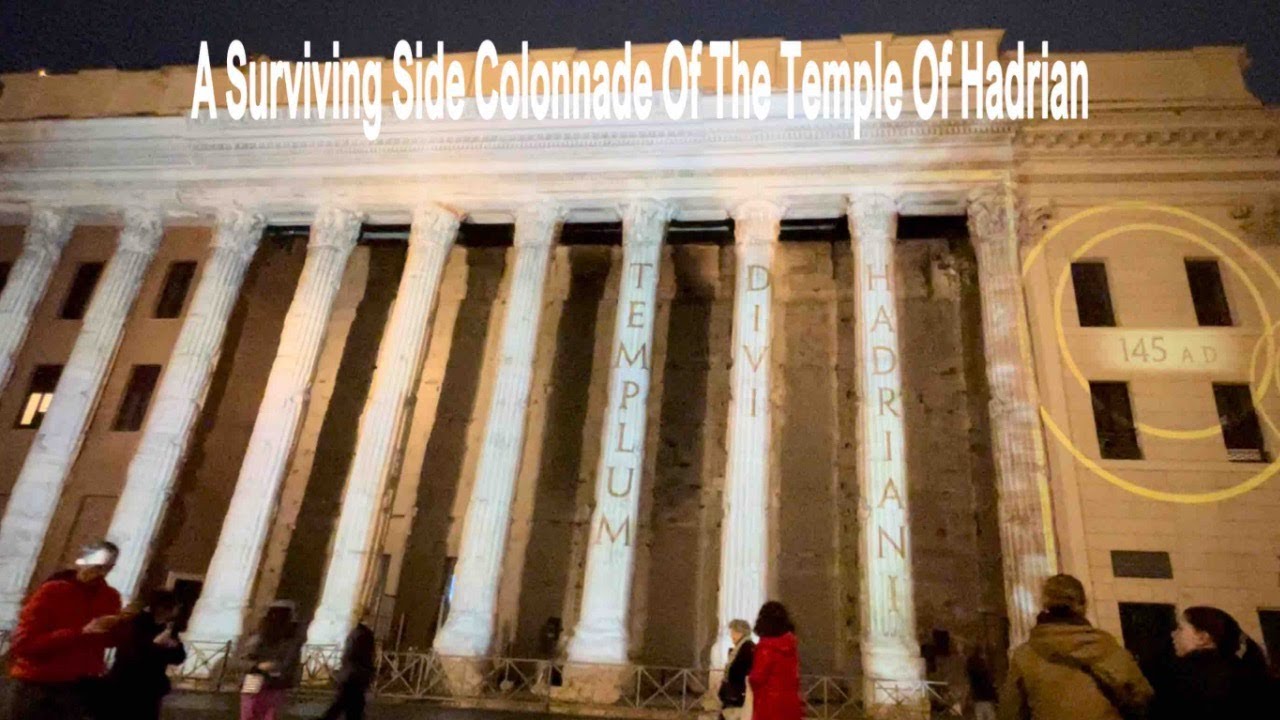
A Surviving Side Colonnade Of The Temple Of Hadrian
Автор: CLAVA world travel
Загружено: 2025-04-02
Просмотров: 401
Описание:
Join this channel to get access to perks:
/ @clavaworldtravel5582
Piazza Colonna is a piazza at the center of the Rione of Colonna in the historic heart of Rome, Italy. It is named for the marble Column of Marcus Aurelius, which has stood there since AD 193.
The Column of Marcus Aurelius is a Roman victory column located in Piazza Colonna, Rome, Italy. A Doric column adorned with a detailed spiral relief, it was built in honor of Roman emperor Marcus Aurelius and modeled after Trajan's Column. Dedicated to the emperor and his military campaigns during the Barbarian Wars, the monument stands as a testament to his reign from 161 to 180 AD. Although few primary sources from his time directly reference the column, many of his documented military deeds are illustrated in its reliefs. The monument was erected to honor Aurelius's memory and designed with grandeur to commemorate his accomplishments. The column's frieze, approximately 367 feet (112 meters) long, spirals upward 21 times, depicting the emperor’s campaigns against the Germanic and Sarmatian tribes. The Romans referred to the wars north of the Danube as Bellum Germanicum or bellum Marcomannicum. The column most likely served a dual purpose: celebrating Aurelius's military achievements and possibly serving as his funerary monument. Its construction likely began after his death in 180 AD and was completed around 193 AD, under the reign of Septimius Severus.
The Obelisk of Montecitorio also known as Solare, is an ancient Egyptian, red granite obelisk of Psamtik II (595–589 BC) from Heliopolis. Brought to Rome with the Flaminio Obelisk in 10 BC by the Roman Emperor Augustus to be used as the gnomon of the Solarium Augusti, it is now in the Piazza Montecitorio. It is 21.79 metres (71 ft) high and 33.97 metres (111 ft) including the base and the globe.
The Temple of Hadrian (Templum Divus Hadrianus, also Hadrianeum) is an ancient Roman structure on the Campus Martius in Rome, Italy, dedicated to the deified emperor Hadrian by his adoptive son and successor Antoninus Pius in 145 CE. This temple was previously known as the Basilica of Neptune but has since been properly attributed as the Temple of Hadrian completed under Antoninus Pius. With one cella wall and eleven columns from the external colonnade surviving, the remains of the temple have been incorporated into a later building in the Piazza di Pietra (Piazza of Stone – derived from use of the temple's stones to build the piazza), whereby its facade, alongside the architrave which was reconstructed later on, was incorporated into a 17th-century papal palace by Carlo Fontana, now occupied by Rome's Chamber of commerce. While only part of the structure remains, excavations and scholarship have provided us with information regarding its construction techniques and stylistic influences, helping us recreate the building dynamics and significance of the Temple of Hadrian in Imperial Rome.
Remains
Long ago both ends of the temple, as well as the other side, disappeared; all that remains are eleven fluted columns with Corinthian bases and capitals, as well as one side of the cella wall which was built into a nineteenth century palazzo that continues to house the Rome Borsa.
While the lower part of the original richly carved entablature survives, the rest was recorded in sixteenth-century drawings. In modern times, the entablature was largely repaired in stucco with the cornice so poorly restored that three different versions exist with only the central one resembling the original.
Traces of vaulting beneath the front steps also demonstrate that the temple originally faced East (towards the Corso) and likely had eight columns across the front, with thirteen down either side of the structure. These traces also consist of surviving remains of clamps which suggest pilasters were joined to the colonnade.
#Temple #Hadrian #Hadrianus #Colonnade #Surviving #Marcus Aurelius #Obelisk of Montecitorio
Повторяем попытку...
Доступные форматы для скачивания:
Скачать видео
-
Информация по загрузке: