Tunable Assembly of Cephalopod Reflectin Proteins
Автор: Rob Levenson
Загружено: 2020-05-01
Просмотров: 174
Описание:
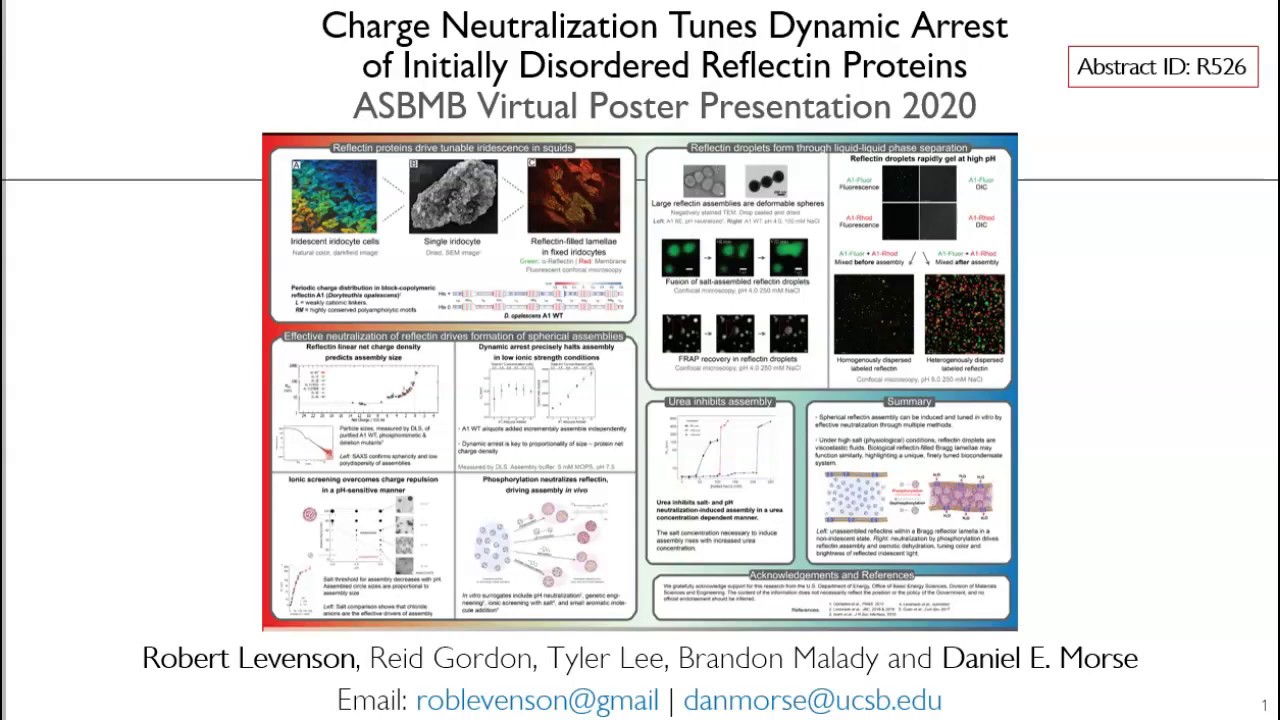
ASBMB 2020 Virtual Poster Presentation
Abstract ID: R526
Title: Charge Neutralization Tunes Dynamic Arrest of Initially Disordered Reflectin Proteins
Authors: Robert Levenson, Reid Gordon, Tyler Lee, Brandon Malady, and Daniel E. Morse
Contact:
Rob Levenson: roblevenson(AT)gmail(dot)com
Daniel E. Morse: d_morse(AT)lifesci(dot)ucsb(dot)edu
Check out our 2019 JBC paper: https://www.jbc.org/content/294/45/16804
Abstract: The intrinsically disordered reflectin proteins fill the reflective Bragg lamellae of iridescent cells in squid. In vivo, phosphorylation of the cationic reflectins leads to protein condensation and hierarchical assembly, driving osmotic dehydration of the lamellae and causing enhancement of intensity and tuning of the color of reflected light. In vitro, purified monomeric reflectin protein can be driven to cyclably and tunably assemble by pH-neutralization or addition of salt, forming spheres of low polydispersity and reproducible size. Analysis of reflectin assembly by dynamic light scattering, x-ray scattering, and transmission electron microscopy shows that the calibration between charge-neutralization and assembly size is enabled by the rapid dynamic arrest of particle growth, as controlled by an electrostatic switch spatially distributed across the reflectin chain. Confocal microscopy of fluorescently labeled micron-sized reflectin assemblies shows that they exhibit internal dynamics that rapidly slow following assembly, suggesting that assembly occurs through a transient liquid-liquid phase separation that undergoes gelation to form stable protein-dense condensates. Electron paramagnetic resonance (EPR) analysis shows the initially disordered reflectin monomers form ordered secondary structure that may be critical in the arrest of growth and stabilization of particles. These results provide new insights into the assembly of these unique intrinsically disordered proteins and the biophotonic systems they form, and suggest pathways for the creation of novel tunable biomaterials.
Повторяем попытку...
Доступные форматы для скачивания:
Скачать видео
-
Информация по загрузке: