BSNL Indoor Coverage Explained: 700 vs 2100 MHz, SINR, Path Loss & Antenna Tuning
Автор: Parag Kar
Загружено: 2025-08-21
Просмотров: 3426
Описание:
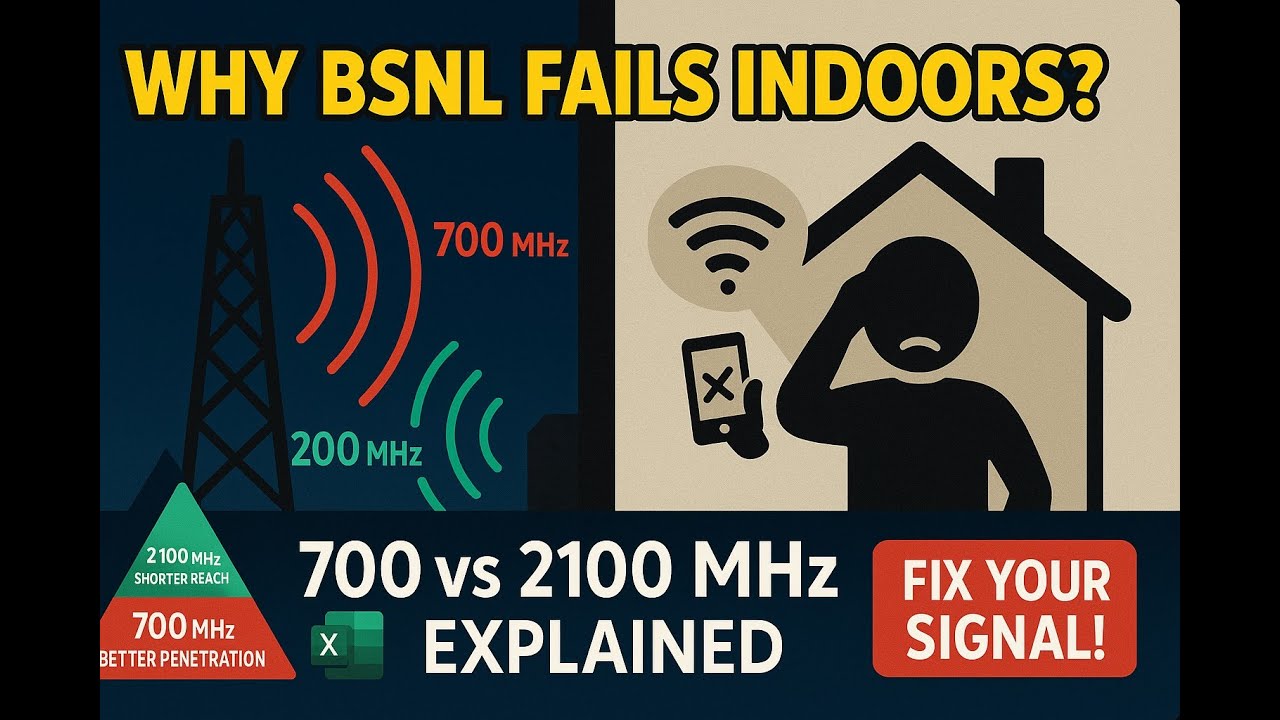
Why does BSNL’s signal collapse the moment you step behind a wall? In this simple, non-mathy explainer, I use BSNL’s spectrum pyramid and a live Excel RF model to show how frequency, antenna gain, body/wall losses, noise figure, and SINR (with interference) decide your real coverage and speeds—especially indoors.
What you’ll learn
BSNL spectrum stack (3500/2500/2100/900/700 MHz) and what each band is used for
700 MHz vs 2100 MHz: reach vs bandwidth trade-offs
Why coverage is often uplink-limited (UE→BTS) even if downlink looks fine
Path loss exponent, thermal noise (kTB), noise figure—without scary equations
How wall/body penetration and antenna tilt/gain can make or break indoor signal
Why mis-tuned sites + thin 2100 MHz carriers = “no 4G/3G/2G” indoors
Chapters
00:00 Intro & the viewer’s complaint
01:24 BSNL spectrum pyramid (bands, bandwidths)
02:35 The Excel model (BTS→UE vs UE→BTS)
05:22 Noise 101: thermal noise (kTB) & noise figure
07:56 SINR (with interference) and spectral efficiency
10:37 Path loss exponent (free-space vs real-world)
11:54 Body/wall penetration losses (indoor vs outdoor)
15:10 Throughput math (keeping it layman-friendly)
16:59 Uplink limits: handset power & antenna gain
18:18 Why coverage is set by UE→BTS, not BTS→UE
19:47 Antenna tilt/gain/config—how bad tuning ruins indoors
21:00 Wrap-up & what to check/fix
If you found this useful, hit Like, Subscribe, and drop your questions—I’ll pick them up in the next video.
#BSNL #TelecomIndia #IndoorCoverage #4G #5G #700MHz #2100MHz #SINR #PathLoss #AntennaGain #NoiseFigure #RFEngineering #LTE #NR #Uplink #Downlink #NetworkPlanning #QoS #MobileNetworks #IndiaTelecom
Повторяем попытку...
Доступные форматы для скачивания:
Скачать видео
-
Информация по загрузке: