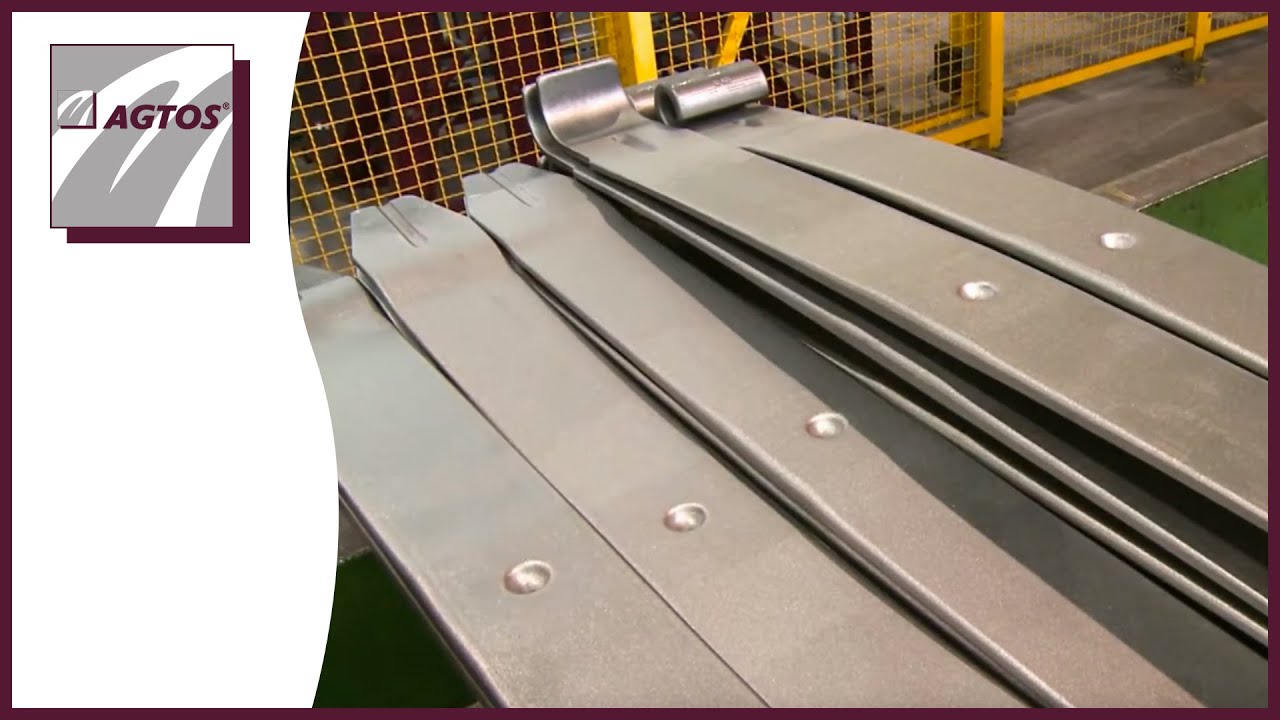
Leaf spring heating treatment +quenching+ shot peening-WONDEE Autoparts 23-July 2020
Автор: WONDEE Autoparts
Загружено: 2020-07-22
Просмотров: 1796
Описание:
Find us : www.wondeeauto.com Email: [email protected]
Quenching is a heat treatment process in which the leaf spring is heated to above the critical temperature, kept for a certain period of time, and then cooled at a rate greater than the critical cooling rate to obtain an imbalanced structure dominated by martensite. Quenching is the most widely used process method in the heat treatment of steel plates.
The purpose of quenching is to transform the supercooled austenite into martensite or bainite to obtain a martensite or bainite structure, and then cooperate with tempering at different temperatures to greatly improve the rigidity, hardness and wear resistance of the steel Performance, fatigue strength and toughness, etc., so as to meet the different use requirements of various mechanical parts and tools.
Tempering: In order to reduce the brittleness of steel parts, the quenched steel parts are kept at an appropriate temperature higher than room temperature and lower than 710℃ for a long time, and then cooled. This process is called tempering.
Tempering is immediately after the quenching process. The quenched leaf spring should be tempered in time, and the time outside the furnace should not exceed 24 hours. The quenched steel is heated to below the austenite transformation temperature, kept for 1 to 2 hours and then cooled. It is the last process of heat treatment.
After tempering, the structure of steel tends to be stable, the brittleness of quenched steel is reduced, toughness and plasticity are improved, quenching stress is eliminated or reduced, the shape and size of steel are stabilized, and the deformation and cracking of quenched parts are prevented. High temperature tempering can also improve cutting processing performance.
Shot peening:
Shot peening is a process in which high-speed steel shots are hit on the concave surface of the spring sheet to cause plastic deformation on the surface of the blade to form a hardened layer with a certain thickness.
The purpose of shot peening: to generate sufficient residual compressive stress on the tensile surface of the reed, reduce the tensile stress on the blade surface caused by the working load, thereby improving the fatigue strength of the spring. In addition, shot peening produces a hardened layer of about 0.25mm on the shot surface of the spring sheet, which can eliminate or improve or passivate the surface defects of the spring sheet, thereby also improving the fatigue life.
There are generally two ways of shot peening:
Free shot peening (shot peening with the reed in a free state); fatigue life can be increased by 1.66 times
Stress shot peening (shot peening where the tensioned surface of the reed is under tensile stress); fatigue life can be increased by 2 to 7 times compared with free shot peening.
Leaf springs are generally shot peened on one side, and shot peened on the stretched surface.
WONDEE Autoparts Leaf Spring Series include : conventional spring, parabolic spring, semi-trailer spring, trailer spring, pickup spring, boat trailer spring, truck spring, agricultural vehicle spring, sprung drawbar, air linker, TRA spring, OEM spring etc, Loose spring, and steel flat bar for springs;
Повторяем попытку...

Доступные форматы для скачивания:
Скачать видео
-
Информация по загрузке: