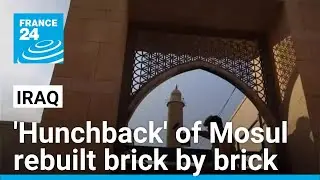
Reconstruction of ancient minaret destroyed by IS
Автор: AP Archive
Загружено: 2019-12-02
Просмотров: 797
Описание:
(27 Nov 2019) LEAD IN:
The Great Mosque of Al Nouri in Mosul was a 12th century monument famous for its leaning minaret - but was destroyed by the Islamic State group.
But more than two years after the militants inflicted the damage, the mosque is being brought back to life.
STORY-LINE:
This is all that is left of the iconic leaning minaret in Mosul known by the nickname of al-Hadba or "the hunchback".
In June 2017, right before its defeat, the Islamic State group destroyed Al Nouri mosque and its minaret.
Now, more than two years later, the reconstruction of the mosque, which is also known as Mosul's Great Mosque, has finally begun.
"UNESCO is now performing the works for the implementation of the safety measures for the minaret and the mosque of Al Nouri, and the minaret of al Hadba is one of the most important sign and icons of the city of Mosul," says Stefano De Vito, UNESCO supervisor of safety mission implementation of the site.
An important historical site, this is also where IS leader Abu Bakr al-Baghdadi declared a so-called Islamic caliphate in 2014, shortly after Mosul was overrun by the militants.
The minaret that leaned like Italy's Tower of Pisa had stood for more than 840 years.
"Unfortunately, the damage is very high level, and we have to check every single part of the minaret before (we can) say it is possible to do, or we have to do in a different way. We hope to do this in the next month," adds De Vito.
The timeline of the restoration plan was hammered out during a meeting in Paris between UNESCO and several Iraqi officials, including Iraqi Culture Minister Abdulamir al-Dafar Hamdani, and Mosul's regional governor, Mansour al-Mareed.
First launched in 2018, the mosque restoration is part of a $100 million UNESCO-led heritage reconstruction plan of Mosul.
Construction workers and engineers have started the works on the site but it will be a long process.
"The nature of our project is to secure the damaged parts of the mosque and the minaret. So, we started to rebuild the damaged parts of the minaret and are banding the dome of the mosque, and the staff that have been used in the work are local people from the area," says Thair Nadhim, Al Nouri mosque site manager.
The United Arab Emirates is providing $50.4 million to finance the project, focusing on the restoration of the mosque, with the European Union providing $24 million.
But the city of Mosul is still very much in ruins. Most of its residents still reside in displacement camps.
Though the UN's development program is working to restore private houses in the historic Old City, many residents like Hussein Abbas, are unhappy with the money spent on the reconstruction of the mosque.
"The Prophet Muhammad, may peace be upon him, once asked: do we build a mosque or feed the hungry? He replied, feeding the hungry is better than building a mosque," says Abbas.
"If they had built residential compounds for sheltering widows and orphan children, that would be much more worthy. I agree with you, it is antique and heritage, but at the end it is just stones."
People who have returned to the city are struggling daily with basic services like electricity, water and health care.
Find out more about AP Archive: http://www.aparchive.com/HowWeWork
Twitter: / ap_archive
Facebook: / aparchives
Instagram: / apnews
You can license this story through AP Archive: http://www.aparchive.com/metadata/you...
Повторяем попытку...

Доступные форматы для скачивания:
Скачать видео
-
Информация по загрузке: