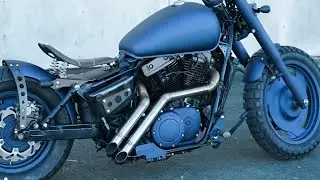
Honda Shadow, VT750, chain radiator cover, bobbercycle, dragster, customized bobber parts, vstar,
Автор: bobbercycle
Загружено: 2019-11-12
Просмотров: 400
Описание: https://bobbercycle.com/ Indroduction of Honda Shadow VT750 (SHAFT).At the 2003 Tokyo Motor Show, Honda exhibited a preproduction "low-and-long"[74] 750cc Shadow kitted out in retro-style bodywork, equipped with shaft final drive and the Honda Ignition Security System (HISS) electronic anti-theft device.[75]Honda dropped the ACE and Spirit models from the 750cc Shadow line for 2004, manufacturing just the new VT750C Shadow Aero model (chain-drive Spirit production restarted in 2005).[52] The reengineered RC50E engine was still a 52-degree, liquid-cooled V-Twin, single-pin crankshaft configuration. SOHC cylinder heads still had two spark plugs and three valves, but were modified to increased the compression ratio. Engine tuning changes de emphasized peak power in favor of torque at low and mid RPMs.[76][77] A 2into1 exhaust ended in a large muffler containing separate silencers for each cylinder (similar to that on the 750 ACE) as well as a catalytic converter.[78] The dual CV carburetors of the RC44E motor were replaced by a single CV carburetor on the RC50E.[79][80] A new steel-tube frame with lower frame rails moved the Aero's seat height further down than either of the models it replaced.[52][40]Honda replaced the 2into1 exhaust with a 2into2 system for 2008 and subsequent model years,[81] including the 20082009 Shadow Tourer VT750T model equipped with a windscreen, saddlebags and passenger backrest.[82][83] Except for North America, 2008 VT750C models had programmed fuel injection (PGM-FI) in place of the CV carburetor.[84][85] Shadow Aero models were given PGM-FI in North America starting with the 2011 model year.[86]Honda offers anti-lock brake options for the 750cc Shadow Aero.[87] Early VT750CA models had front-wheel ABS only, subsequent VT750CS models replace the rear drum brake with a hydraulic disk brake, required for Honda's combined ABS (C-ABS) with individual control of front and rear brakes.[88][89][90] Shadow Aero VT750C[91] and VT750CS[92] models remain in the American Honda line-up for 2019.The term 'chopper' did not appear in print until the mid-1960s, over 30 years after the bob-job was invented. The chopper is a more stylistically and technically extreme evolution of the bob-job, which emerged after the highly elaborate, heavily chromed bob-jobs which appeared in the late 1940s and 1950s. Bobbers are typically built around unmodified frames, while choppers use either highly modified or custom-made frames.[13] Chopper frames are often cut and welded into shape. Thus, bobbers are fairly easy to create from stock motorcycles and are generally hand built.While customized motorcycles can be expensive, bobber builders tend to adopt an economical approach involving old, second-hand, recycled parts and hand-machined items reminiscent of the period before the mass-market motorcycle accessory industry had developed.[11][14]Instead of the large diameter front wheels of Choppers[15], Bobbers[16] usually come with a size similar to the rear rim. Builders mostly use spring saddles, which isn´t a must on choppers with their long extended sissy-bars. Springer forks are popular on both bikes, but often mounted with a higher rake in the Chopper´s triple-tree, to move the front wheel forward. Instead of glossy flake-paintings and chrome parts used for many Choppers, a Bobber more often comes as a Ratbike in flat paint and/or some rusty parts.The bob-job evolved from an earlier type of American custom motorcycle, the 'Cut Down', which appeared in the late 1920s, and which was based on the Harley-Davidson 'J' series v-twin. The cut-down was created to modernize the appearance and improve the performance of the aging J-series Harley-Davidson. By removing the front fender, shortening the rear, and removing all excess accessories, the motorcycle was significantly lightened. The cut-down was also characterized by a modified frame, in which the seat tube was lowered and the wheelbase shortened, resulting in a lower, shorter machine, with a sweeping diagonal line between the steering head and rear axle.In 1933 the AMA introduced Class C racing, which stipulated only catalogued racing motorcycles could be used in sanctioned competition, with points gained towards the National Championship. Class C racers such as the Indian Daytona Scout [3] and Harley-Davidson WLDR and WR [4] were the inspiration of the 'bob-job'; these stripped-down racers had no front fender, an abbreviated rear, and no excess weight. Road riders directly copied the look of the racers for better performance and a measure of style. The first bob-jobs appeared in the mid-1930s, and tended to reflect their somber competition origins, with plain paint jobs and no extra chrome or decoration.
Повторяем попытку...

Доступные форматы для скачивания:
Скачать видео
-
Информация по загрузке: