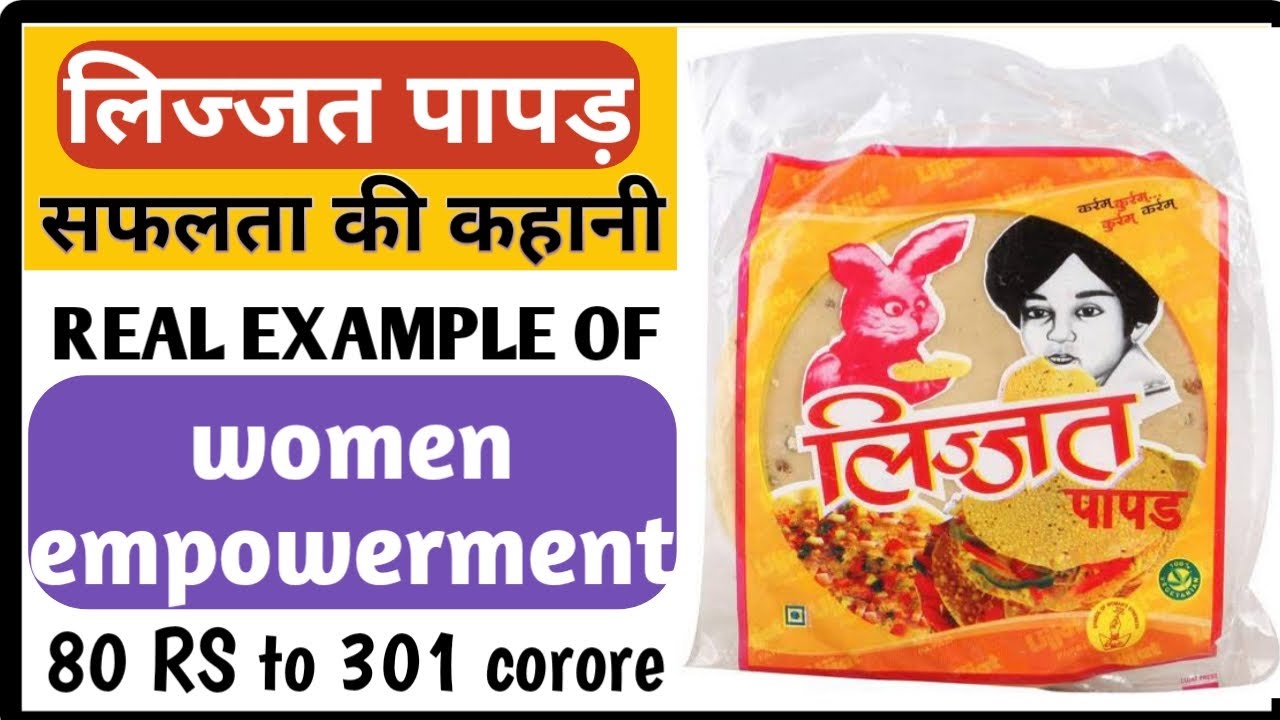
LIJJAT PAPAD success story | 7 sister behind a lijjat papad women empowerment | GBSF | HINDI
Автор: GB SF
Загружено: 2020-07-07
Просмотров: 497
Описание:
Shri Mahila Griha Udyog Lijjat Papad, popularly known as Lijjat, is an Indian women's cooperative involved in manufacturing of various fast-moving consumer goods. The organisation's main objective is empowerment of women by providing them employment opportunities. Started in 1959 by seven women in Mumbai with a seed capital of only Rs.80 ($1.5), it had an annual turnover of more than Rs. 800 crore (over $109 million) in 2018. It provides employment to 43,000 (in 2018) women across the country.[2]
Primarily a cottage industry, urban by its origin, which has spread to the rural areas, it had an annual Rs. 290 million worth of exports in 2010.[3] It is considered as one of the most remarkable entrepreneurial initiatives by women that is identified with female empowerment in India.[4]
Lijjat was the brain child of seven Gujarati women from Bombay (now Mumbai). The women lived in Lohana Niwas, a group of five buildings in Girgaum. They wanted to start a venture to create a sustainable livelihood using the only skill they had i.e. cooking. The seven women were Jaswantiben Jamnadas Popat, Parvatiben Ramdas Thodani, Ujamben Narandas Kundalia, Banuben. N. Tanna, Laguben Amritlal Gokani, Jayaben V. Vithalani, and Chutadben Amish Gawade.[5]
The women borrowed Rs 80 from Chhaganlal Karamsi Parekh, a member of the Servants of India Society and a social worker.[5] They took over a loss-making papad making venture by one Laxmidas bhai,[6] and bought the necessary ingredients and the basic infrastructure required to manufacture papads. On 15 March 1959, they gathered on the terrace of their building and started with the production of 4 packets of papads.[7] They started selling the papads to a known merchant in Bhuleshwar. From the beginning, the women had decided that they would not approach anyone for donations or help, even if the organisation incurred losses.[8]
Chhaganlal Parekh, popularly known as Chaganbapa, became their guide.[3] Initially, the women were making two different qualities of papads, to sell the inferior one at a cheaper rate. Chaganbapa advised them to make a standard papad and asked them never to compromise on quality. He emphasised to them the importance of running it as a business enterprise and maintaining proper accounts.[9]
Lijjat expanded as a cooperative system. Initially, even younger girls could join, but later eighteen was fixed as the minimum age of entry. Within three months there were about 25 women making papads. Soon the women bought some equipment for the business, like utensils, cupboards, stoves, etc. In the first year, the organisation's annual sales were Rs. 6196.[10] The broken papads were distributed among neighbours.[6]
During the first year, the women had to stop production for four months during the rainy season as the rains would prevent the drying of the papads.[3] The next year, they solved the problem by buying a cot and a stove. The papads were kept on the cot and the stove below the cot so that the process of drying could take place in spite of the rains.[5]
The group got considerable publicity through word of mouth and articles in vernacular newspapers. This publicity helped it increase its membership. By the second year of its formation, 100 to 150 women had joined the group, and by the end of the third year it had more than 300 members.[5] By this time, the terrace of seven founders could no longer accommodate the members and the ingredients, so the kneaded flour was distributed among the members who would take it to their homes and make papads.[3] The papads were brought back for weighing and packaging.
An attempt to start a branch in Malad suburb of Mumbai, in 1961, was unsuccessful.[11] In 1962, the name Lijjat (Gujarati for "tasty") was chosen by the group for its products. The name, suggested by Dhirajben Ruparel, was chosen in a contest held for the purpose, with prize money of Rs. 5.[6] The organisation was named Shri Mahila Griha Udyog Lijjat Papad.[5] In many Indian languages, Mahila means women, Griha means home, Udyog means industry. By 1962–63, its annual sales of papads touched ₹ 182,000.[3]
In July 1966, Lijjat registered itself as a society under the Societies Registration Act 1860.[5] In the same month, on Chaganbapa's recommendation, U N Dhebar, the chairman of KVIC personally inspected the Lijjat.[3] KVIC or Khadi Development and Village Industries Commission is a statutory body set up by the Government of India for development of rural industries. In September 1966, KVIC formally recognised Lijjat as a unit belonging to the "processing of cereals and pulses industry group" under the Khadi and Village Industries Act. It was also recognised as a "village industry". In 1966, KVIC granted it a working capital of Rs. 800,000 (0.8 million) and was allowed certain tax exemptions.[5]
Повторяем попытку...
Доступные форматы для скачивания:
Скачать видео
-
Информация по загрузке: