Judicial impeachment - Prelims+Mains Current Affairs 2026 -
Автор: Institute of General Studies (UPSC IAS)
Загружено: 2026-01-22
Просмотров: 6
Описание:
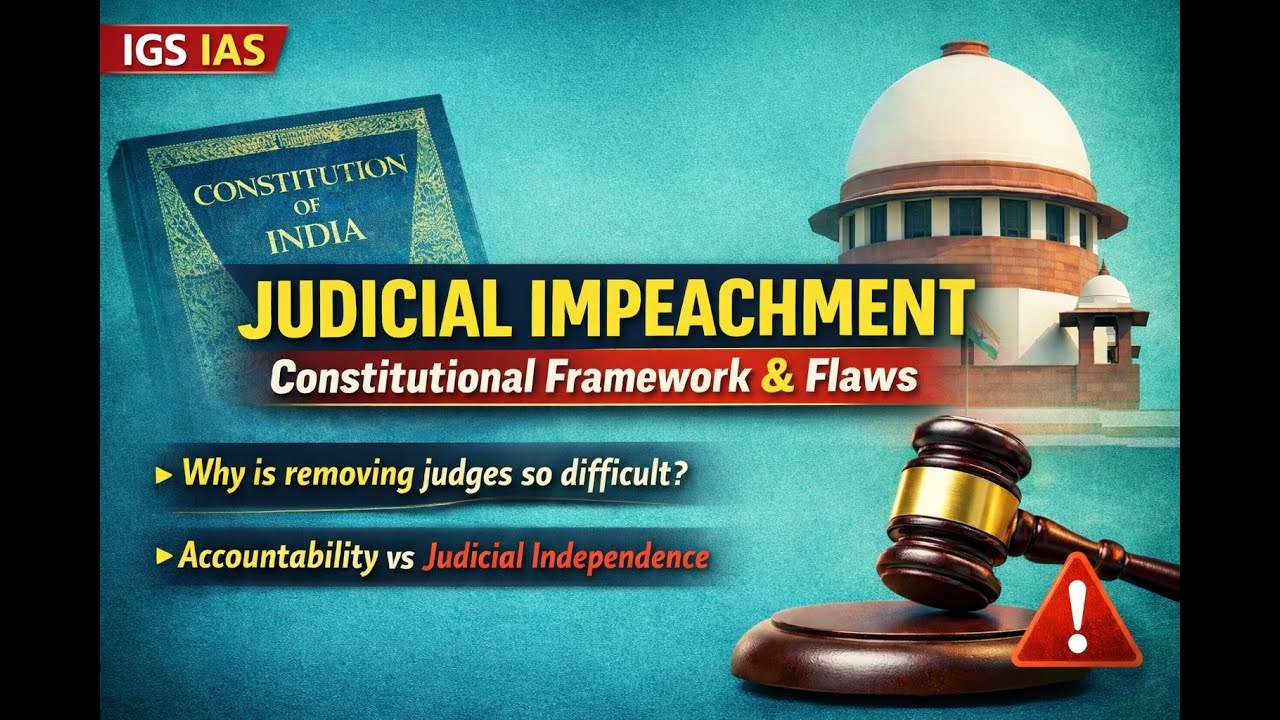
@instituteofgeneralstudiesu598Prelims + Mains Current Affairs 2026 - Polity - Judicial Impeachment
Judicial Impeachment in India: Constitutional Framework and Procedural Challenges
The process for removing a judge of the superior courts in India is a rigorous constitutional mechanism designed to protect judicial independence while ensuring accountability for "proved misbehaviour or incapacity." Recent developments, specifically the December 2025 notice of a removal motion against Justice G.R. Swaminathan of the Madras High Court, have brought the complexities and potential flaws of this process into sharp focus.
107 Members of Parliament in the Lok Sabha (the INDIA bloc) having given notice of an impeachment motion in December 2025
While the Constitution and the Judges (Inquiry) Act, 1968, provide a structured pathway for removal, a critical "threshold" power rests with the Speaker of the Lok Sabha or the Chairman of the Rajya Sabha. This presiding officer acts as a statutory authority with the discretion to admit or disallow a motion before any formal investigation occurs.
--------------------------------------------------------------------------------
Constitutional and Legislative Basis
The removal of judges in India is governed by a combination of constitutional articles and statutory law. It is important to note that the Constitution of India does not use the term "impeachment" for judges; that term is reserved exclusively for the President under Article 61. For judges, the Constitution uses the term "removal."
Primary Legal Authorities
• Supreme Court Judges: Articles 124(4) and 124(5) of the Constitution.
• High Court Judges: Articles 217(1)(b) and 218. The procedure for Supreme Court judges applies equally to High Court judges.
• Procedural Regulation: The Judges (Inquiry) Act, 1968, and the Judges Inquiry Rules, enacted under the authority of Article 124(5), regulate the investigation of charges
--------------------------------------------------------------------------------
Grounds for Removal: Defining "Misbehaviour"
A judge can only be removed on the grounds of "proved misbehaviour" or "incapacity." While the Constitution does not define these terms, the Supreme Court has provided clarity through key judgments.
Standards of Judicial Conduct
The judiciary is held to an "exacting and absolute" standard of honesty. According to the court in K. Veeraswami vs Union Of India (1991), any deviation from impartiality and honesty is considered a betrayal of public trust.
Criteria for "Misbehaviour"
As established in M. Krishna Swami vs Union Of India (1992), misbehaviour is not merely an error of judgment or negligence. It requires:
• Wilful misconduct or wilful abuse of judicial office.
• Corruption or lack of integrity.
• Moral turpitude.
• Mens Rea: There must be some degree of intent or "actuation of mens rea" by the judge.
--------------------------------------------------------------------------------
The Removal Procedure
The process is intentionally difficult to ensure the independence of the judiciary. It involves several distinct stages:
1. Initiation of the Motion
A notice of motion must be signed by a minimum number of Members of Parliament (MPs):
• Lok Sabha: At least 100 members.
• Rajya Sabha: At least 50 members.
2. Admission by the Presiding Officer
The motion is submitted to the Speaker (Lok Sabha) or the Chairman (Rajya Sabha). This officer has the statutory power to:
• Consult relevant materials and persons.
• Admit the motion for investigation.
• Disallow the motion, at which point the matter lapses entirely.
3. Investigation
If admitted, the Speaker/Chairman appoints a three-member committee to investigate the charges:
• A Judge of the Supreme Court.
• A Chief Justice of a High Court.
• A distinguished jurist.
4. Parliamentary Vote and Presidential Order
If the committee finds the judge guilty of misbehaviour, the motion is taken up for a vote in both Houses.
• Required Majority: A majority of the total membership of each House AND a two-thirds majority of members present and voting.
• Final Action: If passed, an address is sent to the President, who then issues an order for the judge’s removal.
--------------------------------------------------------------------------------
Case Study: Justice G.R. Swaminathan (2025)
In December 2025, 107 MPs from the INDIA bloc submitted a notice of motion to Speaker Om Birla seeking the removal of Justice G.R. Swaminathan of the Madras High Court.
Critical Flaws and Constitutional Challenges
The current system contains a "serious flaw" regarding the initial stage of the motion.
The Problem of Discretionary Rejection
Повторяем попытку...
Доступные форматы для скачивания:
Скачать видео
-
Информация по загрузке: