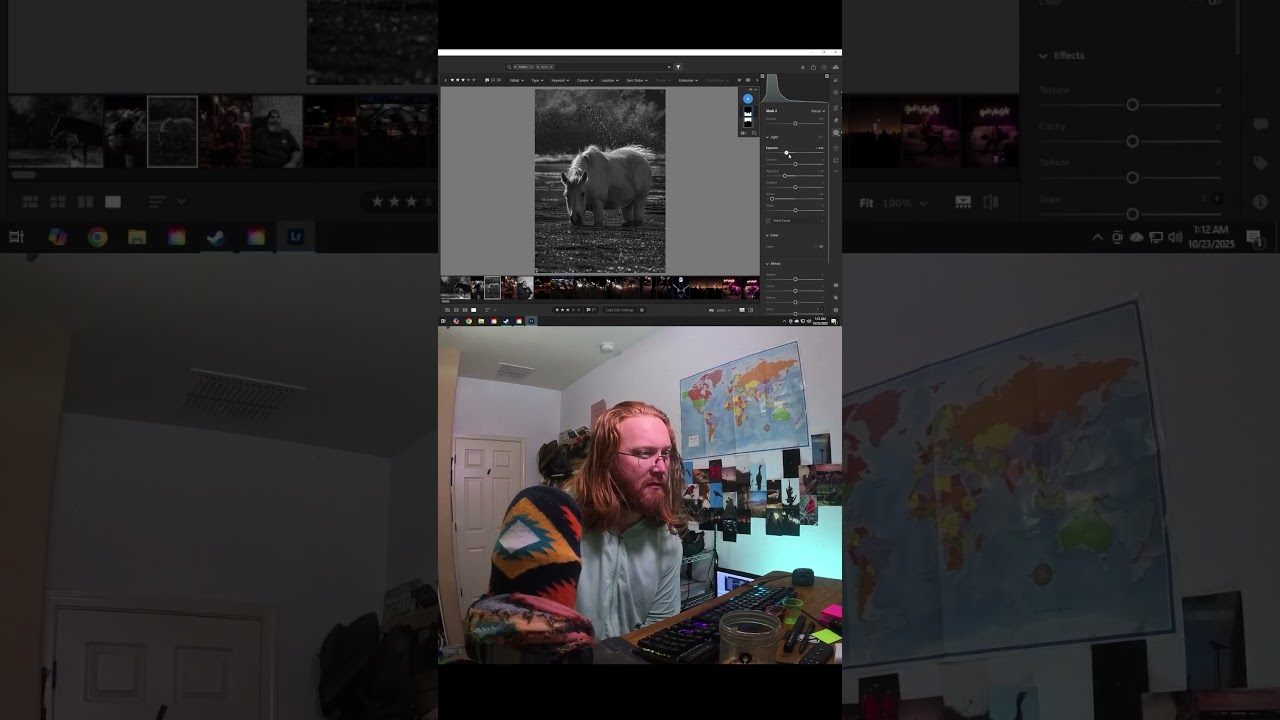
Ripples revealed by editing foreground exposure - wild horse photography
Автор: Postcards With Kevan
Загружено: 2026-01-15
Просмотров: 65
Описание:
Editing Wild Horse Photography from a Paddle Board | Lightroom Walkthrough
This series of short clips comes from a full-length paddle-board photography session and Lightroom edit. I recorded everything—from the river, to the culling, to the final black-and-white image—so you can see the full process.
The story starts on the Arizona river where I grew up. When I was about 11, I cut my foot there, leaving one of the biggest scars on my body. Back then, there were only a handful of wild horses. Today, there are dozens. Returning with a camera years later felt like seeing how time reshapes a place—and how photography preserves those changes.
On this trip, I packed my camera inside a dry bag, stuffed it into a cushion, strapped it to my paddle board, and set off down the river. Mid-day light, high contrast, white horse, strong reflections—all the elements that make shooting wildlife on water both thrilling and hard. I wanted to capture one of the Salt River’s wild horses feeding on river grass, tail swinging, droplets in the air.
What Happens in These Shorts
Across these clips, you’ll see how each step builds toward a finished image.
You’ll hear me talk through composition, exposure, editing decisions, and the emotions behind every adjustment.
I describe shooting around 2 PM with the sun high overhead, the horse between me and the light. My settings hover around 1/1250 sec at f/6.3 on a crop-sensor camera with a 100–400 mm lens. I explain how that speed captured motion but lost some highlight detail, and why, next time, I’d push to 1/2000 sec or faster—especially for white subjects in harsh sun.
You’ll watch me compare near-identical frames, debating which deserves to be edited. I use a simple system: 1 = delete, 2 = maybe, 3 = edit. The process shows how small shifts—a swaying tail, a visible eye, a clean reflection—decide what survives.
I analyze exposure trade-offs: bright whites clipping, deep shadows holding texture. Shooting from a paddle board means compromise—movement, balance, and safety all come first.
When I finally choose an image, you’ll see why: it’s not perfect, but the pose, texture, and splash convey the feel of being there.
Inside the Lightroom Edit
The second half of these clips walks through Lightroom step by step:
Global edits: I crop to 5×7 for balance, adjust exposure, lower highlights to recover softness, and keep contrast mild to preserve that gentle feeling.
Curves: I show how curves refine tone transitions—shaping blacks, shadows, mids, highlights, and whites—to make the image feel more natural and layered.
Black & White Conversion: Removing color reveals texture in the water and droplets. I experiment with highlight recovery, lower contrast, and fine-tune whites and blacks until it feels soft yet detailed.
Masks: I create subject and background masks, subtracting water so adjustments stay clean. I darken the background slightly to separate droplets and lift clarity where it enhances shape without killing the softness.
Gradients: Foreground gradients help build depth, creating separation between horse, grass, and splash. I experiment with exposure and clarity until the image gains a sense of atmosphere.
Details & Grain: I sharpen lightly, add subtle grain for texture, and note that clarity and texture sliders can either emphasize movement or ruin softness if overdone.
Dehaze & Shadows: I test how dehaze affects tone, finding that sometimes gray is better than deep black. The goal stays consistent—retain motion, texture, and that quiet midday feeling.
Throughout, I narrate every small discovery—how a clipped highlight looks burned, how the horse’s legs separate when blacks lift slightly, how foreground ripples add realism, and how restraint turns an average photo into something that feels alive.
Reflections & Lessons
Beyond settings and sliders, this edit is about learning through seeing. I talk openly about the mistakes:
Shooting too slow and losing frozen droplets.
Cropping too tight and cutting off the tail.
Realizing reflections add life, and waiting a few seconds longer might have made magic.
I also share what worked: the shimmer of chest light, the shape of motion in the splash, and how subtle contrast creates a feeling of weight and grace. It’s about being proud of the process, not chasing perfection.
The image ends as a soft, layered black-and-white—a horse wading through river grass, water droplets frozen mid-air, sunlight filtering from the left. It captures both memory and motion.
#wildhorses #wildlifephotography #lightroom #photoediting #arizona #saltRiver #blackandwhite #paddleboard #naturephotography #editingworkflow #learnphotography #postcardswithkevan
Повторяем попытку...
Доступные форматы для скачивания:
Скачать видео
-
Информация по загрузке:


