Glock and Beatbox Queen Fat Bottom Girls Robot Midi Xylophone Glockenspiel drums other percussion
Автор: Scott Haycock
Загружено: 2020-12-08
Просмотров: 573
Описание:
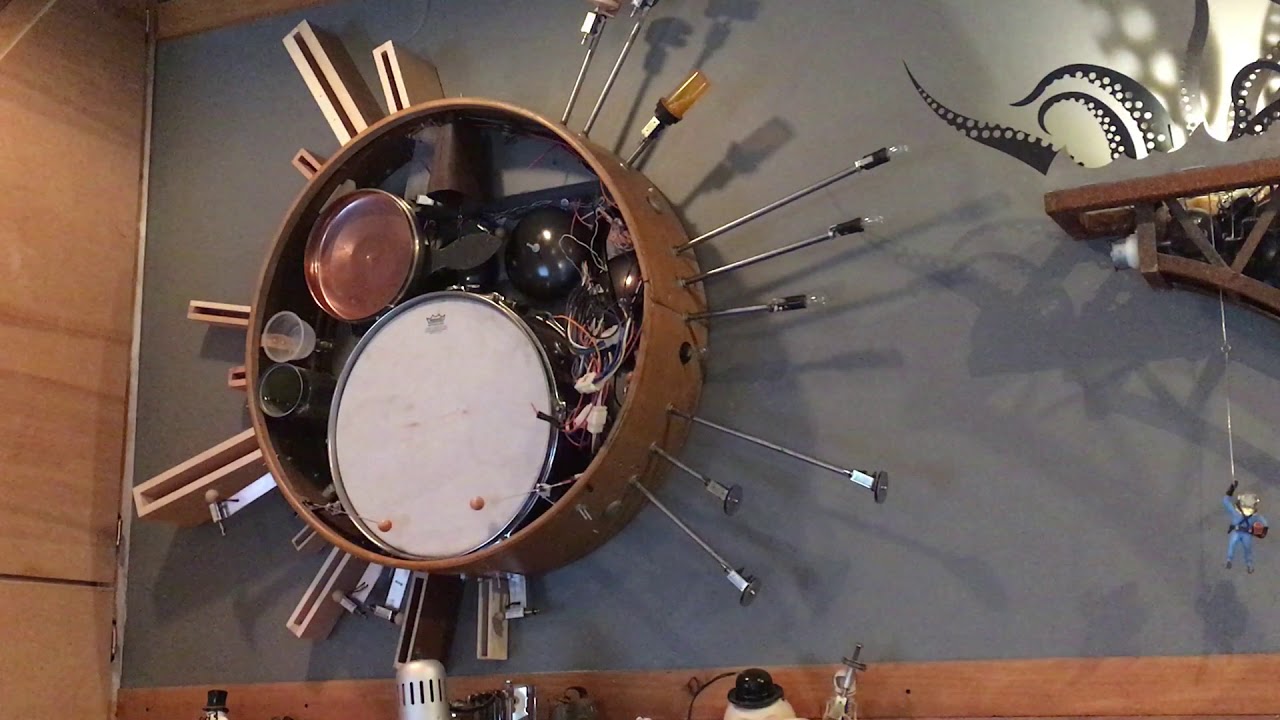
Midi Driven, solenoids, lights and other effects added. Built and refined over about a year. This is the first video I've posted of it, so check and see if there are more recent videos, this is a work in progress, and I'd like you to see the best/most recent version.
Xylophone means wooden keys, glockenspiel means metal. So, this is (mostly) a glockenspiel. But, I imagine that people looking for this kind of thing may be searching “xylophone”.
This all started with Christmas lights. I got into light synchronization back in the zips (00's), and eventually applied that technology to puppetry projects too. You swap a motor or solenoid in for a light, and baby you've got an animatronic going. By now, I may have a Robo Brigham video up on this channel, you can check that out if you're into animatronics.
It wasn't a stretch to sync lots of solenoids to the Christmas light control software (I use Vixen), and set each one up on a glockenspiel note.
Early on, I was using Arduinos as my contollers, with Vixen as my software, and I owe a lot to Dee Higgenbotham's videos helping me do that. You should check out his videos if you're learning to sync lights.
I used an Arduino and Vixen software for the glock too, at first. A friend made me a midi file of Weezer's “Buddy Holly”, and it took a lot of work to convert it and get it to play (sort of) right in Vixen. But for about 6 months, that was the only song the glock could play. It was just too much work to program in new songs.
I'd program the musical sequence in Vixen, Vixen sends the signals to the Arduino, the Arduino activates either a relay or a MOSFET to power the solenoid, the solenoid bangs on the key.
As I was researching how to build a similar setup but with a pipe organ, I learned about organ control modules. These are designed to use MIDI files to automatically play a pipe organ. A pipe organ uses solenoids to open air channels for each pipe, so electrically it's identical to my glock. So, with help and advice from Bill Klinger at Klinger Organs klingerorgan.com , I switched the whole control system over to these modules. I now control them with MIDI signals, which I send right out of free MIDI editing software, which directly powers the solenoids. The control board can carry larger voltages and currents than an Arduino, so I don't have to use relay boards or MOSFET boards. This switch to different control technology just eliminated a lot of parts and headaches.
But I'm glad I did it the hard way first. If you're like me, the best part of the project is when you figure out how to do something, and those victories over ignorance and mistakes along the way. Having proved to myself I can do this with Vixen, Arduino, relays, and MOSFETs, I was glad to find a way to cut out some of the middle components.
Now, I can utilize more direct MIDI control so I don't have to put so much needless work into forcing Vixen to do something it wasn't really designed to do. I can download MIDI files from the internet, and immediately play them on the glock. However, they usually need to be transposed, extra instruments eliminated, and have all the notes shortened to about 25 ms (how long it takes for the solenoid to strike the key, with a fast drawback for a clean sounding note).
My background is in mechanical engineering. But this project, and others I'm doing, have forced me to broaden my abilities considerably. I've had to learn a lot of electrical engineering (thanks for your help Don), Arduino programming (thanks Dee), MIDI control and musical composition (thanks Ben and Bill). I never thought I'd be learning music composition, it's funny how a project like this can force you into a new field.
If you're looking to build something like this, here are some helpful hints that took me a while to learn:
You need to use a flyback diode on each solenoid. You'll have to google that to understand it, but it keeps backwards bouncing currents from finding their way back into your circuit and wrecking things.
You might be tempted to just ding the glockenspiel key directly with the metal end of the solenoid. Well, I thought so too, and I have a whole other glock in a cabinet that I built that way. It just doesn't sound as good, that's why I switched to the lever and wood ball. And, it's also a lot more entertaining to watch this way. But, do whatever you want.
If you don't like refining a design over the course of a year or two (or 20), you might get frustrated doing this kind of thing. I've built two prototype pipe organs now, learned a lot, but neither has really worked yet. I've learned to think of all this as a “hobby” rather than as a “project”. Project suggests that it will eventually be complete, but hobby means that you're constantly refining.
I'd welcome suggestions for songs that would sound good on this type of setup. If you're building something, and you've run into a problem that it looks like I've figured out, feel free to ask and maybe I'll help.
Повторяем попытку...
Доступные форматы для скачивания:
Скачать видео
-
Информация по загрузке: