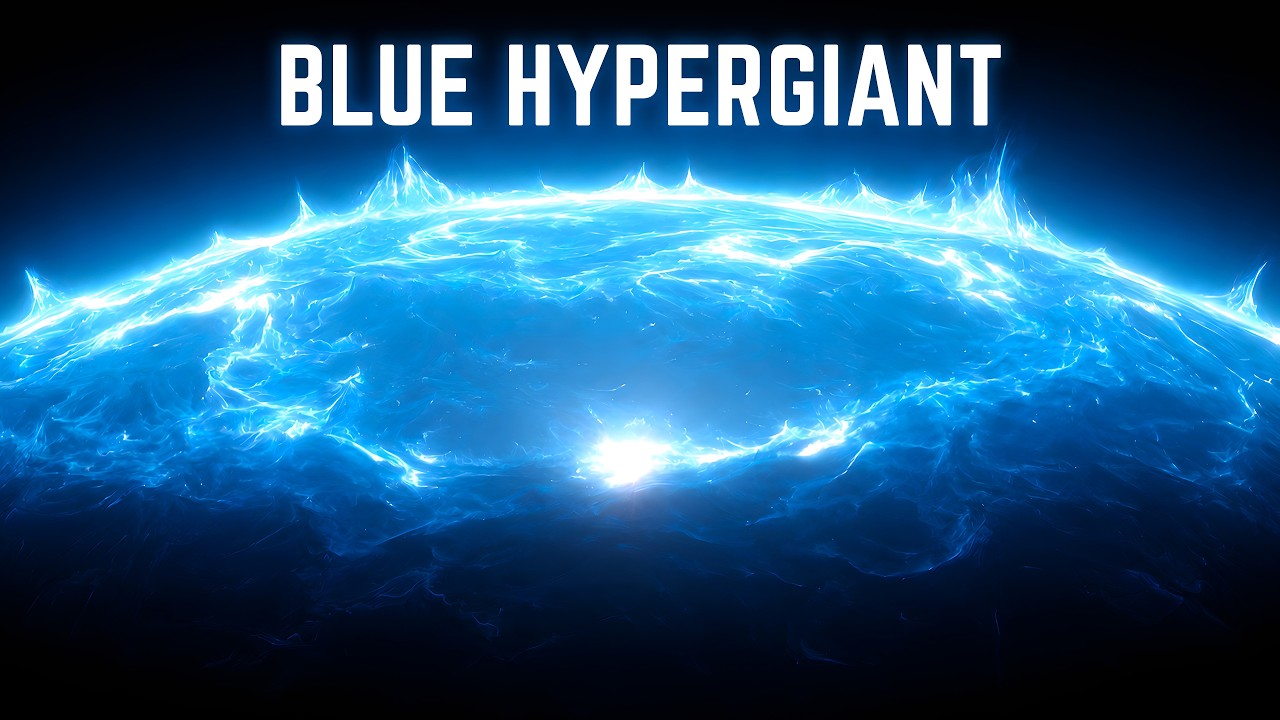
What a Blue Hypergiant Really Is… And Why Stars Aren’t Supposed to Stay This Extreme
Автор: Sleep On Space
Загружено: 2026-06-18
Просмотров: 21661
Описание:
We’re now live on Spotify 🎧
https://open.spotify.com/show/10Hdv6g...
What happens when a star becomes so powerful that its own light starts tearing it apart? Blue hypergiants are the most massive, most luminous, and most unstable stars in the entire universe. Burning millions of times brighter than our Sun, these rare stellar monsters produce so much radiation that the outward pressure of their own light rivals the inward pull of gravity.
The result is a star at war with itself - erupting violently, shedding entire suns worth of mass into space, and evolving at speeds that defy the usual timescales of stellar life. They are magnificent, extreme, and doomed. In this video, we explore what a blue hypergiant actually is, why it differs from ordinary massive stars, how the physics of radiation pressure and the Eddington limit make these stars fundamentally unstable, and why no star can remain this extreme for long. From the catastrophic eruptions of Eta Carinae to the staggering luminosity of R136a1, we trace the life and violent death of the most powerful stars nature can create — and discover why the universe's brightest objects are also its most temporary.
Sources and Further Reading:
Humphreys, R. M. & Davidson, K. (1979). "Studies of Luminous Stars in Nearby Galaxies. III. Comments on the Evolution of the Most Massive Stars in the Milky Way and the Large Magellanic Cloud." The Astrophysical Journal, 232, 409–420.
Smith, N. (2014). "Mass Loss: Its Effect on the Evolution and Fate of High-Mass Stars." Annual Review of Astronomy and Astrophysics, 52, 487–528.
Vink, J. S. (2012). "Mass-Loss Rates of Very Massive Stars." Proceedings of the International Astronomical Union, 279, 29–36.
Brands, S. A., de Koter, A., et al. (2022). "R136 Revised: A Spectroscopic Re-Analysis of the Stellar Content of R136." Astronomy and Astrophysics, 663, A36.
#bluehypergiant #stars #space #astrophysics #universe #astronomy #science
Повторяем попытку...
Доступные форматы для скачивания:
Скачать видео
-
Информация по загрузке: