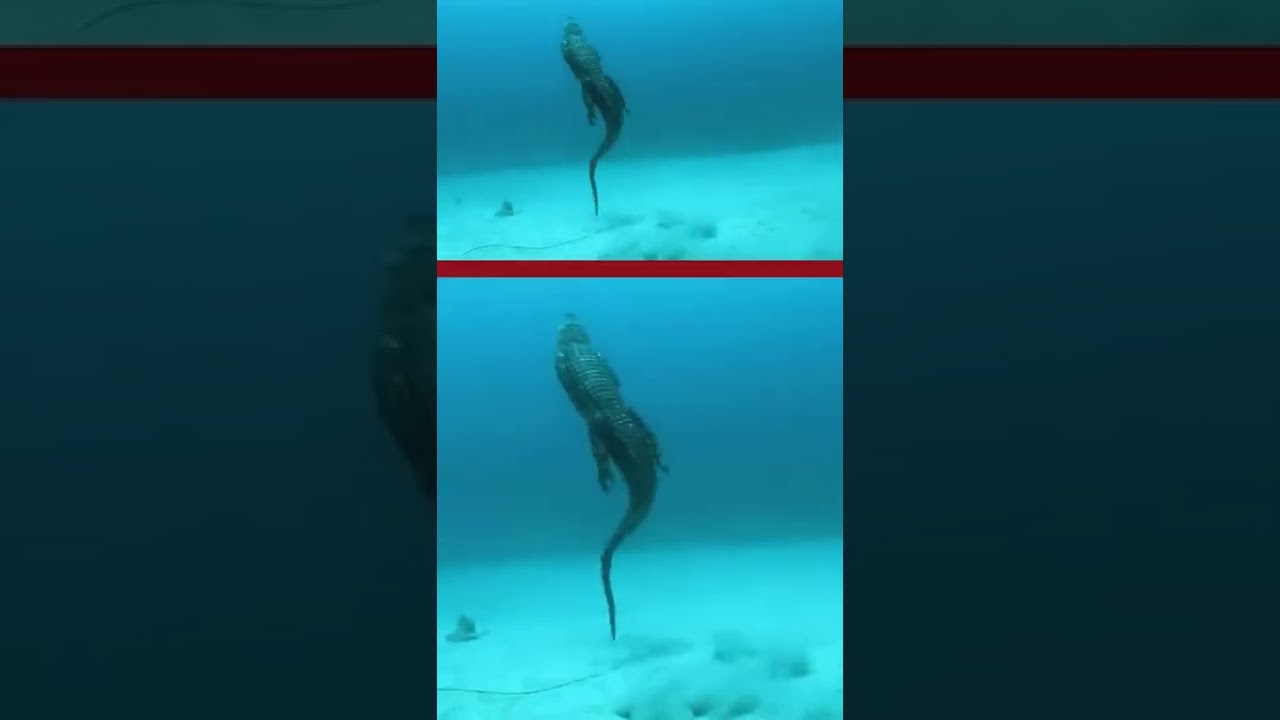
Crocodile swimming speed underwater
Автор: Nano and Tota
Загружено: 2022-02-23
Просмотров: 326122
Описание:
Crocodile swimming speed underwater
Crocodiles (family Crocodylidae) or true crocodiles are large semiaquatic reptiles that live throughout the tropics in Africa, Asia, the Americas and Australia. The term crocodile is sometimes used even more loosely to include all extant members of the order Crocodilia, which includes the alligators and caimans (family Alligatoridae), the gharial and false gharial (family Gavialidae) among other extinct taxa.
Although they appear similar, crocodiles, alligators and the gharial belong to separate biological families. The gharial, with its narrow snout, is easier to distinguish, while morphological differences are more difficult to spot in crocodiles and alligators. The most obvious external differences are visible in the head, with crocodiles having narrower and longer heads, with a more V-shaped than a U-shaped snout compared to alligators and caimans. Another obvious trait is that the upper and lower jaws of the crocodiles are the same width, and the teeth in the lower jaw fall along the edge or outside the upper jaw when the mouth is closed; therefore, all teeth are visible, unlike an alligator, which possesses in the upper jaw small depressions into which the lower teeth fit. Also, when the crocodile's mouth is closed, the large fourth tooth in the lower jaw fits into a constriction in the upper jaw. For hard-to-distinguish specimens, the protruding tooth is the most reliable feature to define the species' family.[1] Crocodiles have more webbing on the toes of the hind feet and can better tolerate saltwater due to specialized salt glands for filtering out salt, which are present, but non-functioning, in alligators. Another trait that separates crocodiles from other crocodilians is their much higher levels of aggression.[2]
Crocodile size, morphology, behaviour and ecology differ somewhat among species. However, they have many similarities in these areas as well. All crocodiles are semiaquatic and tend to congregate in freshwater habitats such as rivers, lakes, wetlands and sometimes in brackish water and saltwater. They are carnivorous animals, feeding mostly on vertebrates such as fish, reptiles, birds and mammals, and sometimes on invertebrates such as molluscs and crustaceans, depending on species and age. All crocodiles are tropical species that, unlike alligators, are very sensitive to cold. They separated from other crocodilians during the Eocene epoch, about 55 million years ago.[3] Many species are at the risk of extinction, some being classified as critically endangered.
The word crocodile comes from the Ancient Greek krokódilos (κροκόδιλος) meaning 'lizard', used in the phrase ho krokódilos tou potamoú, "the lizard of the (Nile) river". There are several variant Greek forms of the word attested, including the later form krokódeilos (κροκόδειλος)[4] found cited in many English reference works.[5] In the Koine Greek of Roman times, krokodilos and krokodeilos would have been pronounced identically, and either or both may be the source of the Latinized form crocodīlus used by the ancient Romans. It has been suggested, but it is not certain that the word crocodilos or crocodeilos is a compound of krokè ('pebbles'), and drilos/dreilos ('worm'), although drilos is only attested as a colloquial term for 'penis'.[5] It is ascribed to Herodotus, and supposedly describes the basking habits of the Egyptian crocodile.[6]
The form crocodrillus is attested in Medieval Latin.[5] It is not clear whether this is a medieval corruption or derives from alternative Greco-Latin forms (late Greek corcodrillos and corcodrillion are attested). A (further) corrupted form cocodrille is found in Old French and was borrowed into Middle English as cocodril(le). The Modern English form crocodile was adapted directly from the Classical Latin crocodīlus in the 16th century, replacing the earlier form. The use of y in the scientific name Crocodylus (and forms derived from it) is a corruption introduced by Laurenti (1768).
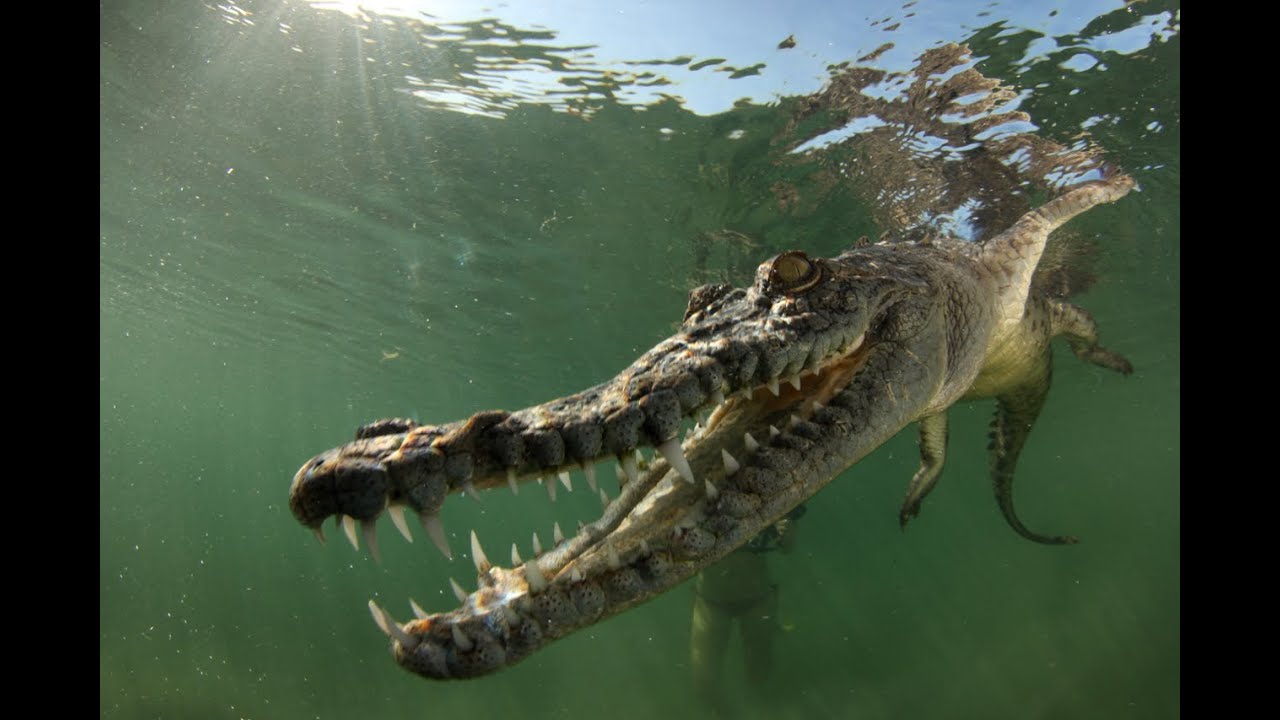
A crocodile's physical traits allow it to be a successful predator. Its external morphology is a sign of its aquatic and predatory lifestyle. Its streamlined body enables it to swim swiftly; it also tucks its feet to the side while swimming, making it faster by decreasing water resistance. Crocodiles have webbed feet which, though not used to propel them through the water, allow them to make fast turns and sudden moves in the water or initiate swimming. Webbed feet are an advantage in shallow water, where the animals sometimes move around by walking. Crocodiles have a palatal flap, a rigid tissue at the back of the mouth that blocks the entry of water. The palate has a special path from the nostril to the glottis that bypasses the mouth. The nostrils are closed during submergence.
Like other archosaurs, crocodilians are diapsid, although their post-temporal fenestrae are reduced. The walls of the braincase are bony but lack supratemporal and postfrontal bones.
Повторяем попытку...
Доступные форматы для скачивания:
Скачать видео
-
Информация по загрузке: