Renault Clio Car Review as American Driver - 11 Day Rental - Manual Transmission - 5spd
Автор: IdeaMan4k
Загружено: 2025-09-02
Просмотров: 232
Описание:
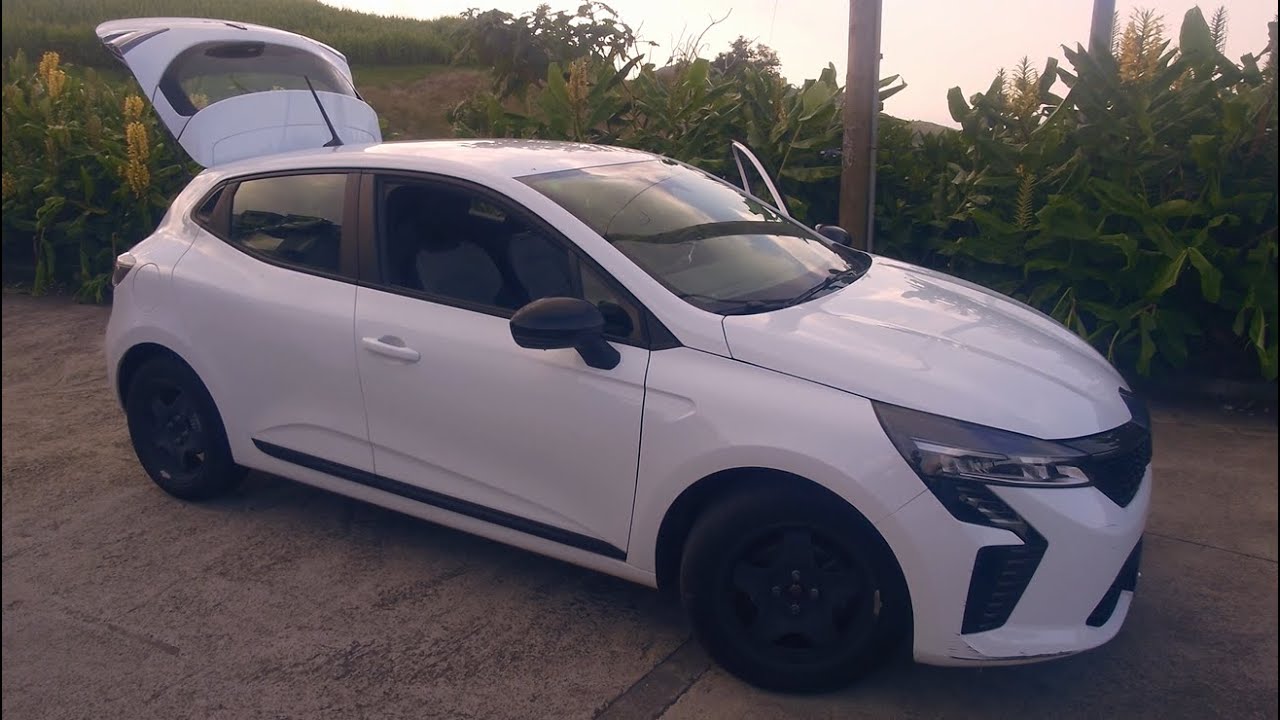
Driving the 2021+ Renault Clio (not 100% sure the year but based on the screen dash it seems at least 2021 or newer. Probably 2022, or 2023 at best.
This is the GAS / LPG (Liquefied Petroleum Gas) version. It has a button as I show to switch between modes.
Azores car rental. ANC Azores Holidays (Rent a Car)
Review / Overview.
Renault Clio car review.
Renault Clio review as an America driver.
Renault Clio rental car.
2020, 2021, 2022, 2023
History of the company overview:
Founding and Early Innovations (1898-1914)
Renault's story began on Christmas Eve 1898 when Louis Renault, a 21-year-old engineer, converted a De Dion-Bouton tricycle into a four-wheeled "Voiturette" with a groundbreaking direct-drive transmission, eliminating belts. Impressed by its hill-climbing ability, friends placed 12 orders that night. In February 1899, Louis founded Société Renault Frères with brothers Marcel and Fernand in Boulogne-Billancourt, France. Marcel handled sales, Fernand administration, while Louis focused on engineering.
Early success came from motorsport: Marcel won the 1902 Paris-Vienna rally in a Renault, boosting visibility. By 1903, tragedy struck when Marcel died in a race, followed by Fernand's death in 1909, leaving Louis in charge. Renault expanded into taxis, buses, and trucks; its AG1 taxis famously transported troops during the 1914 Battle of the Marne, earning the "Taxi de la Marne" legend. By 1913, production reached 10,000 vehicles annually.
World War I and Interwar Growth (1914-1939)
During WWI, Renault shifted to military production: shells, tanks (FT-17, the first modern tank), and aircraft engines. Post-war, it resumed carmaking with models like the 6CV and expanded internationally, assembling in the UK and Japan. In 1929, Renault adopted assembly-line production at its Île Seguin factory, inspired by Ford.
The 1930s brought economic challenges but innovations like the Juvaquatre (1937), Renault's first unibody car. Labor unrest peaked in 1936 strikes, leading to better worker rights. By 1939, Renault was France's largest private employer with 44,000 workers.
World War II and Nationalization (1939-1950s)
WWII disrupted operations: factories bombed, and under Nazi occupation, Renault produced for Germany, leading to Louis Renault's 1944 arrest for collaboration. He died in prison; the company was nationalized in 1945 as Régie Nationale des Usines Renault (RNUR), a state-owned entity.
Post-war, under Pierre Lefaucheux, Renault launched the 4CV (1947), a rear-engined economy car that sold over 1 million units, symbolizing France's recovery. Exports boomed, including to the US. In the 1950s, Renault absorbed truck makers like Somua and Latil, forming Saviem. The Dauphine (1956) became a global hit, though criticized for rust in America.
Expansion and Challenges (1960s-1980s)
The 1960s saw bold designs: the Renault 4 (1961), the first front-wheel-drive hatchback, sold 8 million; the 16 (1965), pioneering the hatchback segment. Motorsport returned with Formula 1 entry in 1977, introducing turbo engines that won in 1979.
In the 1970s, partnerships formed: with Peugeot and Volvo for engines, and AMC in the US (1979). The 5 (1972) supermini, including the Le Car in America, was iconic. However, 1980s losses mounted due to overexpansion and quality issues; CEO Georges Besse's 1986 assassination by terrorists compounded woes. Renault sold AMC to Chrysler in 1987.
Privatization and Alliances (1990s-2000s)
Partial privatization in 1990, full by 1996, spurred recovery under Louis Schweitzer. Hits included the Clio (1990), Europe's best-seller, and Espace minivan. In 1999, Renault allied with Nissan, acquiring 36.8% stake; Carlos Ghosn's turnaround made it profitable. The Renault-Nissan Alliance (later including Mitsubishi in 2016) became a top global group.
The 2000s brought safety focus: five Euro NCAP stars for models like Mégane. Ghosn became CEO in 2005, emphasizing EVs; the Zoe (2012) led Europe's electric sales. Acquisitions included Dacia (1999) for budget cars and Samsung Motors (2000).
Modern Era and Sustainability (2010s-Present)
The 2010s faced scandals: a 2011 spying hoax and Ghosn's 2018 arrest for financial misconduct, leading to his 2019 ouster. Renault pivoted to electrification under Luca de Meo (2020 CEO), launching the "Renaulution" plan for EVs and hydrogen tech. By 2025, Renault aims for 90% electric sales in Europe by 2030, with models like Mégane E-Tech.
Today, Renault Group produces over 2.5 million vehicles yearly, employs 105,000, and leads in EVs while navigating alliances and global markets. From Voiturette to Zoe, Renault embodies innovation amid challenges. (Word count: 842)
Повторяем попытку...
Доступные форматы для скачивания:
Скачать видео
-
Информация по загрузке: