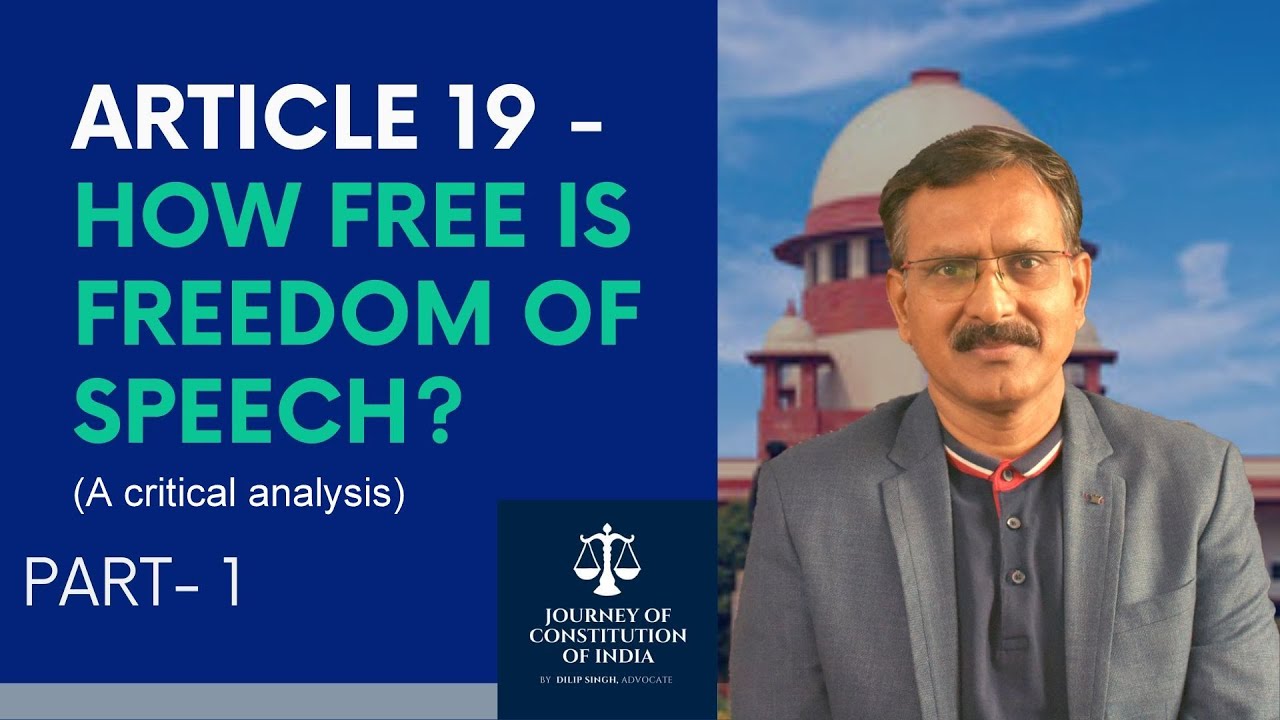
ARTICLE 19: WHY RIGHT TO FREEDOM IS OFTEN SUBJECT TO REASONABLE RESTRICTIONS OF SOCIETY (2020)
Автор: LEGAL OUTLOOK... By Dilip Singh
Загружено: 2020-06-20
Просмотров: 293
Описание:
Article 19: Right to Freedom Series:Part-2
Originally there were 7 rights to freedom. Now it is Six. Right to Property is deleted by 44th Amendment.
Article 19 of The Universal Declaration of Human Rights: “everyone has right to freedom of opinion and expression; this right includes freedom to hold opinion without interference and to seek, receive and import information and ideas through media and regardless of frontiers.” This resolution was adopted on 10th December, 1948. Almost the same time when our constitution was being framed.
Q1 :What were the priorities of framers of Constitution at the time of making of this largest written Constitution?
They had three priorities: first and foremost was unity and sovereignity of nation, second: Social Change to achieve Jusitce, liberty,equality and fraternity. Third, establishing Democracy with well defined structure of government capable of delivering the first two.
Q2: From where the framers got spiritual or moral strength to devise these 7 rights to freedom?
My answer was: the values and experience of our freedom struggle gave them this spiritual and moral strength.
Q3: What were the international events which worked as bacon light or guidelines for framers of Constitution while drafting Rights to freedom?
The development of such constitutionally guaranteed fundamental human rights in India was inspired by historical examples such as England's Bill of Rights (1689), the United States Bill of Rights(1787) and France's Declaration of the Rights of Man (1789). Your remember that the war-cry of french revolution was EQUALITY, LIBERTY AND FRATERNITY.
It is the most important and key article which embodies the “basic freedoms”. Article 19 states:
All citizens shall have the:-
(a)Right to freedom of speech and expression;
(b) Right to assemble peaceably and without arms;
(c) Right to form associations or unions;
(d) Right to move freely throughout the territory of India;
(e)Right to reside and settle in any part of the territory of India;
(f) Right omitted by 44th amendment act. (it was right to acquire, hold and dispose of property)
(g) Right to practice any profession, or to carry on any occupation, trade or business.
In this part of Video, we will discuss the Right to freedom of speech and expression.
The philosophy behind this Article lies in the Preamble of the Constitution, where a solemn resolve is made to secure to all its citizen, liberty of thought and expression.
The freedom of speech under Article 19(1) (a) includes the right to express one's views and opinions at any issue through any medium, e.g. by words of mouth, writing, printing, picture, film, movie, blog, internet etc.
This right is, however, not absolute and
Article 19(2) allows Government to frame laws to impose reasonable restrictions on the Grounds of I. security of the State,
II. friendly relations with foreign States
III. public order IV. decency and morality,
V. contempt of court,
VI. defamation,
VII. incitement to an offence, and
VIII. sovereignty and integrity of India
Romesh Thapar case is a turning point in the evolution of right to freedom of Speech and expression. I will deal this case in detail in my next video.
After the First Amendment (which was in response to cases of Romesh Thappar vs State of Madras and Brij Bhushan vs State of Delhi), the modified Article 19(2). The words added are:
"in so far as such law imposes reasonable restrictions on the exercise of the right conferred by the said sub-clause" "public order", incitement to an offence.”
Later by 16th Amendment in 1963, another ground of "friendly relations with foreign States," was added.
Pandit Thakur Dass Bhargava, a member from East Punjab(From Hisar District in today's Haryana), suggested a way out: by adding “reasonable” before “restrictions."
Reasonable restriction is something needed for community welfare.
I would like to sum up today that "this freedom of speech and expression is essential for pursuit of truth, indispensable for the development of one’s individuality and for the success of parliamentary democracy. This is mother of all freedom and rights. This is natural human right.
Повторяем попытку...
Доступные форматы для скачивания:
Скачать видео
-
Информация по загрузке: