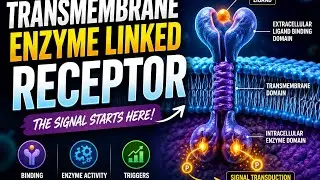
TRANSMEMBRANE ENZYME LINKED RECEPTOR. L2
Автор: Pharma plus
Загружено: 2025-08-07
Просмотров: 19
Описание:
A transmembrane enzyme-linked receptor is a special protein that:
Spans the Cell Membrane: It has one part sticking outside the cell, one part inside the cell, and a section crossing the membrane.
Receives Signals: The outside part is shaped to bind specifically to one type of signaling molecule (like a hormone or growth factor) – this is the "ligand".
Has Built-In Enzyme Activity: The inside part of the receptor itself acts as an enzyme (or directly controls an enzyme attached to it).
How it Works (Step-by-Step):
Ligand Arrival: A specific signaling molecule (the ligand, e.g., insulin, a growth factor) floats by and bumps into the receptor's extracellular domain (the part outside the cell).
Binding & Shape Change: The ligand fits into a specific spot on the receptor like a key in a lock. This binding makes the receptor change its shape.
Activation (Often Involving Pairing): For many of these receptors:
The shape change causes two individual receptor proteins to come together and pair up (this is called dimerization). Think of two separate doorbells snapping together.
This pairing brings their inside parts (the enzyme parts) close together.
Enzyme Turns On: Bringing the enzyme parts together (or just the shape change itself) activates their enzymatic activity.
First Signal Sent: The activated enzyme does its job on the first target proteins inside the cell (often adding or removing phosphate groups - this is called phosphorylation/dephosphorylation). These modified proteins are now active/inactive.
Signal Relay Race: Those first modified proteins then go on to modify other proteins, which modify others, and so on. This is the signaling cascade – like a line of dominoes falling.
Triggers Internal Signals: When the ligand binds outside, it activates the enzyme part inside. This enzyme then modifies other proteins inside the cell, kicking off a signaling cascade.
Cellular Response: Eventually, this cascade reaches targets that change the cell's behavior. This could be:
Turning genes on/off (making new proteins)
Changing the cell's metabolism (how it uses energy)
Triggering the cell to move, grow, divide, or even die (apoptosis)
Key Features:
Direct Activation: The receptor itself is the enzyme (or directly controls it). No middleman is needed to carry the signal across the membrane (unlike G-protein coupled receptors).
Slow but Sustained: The signaling cascades they trigger usually lead to slower, longer-lasting changes in the cell (like growth or gene expression changes) compared to some faster signaling systems.
Amplification: One activated receptor enzyme can modify many downstream target proteins, greatly amplifying the original signal.
Specificity: Each receptor type binds only its specific ligand(s), ensuring the right signal triggers the right response.
Common Types of Enzymes Found in These Receptors:
Tyrosine Kinases: The most famous group! They add phosphate groups specifically to Tyrosine amino acids on other proteins. (Examples: Insulin Receptor, Growth Factor Receptors like EGFR).
Serine/Threonine Kinases: Add phosphate groups to Serine or Threonine amino acids. (Example: TGF-β Receptor).
Tyrosine Phosphatases: Remove phosphate groups from Tyrosine amino acids on other proteins. (Less common as primary receptors).
Guanylyl Cyclases: Produce a small signaling molecule called cGMP inside the cell. (Example: Receptor for the ANP hormone).
Why are they Important? (Real-World Relevance):
Crucial for Life: They control essential processes like cell growth, division, differentiation (cells becoming specialized), survival, and metabolism.
Hormone Action: Key receptors for insulin (blood sugar control), growth hormone, and many others.
Development: Critical for building tissues and organs correctly during embryo development.
Disease: When these receptors malfunction (e.g., stuck "on" all the time), it can cause diseases, especially cancer. Many mutated or overactive growth factor receptors drive uncontrolled cell division in tumors.
Drug Targets: Because they are so important in disease (especially cancer), they are major targets for drugs:
Monoclonal Antibodies: Drugs like Herceptin (Trastuzumab) bind to the outside part of overactive receptors (like HER2 in breast cancer), blocking the signal.
Tyrosine Kinase Inhibitors (TKIs): Drugs like Gleevec (Imatinib) bind to the inside enzyme part, stopping its activity.
Повторяем попытку...

Доступные форматы для скачивания:
Скачать видео
-
Информация по загрузке: