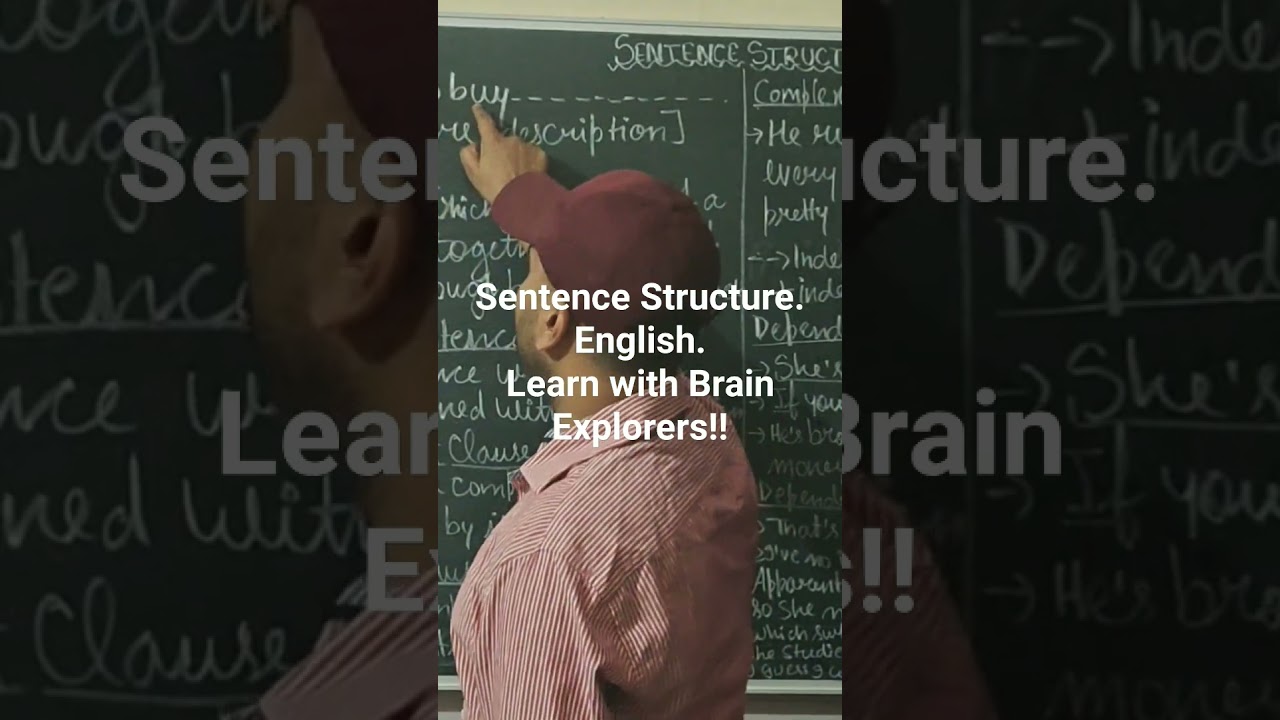
Sentence Structure|| English
Автор: Vipin Kumar
Загружено: 2024-04-25
Просмотров: 72
Описание:
Sentence Structure :
..
..
Sentence structure is how all the parts of a sentence fit together. If you want to make more advanced and interesting sentences, you first have to understand how sentence structure works.
Below, we explain the rules for all types of sentence structure so that you can communicate clearly, correctly, and confidently. But before we dive into the details, let’s start by reexamining the basics.
Polish your sentences
Grammarly helps you write with confidence
WRITE WITH GRAMMARLY
What is sentence structure?
Sentence structure is the order of all the parts in a sentence: subject, predicate, objects, phrases, punctuation, etc. It deals a lot with independent and dependent clauses and how they combine explained below, the placement of words and phrases next to what they modify, as well as the use of proper grammar.
Basic parts of a sentence
Every sentence requires at least a verb and a subject; a verb is an action, and a subject is the noun that does the action.
I am waiting.
In this example, am waiting is the verb. The main verb is wait, but when we conjugate it in the present continuous, we use the –ing form and add the auxiliary verb am. The subject is I, the person who waits.
The exception to this rule is imperative sentences commands, which only need a verb. We can assume the subject is the person the speaker is talking to.
Stop!
This single word is a complete sentence. The verb is stop, and no subject is necessary because it’s a command.
Some sentences can add objects, which are nouns that also participate in the action. Let’s say you forgot your calculator and you ask your friend to borrow theirs.
My buddy lends me their calculator.
In this example, lends is the verb and my buddy is the subject because they’re the one lending. The word calculator is what’s called a direct object, the noun that receives the action. In this case, the direct object is the thing being lent—a calculator.
The indirect object is the noun that receives the direct object. In the example above, the indirect object is me, because that’s who receives the calculator. Indirect objects come between the verb and direct object.
Did you notice that the subject uses the pronoun I but the objects use the pronoun me? Subject and object pronouns are different, so make sure you’re using the right one.
Only a certain type of verb called transitive verbs can use direct and indirect objects. However, transitive verbs are quite common, so you’ll be using them a lot.
Let’s look at another example.
Herrera passes Mbappé the ball.
Can you identify the verb, subject, direct object, and indirect object?
The verb is passes because that’s the action in the sentence.
The subject is Herrera because Herrera is the person who passes.
The direct object is the ball because the ball is the thing being passed.
The indirect object is Mbappé because Mbappé receives the ball.
4 sentence structure grammar rules
Aside from knowing the parts of a sentence, you also have to follow the grammar rules. In case you forget, here’s a quick list:
Capitalize the first letter of the first word in a sentence.
End a sentence with a period, question mark, exclamation point, or quotation marks.
Most of the time, the subject of the sentence comes first, the verb comes second, and the objects come last. Subject - Verb -Object
If the subject is singular, the verb must also be singular. If the subject is plural, the verb must be plural. This is known as subject-verb agreement.
...
...
...
#english
#brain
##explorers
Повторяем попытку...
Доступные форматы для скачивания:
Скачать видео
-
Информация по загрузке: