The Memory Wall: The Invisible Cap on Every LLM
Автор: Adam Rosler
Загружено: 2026-05-10
Просмотров: 9618
Описание:
Same prompt, same model, same GPU. One returns in half a second. The other takes twelve.
The reason isn't more compute. The model doesn't "think harder" — its weights are frozen at inference time. The reason is bandwidth.
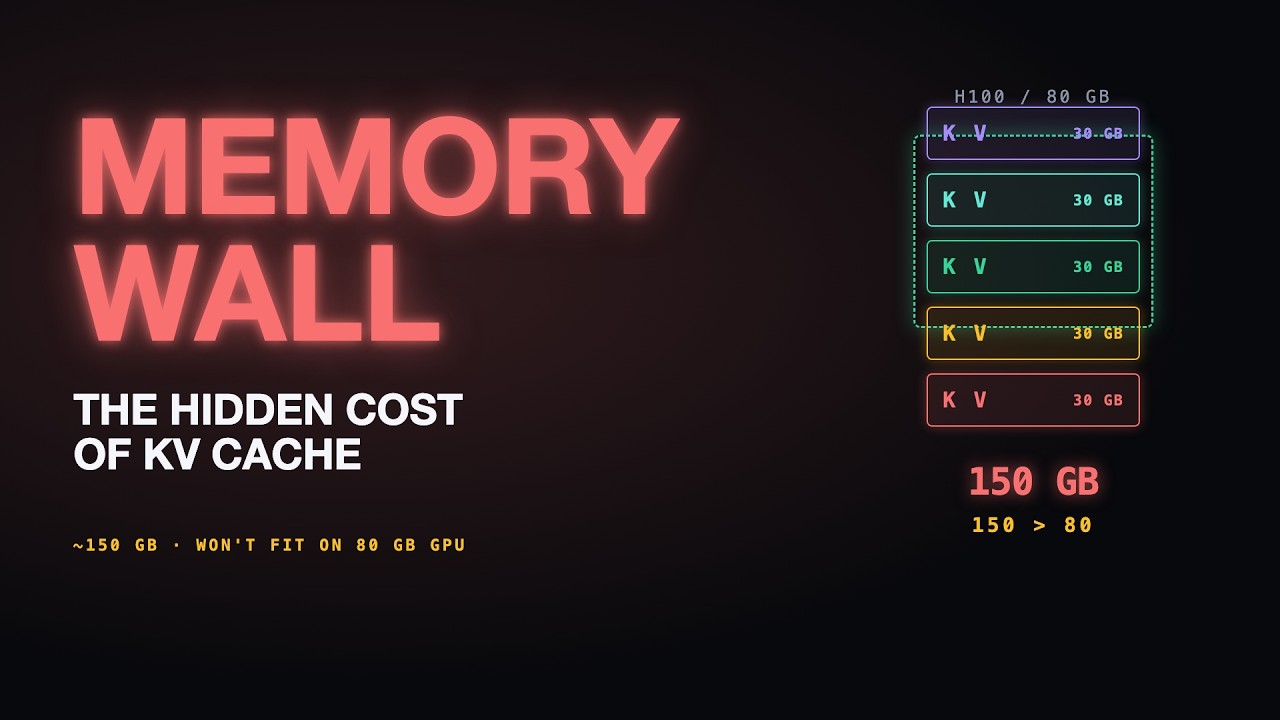
Every token in your prompt has a Key and a Value vector cached in GPU memory. About 16 KB per token, per layer. Multiply by ~96 layers and you're at 1.5 MB per token. A 100K-token prompt: 150 GB sitting in memory.
An H100 has 80 GB. Your cache is twice the slot size.
But even when it fits, attention has to read every prior K/V from memory on every new token. That's bandwidth-bound, not compute-bound. The H100 does 989 TFLOPS but only 3.35 TB/s of memory bandwidth. Compute keeps doubling. Bandwidth doesn't.
Wulf and McKee called this "the memory wall" in 1995 — three decades before transformers ran straight into it.
The field has been fighting back: Flash Attention keeps K/V in SRAM. Sliding window goes O(N) instead of O(N²). KV quantization stores at 4 bits instead of 16. Multi-query attention shares K/V across heads — ~96× less cache.
Every long-context model uses all four. Simultaneously.
The wall is bandwidth, not compute.
Повторяем попытку...
Доступные форматы для скачивания:
Скачать видео
-
Информация по загрузке: