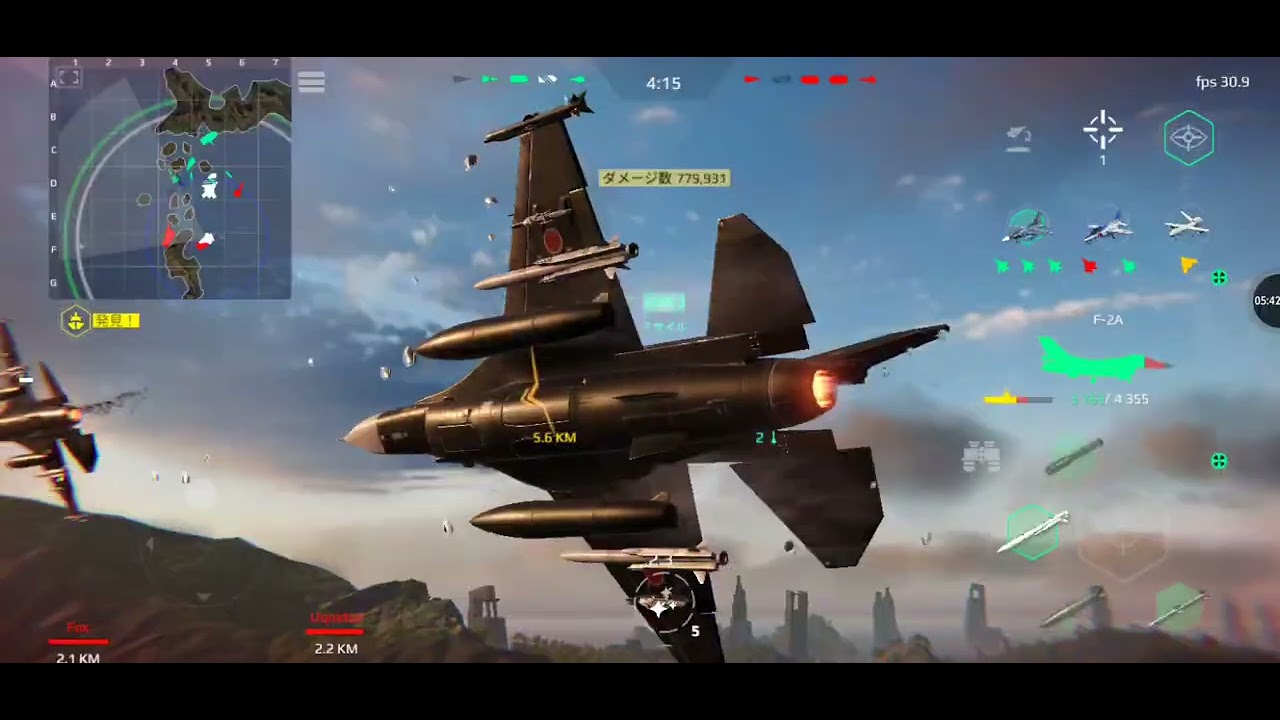
Modern Warships: F 2A Japanese strike fighter gameplay | Modern Warships: F 2A gameplay
Автор: Gunship Battle
Загружено: 2023-06-27
Просмотров: 308
Описание:
Modern Warships:
Take control of the most awesome modern warships and aircraft in epic naval battles online!
Create clans, gather your friends and win battles between squads, win top places in tournaments and become a Modern Warships Legend!
The Mitsubishi F-2 is a multirole fighter derived from the General Dynamics F-16 Fighting Falcon, and manufactured by Mitsubishi Heavy Industries and Lockheed Martin for the Japan Air Self-Defense Force, with a 60/40 split in manufacturing between Japan and the United States. The basis of the F-2's design is the F-16 Agile Falcon, an unsuccessful offer by General Dynamics to provide a low-cost alternative for the Advanced Tactical Fighter (ATF) competition. Production started in 1996 and the first aircraft entered service in 2000.
The first 76 aircraft entered service by 2008, with a total of 98 airframes produced. The first active electronically scanned array (AESA) radar on a combat aircraft was the J/APG-1 introduced on the Mitsubishi F-2 in 1995.
The F-2 is nicknamed "Viper Zero", a reference to the F-16's unofficial nickname of "Viper" and the Mitsubishi A6M Zero.
General Electric, Kawasaki, Honeywell, Raytheon, NEC, Hazeltine, and Kokusai Electric were among the primary component sub-contractors. Lockheed Martin supplied the aft fuselage, leading-edge slats, stores management system, a large percentage of wingboxes (as part of two-way technology transfer agreements), and other components. Kawasaki built the midsection of the fuselage, as well as the doors to the main wheel and the engine, while the forward fuselage and wings were built by Mitsubishi.
Some of the avionics were supplied by Lockheed Martin, and the digital fly-by-wire system was jointly developed by Japan Aviation Electric and Honeywell (formerly Allied Signal). Contractors for communication systems and IFF interrogators included: Raytheon, NEC, Hazeltine, and Kokusai Electric. The fire control radar, IRS, the mission computer, and the EW system were developed by Japan.
In addition, the flight control computer, the flight control laws and related computer software were essentially all developed and integrated by Japan.
Final assembly was done in Japan, by MHI at its Komaki-South facility in Nagoya.
Larger wings give an aircraft better payload and maneuverability in proportion to its thrust, but also tend to add weight to the airframe in various ways. More weight can have negative effects on acceleration, climbing, payload, and range. To make the larger wings lighter, the skin, spars, ribs and cap of the wings were made from graphite-epoxy composite and co-cured in an autoclave. This was the first application of co-cured technology to a production tactical fighter.
This technology for the wings encountered some teething problems, but proved to be a leading-edge use of a technology that provides weight savings, improved range, and some stealth benefits. This technology was then transferred back to America, as part of the program's industrial partnership.
The F-2 has three display screens, including a liquid crystal display from Yokogawa.
Mitsubishi used the existing F-16 design as a reference guide for design work, and more than 95% of F-16 engineering drawings are changed for F-2.
Some differences in the F-2 from the F-16A:
a 25% larger wing area
composite materials used to reduce overall weight and radar signature
longer and wider nose to accommodate a J/APG-1/J/APG-2 active electronically scanned array (AESA) radar. Almost simultaneously with a single squadron of USAF F-15C Eagles, the F-2 was the first operational military aircraft in the world to feature an AESA radar, before the F-22 Raptor’s AN/APG-77 AESA radar.
larger tailplane
larger air intake
three-piece cockpit canopy
Equipments and OFP related to the avionics system differ from the F-16 in many aspects.
Original flight control system.
capabilities for four ASM-1 or ASM-2 anti-ship missiles, four AAMs, and additional fuel tanks
Also, the F-2 is equipped with a drogue parachute, like the version of the F-16 used by South Korea, the Netherlands, Norway, Greece, Turkey, Indonesia, Taiwan, and Venezuela.
Download here
App Store:
https://apps.apple.com/us/app/modern-...
Play Store:
https://play.google.com/store/apps/de...
Повторяем попытку...

Доступные форматы для скачивания:
Скачать видео
-
Информация по загрузке: