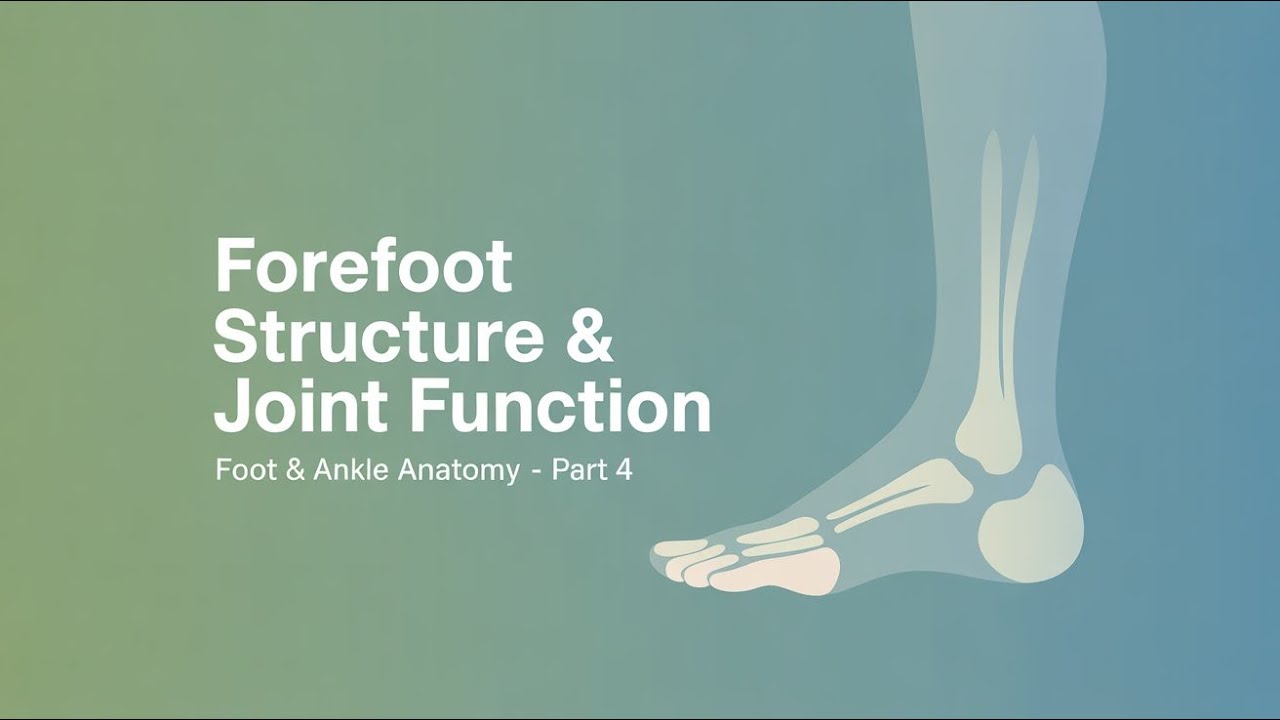
Anatomy of the Foot & Ankle — Part 4 | Forefoot Structure & Joint Function
Автор: Kathryn Kuppan
Загружено: 2026-02-01
Просмотров: 2
Описание:
In this lesson, we explore the bones of the forefoot, including the metatarsals and phalanges, and how these structures contribute to alignment, propulsion, and functional movement in yoga and daily life.
🧠 Anatomy of the Foot & Ankle — Part 4 | Forefoot Structure & Joint Function
🦴 Metatarsals: The Long Bones of the Foot
After the tarsal bones, the metatarsals form the long structural bones of the forefoot.
There are five metatarsals, numbered from medial (1st) to lateral (5th)
They articulate with the tarsals at the tarsometatarsal joints, which are gliding joints with limited movement
The first metatarsal (big toe side) is thick and strong, designed for propulsion
🧩 The Pillar of the Foot
The second metatarsal is deeply set into the tarsals and is known as the pillar of the foot
Proper alignment:
The center of the ankle aligns with the base of the second toe
This alignment cue supports structural integrity in standing poses and gait
✋ Self-Palpation: Finding the Fifth Metatarsal
To locate the fifth metatarsal:
Palpate the lateral ankle bone (distal fibula)
Move forward and downward to feel the bony protrusion
This marks the base of the fifth metatarsal
🦶 Metatarsophalangeal (MTP) Joints
The MTP joints connect the metatarsals to the phalanges (toe bones).
These are condyloid joints
Allow flexion, extension, abduction, and adduction
Do not allow rotation (similar to finger joints at the palm)
Major movement occurs here during toe-off and weight-bearing
💡 The “ball of the foot” is actually the MTP joint region.
🔗 Interphalangeal (IP) Joints: Toe Hinges
The IP joints are the joints between toe segments.
These are hinge joints
Allow toe flexion and extension
Enable actions like curling and spreading the toes
Toe Bone Structure
The big toe has 2 phalanges
Other toes have 3 phalanges each
🚶 Propulsion & The First Metatarsal
The first metatarsal is critical for push-off in walking and running.
It must be stable to support propulsion
Two sesamoid bones under the big toe increase stability and mechanical advantage
🧘 Experiential Movement Practice
MTP Joint Mobilization
Stand in Mountain Pose (Tadasana)
Lift heels and rise onto the balls of the feet
Lower heels and repeat
This mobilizes the MTP joints
IP Joint Movement
Lift toes up
Curl toes down as if gripping sand
Spread toes apart
These actions train toe flexion, extension, and abduction
🧠 Key Teaching Insight
The forefoot is designed for:
Structural stability
Mobility during gait
Efficient force transmission during propulsion
Proper alignment and awareness of metatarsals and toe joints help prevent foot dysfunction and enhance sustainable yoga practice.
✨ Additional activities, palpation exercises, and skeletal variation exploration are provided in the Google Classroom for deeper learning.
Повторяем попытку...
Доступные форматы для скачивания:
Скачать видео
-
Информация по загрузке: