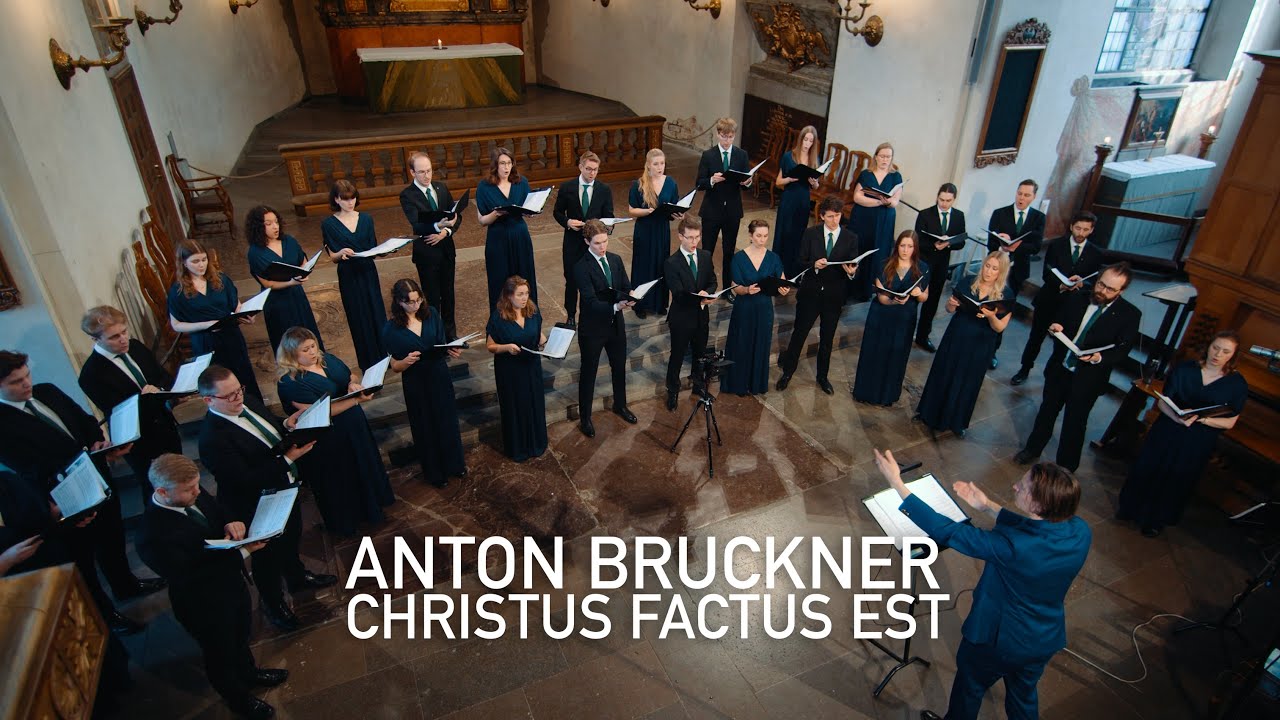
Anton Bruckner - Tantum Ergo in D-Major WAB 32 (Latvian Radio Choir)
Автор: Polish Scores
Загружено: 2024-05-24
Просмотров: 12915
Описание:
Written in 1845
Bruckner's 1st Tantum Ergo stems from his Kronstorf period after having been transferred to teach there. Compared to his old duties under Franz Fuchs who demanded much manual labor from Bruckner, his new posting allowed for more liberty. As a result, he was able to compose several choral works, but these all followed after classical models. They betray very little of the Bruckner known today.
Bio
One of the most original, outstanding symphonists of the 19th century, a peerless organist, a conscientious schoolteacher, and the unintentional bane of the Conservatives during the war of the romantics, Anton Bruckner (1824-1896) helped pave the way for the development of radical symphonic language that would bend conceptions of music as they were held at the time. His works are characterized by increasingly radical tonal language that culminated in his last three symphonies, and his approach to symphonic form misled many to dismiss the formal nature of his symphonies entirely. Yet Bruckner's works with their telescopic development, three subject sonata-form movements, sensitive and soulful slow movements, heart pounding scherzos, and transcendent synthetic finales requiring incredibly precise counterpoint betrayed a vision of music as something no other composer before him ever conceived of. In hearing his music, one cannot escape the question of its ultimate meaning, and, to many, contemplating it yields more questions than answers.
When discussing Bruckner, many misconceptions linger from the fierce polemics of earlier times. Quite a few arise from his manifold oddities both in Viennese society and in general. While Bruckner was a provincial upper Austrian and maintained many provincial customs, he was no simpleton. Quite the contrary. Bruckner was a schoolmaster by trade, and to hold posts of that nature, he had to take exams to prove his intimate knowledge of many subjects, which he convincingly did. In addition to his general education and musical prowess, he was interested in physics, Mexican history, expeditions to the North Pole, law, Latin, anatomy, and medicine. Of course, his arithmomania (OCD), his overly cautious nature regarding finances, his obsession with dead bodies, his scrupulosity-induced romantic propositions to girls much younger than him, and his relentless devotion to Wagner (calling him 'master' and praying at his grave constantly) only added to his incomprehensibility by Viennese society. Despite this, he was a social man with many friends who enjoyed good jokes, good beer, and got along well with his students who, by many accounts, enjoyed his company both inside and outside of the classroom. Surprisingly enough, he was also a fantastic dancer. Given the biographical evidence, Hans von Bülow's quip about Bruckner as a "Half genius, half simpleton" is thoroughly debunked.
While Bruckner's intelligence was at work designing and measuring his new symphonic constructions, the content of those works was inspired by his experience of life in Upper Austria, the music of the German Romantics, and, above all, his Catholic faith. Bruckner's arithmomania combined with his deep Catholicism to produce stunning physical evidence of his rich prayer life. Bruckner counted his prayers and left notebooks full of accounts of prayers said. In the musical dimension, composers find melodies to concretize their works as, for example, Mahler does with Des Knaben Wunderhorn or Dvorak with Czech folk material. Bruckner, likewise, quotes his masses and sacred music in his symphonies, giving them a concrete spiritual meaning. Even in their construction one can gleam the Thomistic approach of privation to form in the telescopic development, the attempt to describe spiritual reality in a finite medium as tonality, stretching to capture the infinite inasmuch as possible, and the promise of final redemption of all aspects of life in the synthetic finales of his most brilliant works. Along this vein, Schönzeler wrote "[Bruckner] may have attained visionary realms which found their expression in music," [1] and Watson assures us that Bruckner's "life-long and deepest love" was for his "'dear God'" [2]. Hart writes of Bruckner that "in a sense God had always been the object of all his artistry" [3]. Bruckner himself dedicated his Te Deum to "The greater glory of God" and his 9th to "My Beloved God."
Unless otherwise noted, bio info comes from [2]
[1] H. Schönzeler. Bruckner. Grossman Publishers. London. 1978.
[2] D. Watson. Bruckner. Schirmer Books. New York. 1975. rev. 1997.
[3] D. B. Hart. "The Music Of Eternity." First Things. 2009.
Повторяем попытку...

Доступные форматы для скачивания:
Скачать видео
-
Информация по загрузке: