No One Alive Has Ever Seen What SPACEX Just Left On The Moon
Автор: Mystral
Загружено: 2026-08-08
Просмотров: 12363
Описание:
If you found this interesting, please subscribe: / @mystraltv
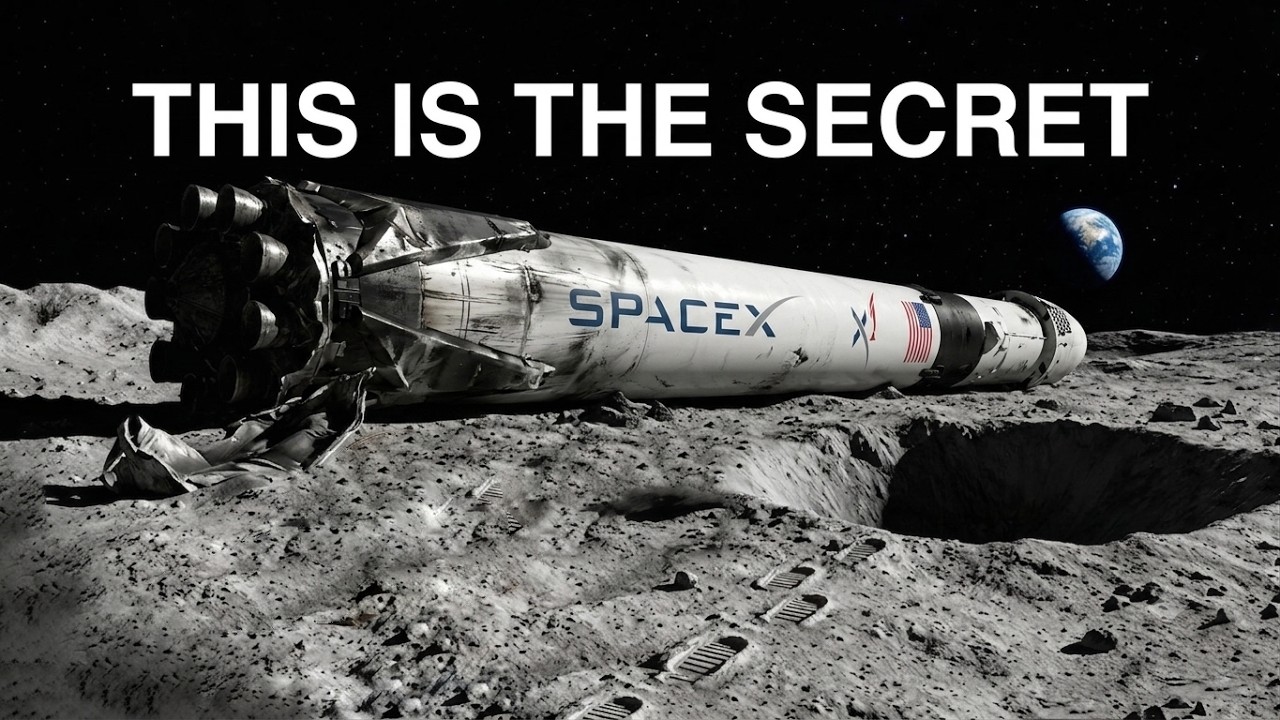
This video details the August 5, 2026, impact of a spent SpaceX Falcon 9 rocket stage on the sunlit surface of the Moon near Einstein crater.
On August 5, 2026, a spent Falcon 9 upper stage collided with the sunlit western edge of the Moon at five thousand four hundred miles per hour after orbiting in cislunar space for eighteen months. Although the collision could not be visually recorded in direct optical images due to sunlight blinding Earth-based telescopes, spectrographic instruments at the Very Large Telescope in Chile detected vaporized sodium and lithium gas rising from the crater. This video examines the tracking history of the hardware, the physics simulations behind lunar collisions, and the necessity of managing space debris between the Earth and the Moon.
What's covered in this video:
The video opens on August 5, 2026, when a spent rocket stage struck the sunlit edge of the Moon near Einstein crater at five thousand four hundred miles per hour.
Independent astronomer Bill Gray used orbit-computing software in September 2025 to accurately predict the lunar impact coordinates eleven months in advance.
The rocket stage, catalogued as 2025-010D, launched in January 2025 to deploy the Firefly Aerospace Blue Ghost Mission 1 and ispace Resilience landers.
Observers Grant Privett and Jean-François Gout recorded light curves of the tumbling cylinder as it drifted through cislunar orbit.
The transcript explains why military radar fails at lunar distances, leaving orbital tracking dependent on global asteroid survey networks.
Solar radiation pressure continuously nudged the tumbling four-ton stage, introducing minor trajectory shifts before impact.
Physics simulations from the University of Texas at Austin and Los Alamos National Laboratory modeled how the hollow rocket shell would collapse to excavate a twenty-meter crater.
The video contrasts the August 2026 event with past historical lunar impacts, including Luna 2, Apollo stages, Hiten, SMART-1, and LCROSS.
While direct visual flashes could not be seen against bright sunlight, the Very Large Telescope in Chile detected spectral emissions of vaporized sodium and lithium.
The narration references the unexplained double crater formed by the Chang'e 5-T1 impact while awaiting orbital photographs from the Lunar Reconnaissance Orbiter and Danuri.
Mentioned in this video: August 5 2026, Moon, Einstein crater, SpaceX, Falcon 9, Apollo, Artemis II, Bill Gray, Chang'e 5-T1, NASA, Center for Near Earth Object Studies, January 15 2025, Kennedy Space Center, Blue Ghost Mission 1, Firefly Aerospace, Commercial Lunar Payload Services, Hakuto-R Mission 2, Resilience, ispace, 2025-010A, 2025-010B, 2025-010C, 2025-010D, Argentina, Chile, Grant Privett, United Kingdom, Jean-François Gout, Mississippi, Utah, Beijing, England, Warren-Odom, University of Texas at Austin, Los Alamos National Laboratory, TNT, Luna 2, Luna 5, Hiten, Anglo-Australian Telescope, SMART-1, Canada-France-Hawaii Telescope, LCROSS, Centaur, Gervase of Canterbury, Apache Point Observatory, New Mexico, Lowell Discovery Telescope, Arizona, Very Large Telescope, Atacama Desert, Lunar Reconnaissance Orbiter, Danuri, South Korea, James Webb Space Telescope, EscaPADE.
Повторяем попытку...
Доступные форматы для скачивания:
Скачать видео
-
Информация по загрузке: