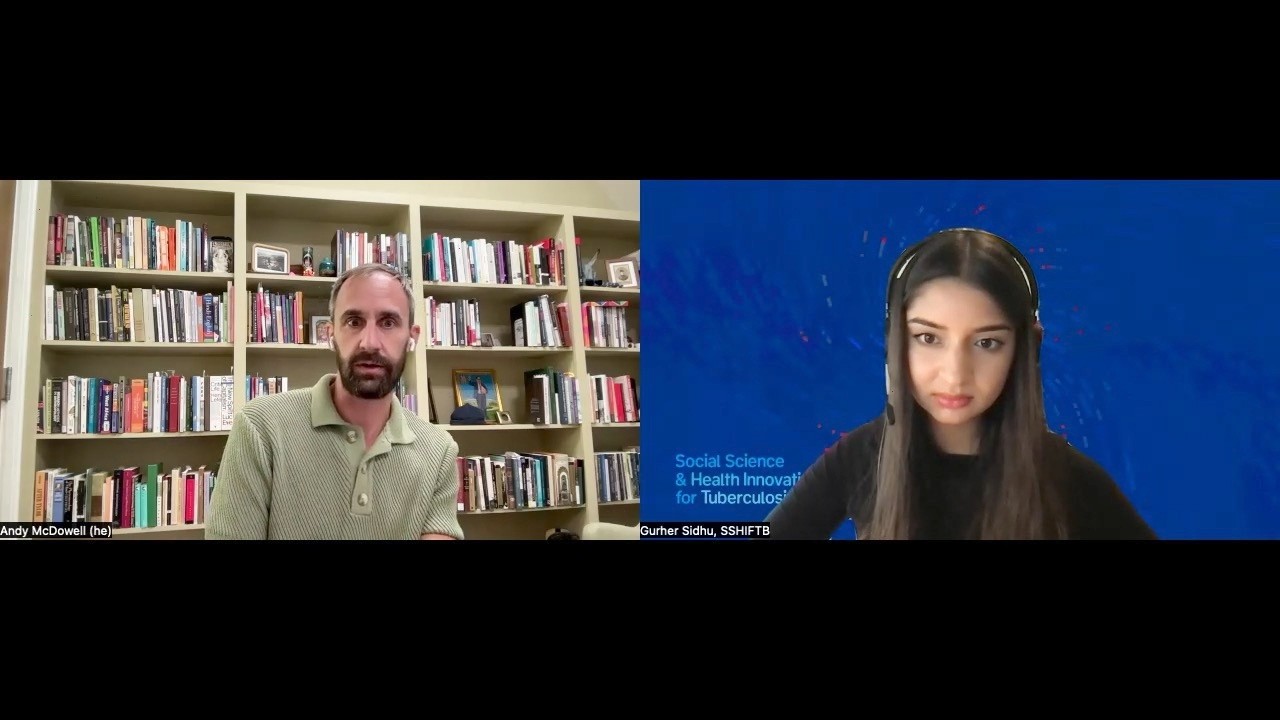
Breathless: Tuberculosis, Inequality, and Care in Rural India | Interview with Andrew McDowell
Автор: Social Science & Health Innovations for TB
Загружено: 2024-08-08
Просмотров: 123
Описание:
01:59 What inspired you to write this book? Could you tell us briefly about your book?
07:28 To what extent do researchers need to go build to to go to build relationships with the communities they work in? How else can qualitative researchers and social scientists who do not have these experiences connect with the communities they are working with?
11:35 There was a moment in the "Mud" chapter where you are drawn into being complicit in not disclosing a history of previous tuberculosis treatment with the hope of facilitating better treatment for the patient. You breakdown each person's motivation and perspectives for doing this. Can you tell us a bit more about what the emotional experience of that episode was like for you?
21:02 For the TB community, the ways you've described "atmospheres" within the book are unusual words and ways of describing TB and TB care. What would you say is the value of this type of anthropological, anthropological gaze on atmospheres and these unusual words for the TB community? What do you hope people could do with these insights?
About "Breathless: Tuberculosis, Inequality, and Care in Rural India" by Andrew McDowell
Each year in India more than two million people fall sick with tuberculosis (TB), an infectious, airborne, and potentially deadly lung disease. The country accounts for almost 30 percent of all TB cases worldwide and well above a third of global deaths from it. Because TB's prevalence also indicates unfulfilled development promises, its control is an important issue of national concern, wrapped up in questions of postcolonial governance. Drawing on long-term ethnographic engagement with a village in North India and its TB epidemic, Andrew McDowell tells the stories of socially marginalized Dalit ("ex-untouchable") farming families afflicted by TB, and the nurses, doctors, quacks, mediums, and mystics who care for them. Each of the book's chapters centers on a material or metaphorical substance—such as dust, clouds, and ghosts—to understand how breath and airborne illness entangle biological and social life in everyday acts of care for the self, for others, and for the environment.
From this raft of stories about the ways people make sense of and struggle with troubled breath, McDowell develops a philosophy and phenomenology of breathing that attends to medical systems, patient care, and health justice. He theorizes that breath—as an intersection between person and world—provides a unique perspective on public health and inequality. Breath is deeply intimate and personal, but also shared and distributed. Through it all, Breathless traces the multivalent relations that breath engenders between people, environments, social worlds, and microbes.
Winner of the 2023 The Joseph W. Elder Prize in the Indian Social Sciences, sponsored by the American Institute of Indian Studies (AIIS).
You can purchase Breathless: Tuberculosis, Inequality, and Care in Rural India at the following links:
Stanford University Press: https://www.sup.org/books/title/?id=3...
About the author
Andrew McDowell is an assistant professor in the Department of Anthropology. He has a Ph.D. in sociocultural anthropology from Harvard University. His research interests focus on care, contagion, pharmaceuticals, diagnosis, and inequality in North and Western Indian social worlds entangled with tuberculosis. His book, Breathless: Tuberculosis, Inequality, and Care in Rural India, traces the complex relationships between development, disease, inequality, and biomedicine to theorize atmospheric but life changing connections forged by breath. Breathless won the AIIS’s 2023 Joseph W. Elder Prize in the Indian Social Sciences.
In a second project McDowell considers global health’s role in TB’s dynamic local biologies. Focusing on private medical worlds in Mumbai, Profitable Practices: Medicine, Money, and Morals in Mumbai’s Private Medical Worlds, traces globalized treatment and diagnosis interventions in India. It centers on the moral questions that providing medicine for money in zone of economic precarity raise for private sector doctors, pharmacists, their patients, and those who hope to intervene in this world. More broadly, this research examines the human and microbial impact of global health initiatives that aim to manage patients’ access to technologies and medicines, standardize medical practice in Mumbai, and guide TB-related expertise and knowledge production across India.
His work has appeared in Medical Anthropology Quarterly, Ethos, Biosocieties, and The Lancet among other venues.
Повторяем попытку...
Доступные форматы для скачивания:
Скачать видео
-
Информация по загрузке: