Learn Mandarin While Listening to Music · HSK 2 Lesson 13 · 门开着The Door is Open
Автор: Mandarin Lofi Melody Lab
Загружено: 2026-03-02
Просмотров: 33
Описание:
Everyday Mandarin — HSK 2 · Lesson 13 · 门开着呢
the door is open
gentle Mandarin for stillness, state, and quiet reflection
in a calm, looping lo-fi track.
This song is built around two important HSK 2 grammar patterns:
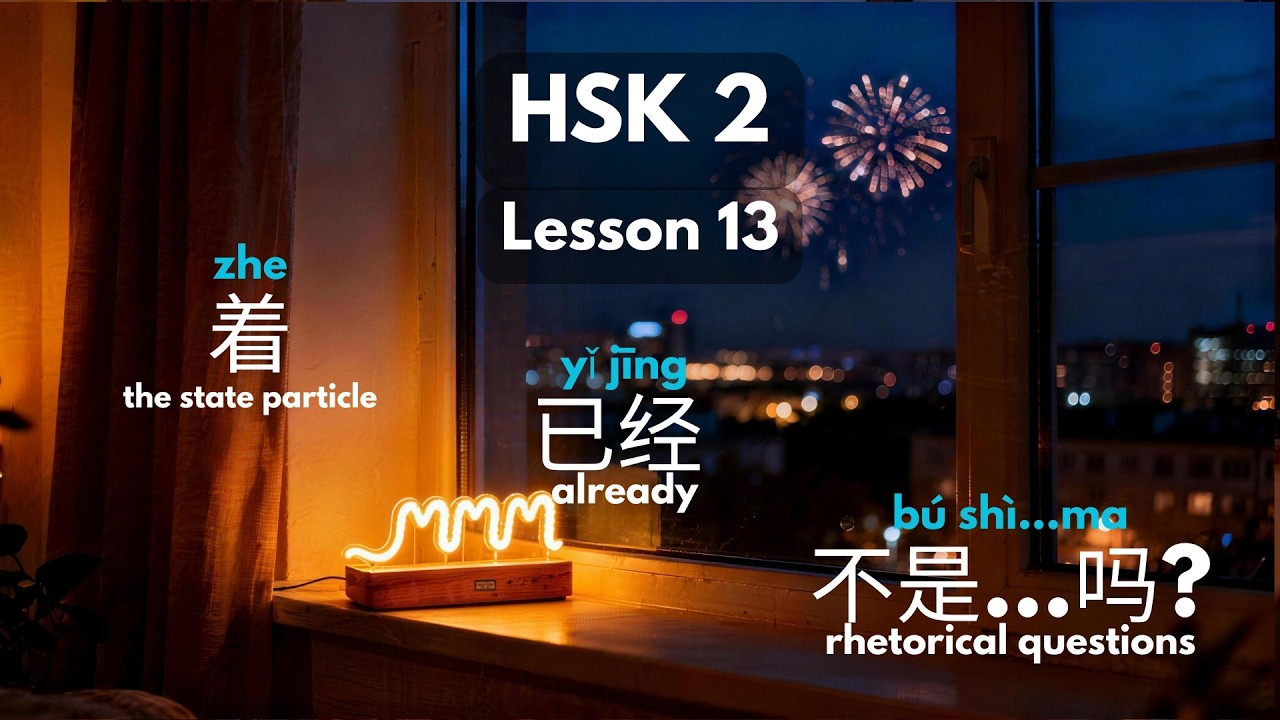
the state particle 着 (zhe)
and the rhetorical question pattern 不是……吗?
It’s the kind of Mandarin used when describing what is happening —
not as an action,
but as a continuing state.
The door is open.
The light is on.
I’m still sitting here.
Designed for calm listening, repetition, and natural internalization.
What you’ll hear and learn in this track
(HSK 2 · 第十三课 dì shí sān kè)
describing a continuous state with 着 (zhe)
门开着呢
(mén kāi zhe ne)
— the door is open
灯亮着呢
(dēng liàng zhe ne)
— the light is on
我坐着
(wǒ zuò zhe)
— I’m sitting
手机拿着
(shǒu jī ná zhe)
— holding the phone
穿着睡衣
(chuān zhe shuì yī)
— wearing pajamas
着 (zhe) does not describe an action happening now.
It describes a state that continues.
The door is not opening.
It is already open.
The light is not turning on.
It is already on.
This small particle changes how time feels in Mandarin.
You’ll also hear rhetorical questions with 不是……吗?
不是说要出门吗?
(bú shì shuō yào chū mén ma)
— Didn’t we say we were going out?
不是已经很久了吗?
(bú shì yǐ jīng hěn jiǔ le ma)
— Hasn’t it been a long time?
不是一直想走吗?
(bú shì yì zhí xiǎng zǒu ma)
— Didn’t I always want to leave?
The structure 不是……吗?
is used to confirm something the speaker believes is already true.
It often carries feeling —
doubt, reflection, hesitation, regret.
Grammar you’ll internalize naturally
Verb + 着 → continuing state
门开着
灯亮着
我坐着
不是 + 句子 + 吗? → rhetorical confirmation
不是说要出门吗?
You don’t need to memorize the rule.
Let it repeat.
Let it settle quietly.
🎧 About the song
This is not a dialogue.
It’s a reflective Mandarin track designed to loop
while studying, working, or thinking.
The door is open.
The light is on.
The world is outside.
And still —
我坐着
(wǒ zuò zhe)
Part of the Everyday Mandarin · HSK 2 series.
🎵 Available on YouTube
🎧 Also streaming on Spotify and other music platforms
Great for
HSK 2 learners
Mandarin state descriptions
learning 着 naturally
understanding rhetorical questions
calm listening and repetition
lo-fi for study and memory
#HSK2 #LearnChinese #Mandarin #ChineseGrammar
#ChineseListeningPractice #EverydayChinese
#LoFiChinese #MandarinMusic #hsk
在开头就标明这两种句型用法,格式更清晰易懂
当然可以。下面是结构更清晰版本,在开头就明确标出两种重点句型,并用更清楚的分区排版,方便学习者快速理解。
Everyday Mandarin — HSK 2 · Lesson 13 · 门开着呢
the door is open
gentle Mandarin for stillness, state, and reflection
in a calm, looping lo-fi track.
━━━━━━━━━━
🎯 This track focuses on two key HSK 2 grammar patterns:
1️⃣ 着 (zhe) — describing a continuing state
2️⃣ 不是……吗?— rhetorical question for confirmation
━━━━━━━━━━
This song explores how Mandarin describes:
• things that are already in a state
• feelings of hesitation
• quiet self-questioning
Designed for calm listening, repetition, and natural understanding.
━━━━━━━━━━
GRAMMAR FOCUS 1
🔹 Verb + 着 (zhe)
Used to describe a state that continues.
It does NOT mean the action is happening now.
It means the result is still there.
Examples from the song:
门开着呢
(mén kāi zhe ne)
— the door is open
灯亮着呢
(dēng liàng zhe ne)
— the light is on
我坐着
(wǒ zuò zhe)
— I’m sitting
手机拿着
(shǒu jī ná zhe)
— holding the phone
穿着睡衣
(chuān zhe shuì yī)
— wearing pajamas
In Mandarin, 着 makes time feel still.
The state continues quietly.
━━━━━━━━━━
GRAMMAR FOCUS 2
🔹 不是……吗?
A rhetorical question used for confirmation.
Structure:
不是 + statement + 吗?
It expresses:
• “Isn’t it…?”
• “Didn’t we…?”
• “Wasn’t it…?”
Often emotional or reflective.
Examples from the song:
不是说要出门吗?
(bú shì shuō yào chū mén ma)
— Didn’t we say we were going out?
不是已经很久了吗?
(bú shì yǐ jīng hěn jiǔ le ma)
— Hasn’t it been a long time?
不是一直想走吗?
(bú shì yì zhí xiǎng zǒu ma)
— Didn’t I always want to leave?
It’s not asking for information.
It’s confirming something already known.
━━━━━━━━━━
🎧 About the song
This is not a textbook dialogue.
It’s a listening-first Mandarin track designed to loop quietly
while studying, working, or reflecting.
The door is open.
The light is on.
The world is outside.
And still —
我坐着
(wǒ zuò zhe)
Part of the Everyday Mandarin · HSK 2 series.
🎵 Available on YouTube
🎧 Also streaming on Spotify and other platforms
Great for
HSK 2 learners
learning 着 naturally
understanding rhetorical questions
Mandarin listening practice
calm repetition and memory
#HSK2 #LearnChinese #Mandarin #ChineseGrammar
#ChineseListeningPractice #EverydayChinese
#LoFiChinese #MandarinMusic #hsk
Повторяем попытку...
Доступные форматы для скачивания:
Скачать видео
-
Информация по загрузке: